Thursday, April 7, 2022

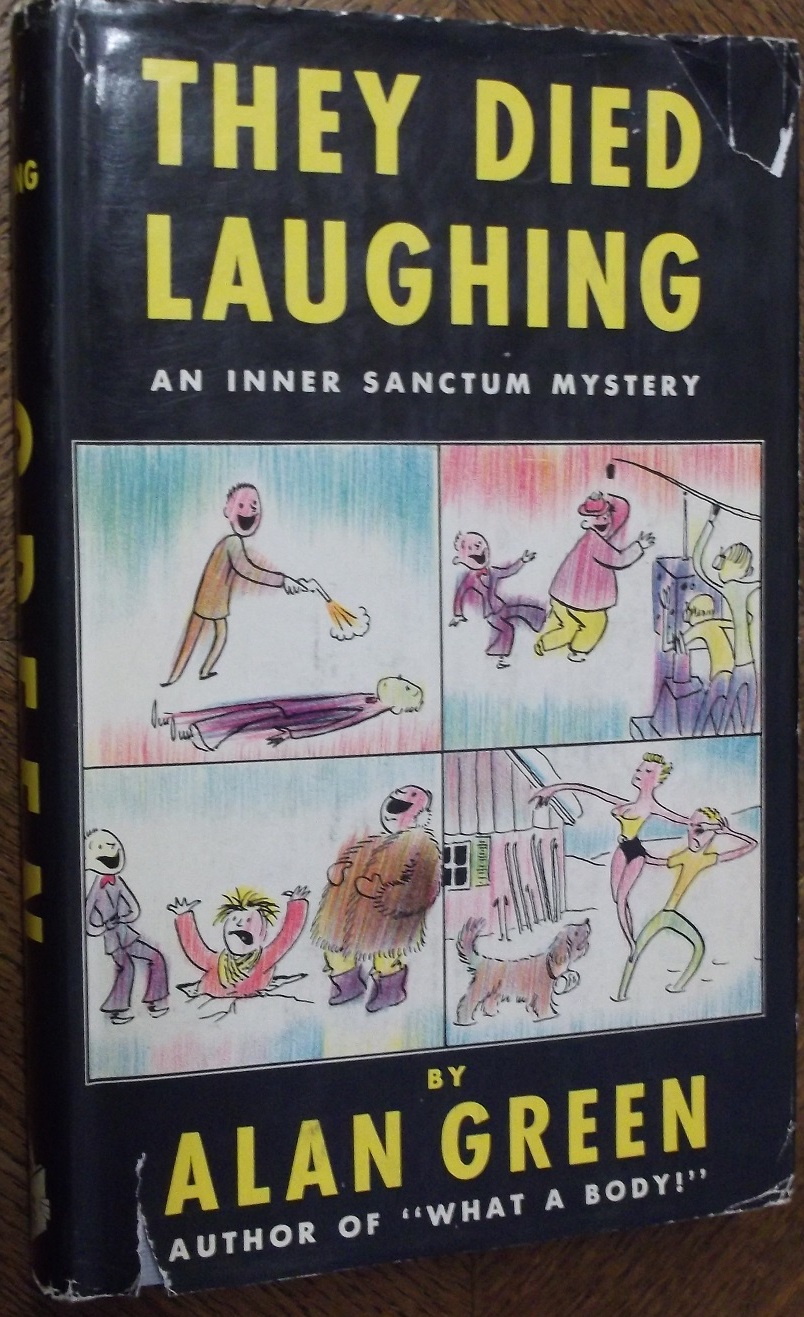
Alan Green : They Died Laughing, 1952


Surely after a prodigious debut like that of Green's first novel, which deserved the conquest of Edgar for the best debut novel, it would have been difficult for anyone to repeat themselves at the same levels. Indeed, the underlying verve of They Died Laughing, published in 1952, is the same: brilliant prose. It is certainly difficult, in itself, to be able to blend a brilliant style and comic verve with crime! The result is a black comedy, very black, which ridicules the glossy world of comedians of the twenties, thirties and forties, with their substratum of ineffable vices.

WARNING: SPOILERS !!!

They Died Laughing” deals with a crime that takes place in the context of a television recording of a trio of comic actors, very famous until the Great Depression of 1929, who since then had had ups and downs, to the point of seizing the opportunities given by the diffusion of TV at the American public, agreeing to work in the pay of commercial firms, in real sketches.

The trio is formed by Junior Watkins, Elroy Schneider, and Baby Blue. To the two men who already work in pairs, when you add the woman, success is at home. Of the three, however, the star is Junior: everything revolves around him. For a long time, Junior has even had an affair that everyone knows about with Babe, and even her husband Bo Llewellyn, a former circus athlete, who doesn't give a damn about his wife being in love with the manager, because it's all over for a long time the two spouses are together as a couple, but it's just a screen, even if they respect each other and still love each other.

One fine day, the advertising agent of the firm "Dormer, Porter, Hormer & Plant", that is, Mr. Hormer, who acts on behalf of the Glassay Grocer, who pays them for their television sketches, finances a new one, which it will have to take place at the well-known "St. Bernard" hotel. Actually, the television shooting was an idea of ​​John Hugo, grandson of Arthur Hutch, that whoever had the good fortune to read Alan Green's first novel, What a Body! in 1949, he has already met. In fact in this second novel, some of the characters of the first recur: Arthur Hutch is the owner of the hotel, being the brother-in-law of that Merlin Broadstone, who obsessed with diet and beauty of the body had created a SPA of high level on an island, as well as being the owner of many hotels, he was later murdered, and he, Hutch had become the main heir, being the husband of his sister) had also been the one who he had resolved the matter, yet leaving all the credit to that clumsy inspector John Hugo who had fallen in love with his niece; later, Hugo had also married her, and retired from the police, he had become Hutch's main collaborator in the management of the Hotel. Hugo basically dealt with advertising: he had invented the gimmick of the Saint Bernard dogs who brought a flask of liquor for the use of the Hotel's customers, and now he had proposed to have the television comic trio exhibit, right in the spaces of the Hotel in the middle to the snow, to sponsor its winter activities.

After filming has started, the crime suddenly takes place: Elroy Schneider, warns Huth and Hormer that she has seen through the window, Watkins dead, in his bedroom, locked from the inside; the strange thing is that Watkins was claustrophobic and therefore he would never lock himself in. They break down the door, because in fact the door is closed from the inside, and they find him sunk in an armchair with a bullet hole in the forehead, without any ticket and above all without a weapon. There would also be a way out, but it is a window at the top that communicates with the corridor, but it is also closed.

Almost simultaneously with the discovery of the body, under the door of the vice president of Glassay, Hulburt, a sheet is slipped on which communicates how Watkins had been seen passionately kissing Francy Wilson, a singer and actress with whom he is in love. Watkins was indeed an unrepentant Don Giovanni: in the past Wilson had obtained a job from him, of which he however took a large part of the salary, and moreover she had had to have sex with him to obtain it and be able to pay the debts of housing. He also took unpaid leave with Elroy's and Celeste's daughter, Gloria Ann. And then there was the romantic relationship with Babe Blue. Basically, no one would have had reason to kill Watkins, because with him the greatest form of income would have disappeared and the trio would have dissolved, and therefore only the passionate motive appears, even if this too deflates.

Everything will make sense after the second death occurs: that of Elroy, who apparently committed suicide, with a .38 caliber pistol among those used during the sketches to shoot at the cards. In fact, on the forehead of the victim, in addition to the bullet hole, there will also be a sign, given by the wick of an exploded blank cartridge, like those used in all the shots of the sketches. Why a blank cartridge other than the real one?


The reconstruction of Hutch will once again be the overturning of his nephew's theses, and the following will also assume importance: the contents of tampered blanks, owned by the late Watkins; the health conditions of Babe Blue; a sign stolen from the hotel theater; an attempted robbery in Watkins' room; Watkins' movements in the train, taken to get to St. Bernard. It goes without saying that the killer will come unexpectedly at the end.

THE END OF THE SPOILERS

Green is always very biting in his social criticism: after all, the trio of comedians, with their husbands, with their lovers, with their vices, with their weaknesses, express the golden world of American cinema and television of that period, following the Great Depression of 1929.

From the point of view of the structure of the detective novel, while not reaching the heights of the first (whose solution was close in complexity and virtuosity to those of Carr), the solution of this second novel is based on an overturning of what is said about two single crimes, so much so that the solution of the first crime and the framing of the fugitive from the room locked from the inside, automatically leads to the solution of the second death, but not in the sense that one would expect.

Very interesting is the question faced with the blank cartridges, and the action of the wick, to overturn an argument made up to that moment, as well as the burglary noticed on some cartridges, to manually remove the mechanically inserted wick, empty them of black powder and fill them with heroin. The trafficking and use of heroin is therefore another subplot in addition to that of Watkins' gallant adventures, which however does not load the novel with the typical atmospheres of the hardboiled novel, because essentially the traffic, limited to the troupe, finds its origin in personal events painful,

In itself, once explained, the locked room solution is trivial; nevertheless, the novel, which up to half has little rhythm, in the last twenty thirty pages, acquires a considerable one, to the point of nailing a clever but also compassionate murderer.

Pietro De Palma

Sunday, April 3, 2022

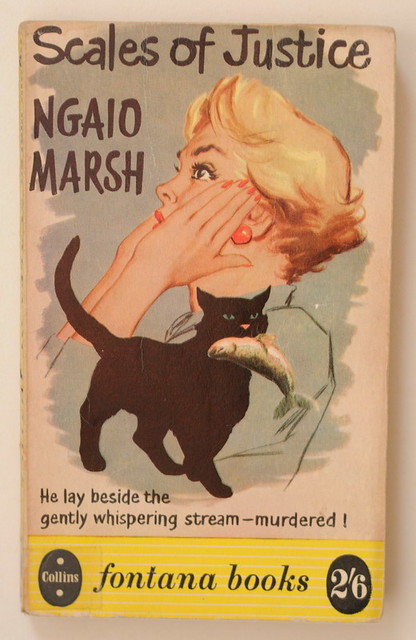
Ngaio Marsh : Scales of Justice, 1955


Scales of Justice by Ngaio Marsh is a novel of 1955, and is the eighteenth with Roderick Alleyn, the son of a lady, brother of a baronet, a nobleman who preferred the slow climb of a mistreated but great profession to a diplomatic career: that of the policeman. A noble policeman. There was another, "son" of another of the 4 Crime Queens, Dorothy Sayers: Lord Peter Whimsey. But that is a nobleman who improvises himself as a detective, partly out of snobbery and partly out of passion; here, on the other hand, we have a nobleman who has chosen, as a job, to be a policeman: starting from the ranks, as a simple Inspector. In this novel we find him Chief Inspector, followed like a shadow by his "help" Inspector Brer Fox.

The interesting note is that we find him operating in a fairytale landscape, in a corner of the old British feudal world, in which four families, the Cartarette, the Syce, the Lacklander and Danberry-Phinn, heirs of their traditional blazons for centuries, they are united, more or less firmly. The event that irremediably brings them into contact is the death of the old Sir Harold Lacklander, a very active and highly prestigious ambassador during the Second World War. Before dying he left the burdensome task of publishing his memoirs to his friend, Colonel Cartarette: burdensome above all because the theme of the death of the scion of one of the four noble families, the young Ludovic Danberry-Phinn, will certainly be addressed. he had worked with Sir Harold during the war, getting involved in a leak that had led the Nazis to win the English competition, that is of a hostile power, in the management of a certain affair of a neutral country: his suicide had followed . Now Sir Harold probably wanted posthumously to rehabilitate his memory. But how?

Everyone fears this extreme will of the old man. Mainly the close family of Sir Harold who fear the worst, that is to be directly involved and to pay the dishonor of the death of young Ludovic with the dishonor of someone else.

It is clear that they try to persuade the old Cartarette not to pronounce himself and not to publish the controversial seventh chapter; but the colonel is in one piece, and even if he is threatened with the breakup of the engagement between his daughter Rose and Mark Lacklander, the son of George Lacklander, Harold's eldest son and now a baronet, he does not break down and hold on.

However, he first wants to talk to Octavius ​​Danberry-Phinn, Ludovic's father, who after the tragedy of his son lost himself, also losing his wife and living with a myriad of cats: he has a passion for trout fishing as well as Cartarette, and they often quarrel because the Lacklanders, essentially owners of Swevenings, a small town, have rented to their two friends the stretches of the Chyne, the river that flows through its meadows, whose waters are full of trout. The two are mainly adversaries, both wanting to catch “The Old Friend”, a trout of exceptional weight, over two kilos, which is the damnation of the fishermen.

In the late afternoon that the Colonel has to talk about the manuscript to Octavius, and then to Sir Harold's widow, and then go fishing, the unexpected happens: Nurse Kettle, who lives on the same property Danberry-Phin inhabits, skirting the Chyne near the spot where they go to fish for trout, near some weeping willows, finds the dead colonel, murdered.

After investigations and reconstructions, Alleyn will find the killer he killed for abject reasons and also wore clothes and shoes not his own to blame others. The last scene is one of love between Nurse Kettle and Captain Syce: the captain promises to her not to drink more whiskey and to be worthy of her love for her.

Meanwhile, let's say that among all the novels read by Marsh so far, this is a great masterpiece: I don't know if The absolute masterpiece, but certainly one of his best works. Ngaio, creates a large fresco of the English landed province, talking about four aristocratic families, with an extremely sophisticated writing, but which is very easy to read, and a psychological introspection that leaves little to chance, managing to wonderfully characterize each character. It is an extremely classic whodunnit, a very well-defined formal story, which is very, very much reminiscent of the typical British crime fiction novels of the 1930s and 1940s (in a sense it is an "out of time" novel, like if for Marsh there had not been the War, and the abandonment of the classic whodunnit, even if the Second World War enters the history of smear), set in rural villages, where the military, the reverend, the ladies of good society who participate in social events for charity, the baronet are always subjects who are the masters: in some ways this is Marsh's novel that is closest to those of Agatha Christie.

The novel is chock full of descriptions, and we know that descriptions are Nagio Marsh's trump card: when she describes a corner of paradise, you can be sure that sooner or later something dramatic will happen. Here even, it would seem that the bad omen is contained in a song, a very melancholy motif associated with a romantic vision: two young people united in an unequivocal gaze. The tune is “Come away, come away, death,  And in sad cypress let me be laid. Fly away, fly away, breath;  I am slain by a fair cruel maid. My shroud of white, stuck all with yew,  O, prepare it! My part of death, no one so true  Did share it” (from Twelfth Night by William Shakespeare). After all, the marriage between love and death is always present: in this novel it is particularly so. Where there is love or there would seem to be, there is always a wrong note: there is in the union between Kitty and Captain Syce in the past of the two, there is in the union of Kitty with George, of Syce with Kettle, of Kitty with Cartarette, by Mark and Rose.


I would also make a distinction regarding the sexual identity of the characters: male characters, austere, are always unlucky or cursed: Cartarette, a symbol of a past world, is murdered; Octavius ​​is emotionally devastated by losing his son and wife; Syce is also emotionally devastated, having lost his beloved wife to one of his comrades in arms, and moreover he is semi alcoholic; Harold, remorseful of something from the past; George, lost in his extreme vanity, and in the empty defense of a noble prestige, is underestimated by everyone, even his mother. The female characters, on the other hand, are winners: Kettle is the nurse who always bets on something positive; Rose is a woman who would seem helpless because she is romantic but is instead strong in defending her love for her; Kitty is a strong femme fatale; and also very strong is Lady Lacklander, determined to defend her kingdom to the bitter end and the memory of her husband and her family, by all means. If we turn Brer Fox too, Alleyn's shadow is unfortunate, because he makes a half-idea about the nurse in the course of the novel, but then realizes that it is a vain hope. The only strong and successful male character is Alleryn. And some of her subordinates, for example. Sergeant Oliphant of the County Police. I I don't know if this difference between male and female characters, and the winning characterization of female ones, is ultimately due to the fact that Ngaio Marsh was a lesbian.

As always, Ngaio manages to direct a composite orchestra of characters, each with their own personality, managing to make everyone suspect something hidden, as well as what is being affirmed. And this is her extreme virtuosity: she has control of the macroform, which, for example, is lacking in many of her other British colleagues and especially in French novels. And so she invents an extremely complex plot, because it is the result of three subplots, which like three parallel waves with a sinusoid effect, continuously intertwine and interface, throwing the reader into complete amazement. Frankly, the trout thrown there raises the suspicion that fishing has little to do with the death of the colonel; and does the revelation of old Sir Harold's memoirs also come into reality with the crime? But if we get these two subplots out of the way, what are we left with? An investigation like many others, but in which the motives seem to be extremely limited if not absent. And then, here the two subplots return, and it is precisely some of their consequences that shed light on a solar but hidden motive, and to frame a truly despicable murderer: evil, envious, lustful, slothful, angry. It can be said that at least 5 of the 7 deadly sins are in his cords. That he kills, disguises himself to indict others, and gain a different advantage. Who despises other people's behavior, hiding a truly disarming emotional and spiritual misery.

What remains, until the end, is the suspicion that the same nurse Kettle and the same Captain Syce, who it is understood that they are cultivating an affair, are truly innocent and unrelated to the turbulence of events, or somehow they too become part of it. . The captain actually enters it, but in passing, only because his behavior has a decisive importance in the events that happen.

The structure of the novel is circular: in fact it begins where it ends. It begins with the nurse observing the curves of the hills, and the Chyne flowing between them, and the homes of the four ancient families of the place, and at the same time observing the map that she would like to complete, which would become like the one for visiting a certain tourist attraction; and it ends, with Captain Syce realizing what his nurse craved: a figured map.

It is the gift of an announced engagement, between two people each with his age and his history, each of which gives the other a little of his attention and his esteem: the captain does not take into account the social condition of the nurse, but look ahead; the nurse does not look at the condition of alcoholism as a form of depression, of the captain but she wants to see in him the ability to want to stop on the slope of the end, and instead of resuming the climb. This time with her by her side.

There is also in Marsh's novel, and it is very clear, a sort of revaluation of the small landed nobility, that social part that has held the intertwining of the basic values ​​of society in its hands for centuries: it makes a mockery of them, but only to better define the forces of reaction, to make the best subjects spring the will to start over and in any case to give an example to those who are not of noble birth like them. One of the subjects that comes out best from the novel's weaving is the old Octavius: considered a half madman, upset by the death of his son and later of his wife, he vented his pain in love for cats and fishing. But even if he had, humanly speaking, to have a human resentment towards the Lacklander neighbors, he instead forgives, because he wanted his son, a candid soul, who did not betray, but was only negligent, and also when everyone should being against the Lacklanders, he holds out his hand. It is the old Lady, at the end of the novel, who, mindful of something that had broken one day, tightens hers to Octavius's, strengthening a bond, defrauded by betrayal and subsequently strengthened by the esteem and help of the vassal to her. man. It is a bit as if the lord recognized a vassal's merit and promoted him to social status.

And it is also how Ngaio Marsh, New Zealander forever, would affirm with conviction: God Save the Queen!

Masterpiece. 

Pietro De Palma

Tuesday, March 29, 2022

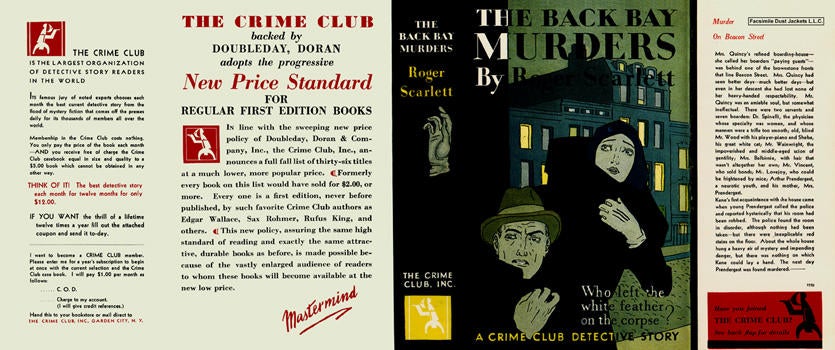
Roger Scarlett : The Back Bay Murders (1930)


Roger Scarlett is a pseudonym behind which there were two writers, a 4-handed couple like Ellery Queen. The writers were called Dorothy Blair (1903-1975) and Evelyn Page (1902-1976). They had not grown up together as one might easily guess, but in two quite different places. In fact, the first, originally from Montana, even though her parents came from Massachussets, had graduated from the State of New York; the second came from Philadelphia, Pennsylvania. The two girls met by the same publisher “Houghton Mifflin, based in Boston's Back Bay, where the two women met. The couple left Houghton, Mifflin in 1929 ”to create their own character and business name Roger Scarlett. After some time spent writing their 5 novels together, the couple retired to a remote farm in Abington, Connecticut, where they lived together for 50 years (they were a lesbian couple, like Curtis confirmed to me).

The 5 novels in question, written and published from 1930 to 1933 are:

The Beacon Hill Murders (1930)

The Back Bay Murders (1930)

Cat's Paw (1931)

Murder Among the Angells (1932)

In the First Degree (1933)


WARNING: SPOILERS !!!


The Back Bay Murders (1930) essentially speaks of a series of murders in a pensioner, that of Mrs. Quincy.

At first, a strange thing occurs: someone smears the walls and floor of the room occupied by Prendergast, a very excitable young man who lives with his mother, with substance of the same color as blood, probably ketchup. Then a few days later, the thing repeats itself only that it is blood to smear the floor, as Prendersast is killed. And a white feather is found under Prendergast's body.

The investigations are difficult: all the pensioners, occupying rooms on the second and third floors of the building, give depositions which show how essentially no one could have committed the crime, except one person who had gone to see the blind Weed, Alvin Hyde . This person, it must be said, introduces himself to Sergeant Moran who supports Inspector Norton Kane, and gives evidence denying his responsibilities like the others. When Kane realizes that it may have been just him, and the police search the apartment he lives in, they find an envelope with the words "Exhibit A" in a drawer and inside the blood-smeared knife that was used to kill Prendergast. In a closet, also the suit that the suspect wore in front of Sergeant Moran.

However, the police do not issue the search order for Hyde, as Kane is sure to be the person living in Quincy's house, who assumed Hyde's identity through disguise.

The investigations are progressing, but they do not produce appreciable results. Kane elaborates a series of accusatory hypotheses, also based on the gift of a piano roll that Hyde had given to Weed, but while focusing attention on a series of characters, it is not possible to identify the right one.

The investigations take another turn, after the second crime, that of Mrs. Quincy, found dead from a puncture on the arm, in her bedroom, connected by a door to the living room where her husband was staying and through another to the corridor of the house. The husband states that his wife died around 10.30 pm when he normally went to bed: he heard a loud noise, ran, and found his wife dead.

All the other occupants of the house say the same thing, even if they are frightened. Near the place of death, four of the retirees were playing bridge: Lovejoy, Vincent, Wainwright, and Dr. Spinelli. Kane speculates that the culprit may be Wainwright (who would be Hyde) who was absent from the table for a moment and allegedly killed the woman. However since the poison is cyanide, which acts immediately, and not after several minutes, he could not be and this hypothesis falls completely when the cat Sheeba of Weed, who has always purred with Hyde, does not purr near Wainwright .

Then he returns to the starting point. Or rather no. Because Quincy was killed because she had discovered one thing: green glass fragments found in her pocket, initially connected to a spectacle lens or a monocle, then they were instead connected to something else. Quincy had revealed that the night before the Prendergast murder, when she went to open the door for Hyde, he had stumbled and heard the sound of glass breaking so much that he thought at first that the panel had broken. top of the front door. Only later, a pocket watch left guilty on a piece of furniture with broken glass had directed her to the true identity of Hyde, thus signing his death sentence. After a final fireworks display in which three different people are suspected, Kane will be able to identify the right one, not before she commits suicide. And he will also explain how that white feather fits into the solution and identification of the motive for the murder of Prendergast.


THE END OF THE SPOILERS


I immediately say that the novel did not immediately fascinate me: in fact, I read the first 100 pages in almost a month. Perhaps the style, perhaps the testimonies, perhaps even the expectation of an impossible crime that hadn't occurred, held me back for a long time, so much so that I had started reading another book. The fact is that I noticed some strange things.


I do not know if the layout of the novel is the original one or if the maps on pages 76-77 were originally inserted elsewhere: the fact is that placed in this position they take away a lot of the surprise effect. In fact, if you insert some maps in which the occupants' rooms are drawn and Hyde's is not among those, a reader quite accustomed to the subtleties of a mystery immediately understands that if the investigations are directed towards Hyde and Hyde does not live in the house. , and nevertheless some plans of the house are inserted, it is evident that Hyde is another person. And this when Kane has not yet expressed his doubts that Hyde is in fact the second identity of an occupant of the house.

Beyond this, the rhythm of the narrative acquires considerable weight and speed only after the second crime, which is an impossible crime. Indeed, by conception, it anticipates by many years a very famous one by Agatha Christie, and by a few years one by Vindry. However, there is a certain underlying naivety: using hydrogen cyanide as a weapon, if it is true that it has its undoubted efficacy, nevertheless exposes to a question above the lines that is not considered (nor is obviously answered: how Did the killer get it? Hydrocyanic acid is not easy to find, as it was at the time for example arsenic used to kill mice, as even at that time it was a commodity that only perhaps pharmacists could deal with In fact, for some time I suspected Spinelli, before turning to the real killer, about thirty pages before the explanation.

However, it must be said that, for the average reader, the identification is very problematic since the game of the parts is developed with skill and very intelligently: the tension, except for the detail I mentioned above, never decreases starting from the second crime, even because various accusatory hypotheses are proposed, one followed by another, addressing Wainwright, Lovejoy, Spinelli, and even Weed (in case he is a false blind man, since he retracts when Kane is about to strike his forehead with a ruler) , all supported by their own cause.

To me, however, basically there is only one doubt left: in the mysteries, except perhaps those of Fantomas or Arsene Lupine, the disguise is almost never used. Here a person, it turns out that for years he has built a double identity, also going to live in another house (a bit like the Inspector Belot of Aveline), but he has the nerve to be seen by the mistress of house who receives him in the house as Hyde, but who knows him under another identity, or to introduce himself to Moran and then be seen by the narrator, that is the lawyer Underwood, without all these people realizing that he is others. However, what strangely comes to me is not so much the disguise (and here also the change of some facial features), but the change of the voice: it is possible that all people have never noticed the voice, or it too was changed ? It seems that only I noticed it, since in the novel it is not mentioned at all.

By setting, the conception of the novel and its characters leads us towards the Van Dine novel: the couple of the two authors were certainly very influenced by Van Dine, who over time was the master in America. Not surprisingly, the main characters can be superimposed on the Van Dine characters: Philo Vance here is Norton Kane, S.S. Van Dine is Underwood, Judge Markham is Sergeant Moran, although there is not the amateur super-detective but the detective cop, according to a rib also born from Van Dine, but powered by Abbot and Daly King. Kane, however, although deriving from Philo Vance, is not a faithful clone, and takes the attitudes of Sherlock Holmes: in fact only S.H. he would go on all fours with the magnifying glass to find something that others missed. Well, Kane gets on all fours with a broom and shovel to collect any glass fragments from the watch. However, certain details bring us back to Philo Vance's encyclopedic culture: eg. the somatic characters of cats, and the differentiations within the same breed of Persian cats.

Good novel, appreciated also and above all by fans of Van Dine.


Pietro De Palma

Sunday, March 27, 2022

F. G. Parke : First Night Murder, 1931


The novel was not only published in the USA in 1931 but also in France in 1932. Since then more than seventy years have passed for it to be translated in Italy. And now let's talk about F G Parke: who is he/she? It is certainly a pseudonym. Many years ago I debated this novel with Steve Lewis, an American writer, as passionate as many of us are: he argued that it could have been an unknown novel by Ellery Queen, or the fruit of the collaboration of a man and a woman. I initially espoused his very suggestive hypothesis of him, of another pseudonym besides Barnaby Ross but without having read the book and I thought he was initially right, but then, after reading the book and discussing it with Mauro Boncompagni, an Italian student (who has got one original copy), who argued that the English quality of the writing did not reach the refinement of the two cousins, I was convinced that it was the work of a woman , who sought his role model in Ellery Queen (as did Hugh Austin) and who remained under anonymity.

 I say this with confidence, because for some years we have known her real name: the American geneticist Janet Akaha, revealed on site of Steve,  F G Parke was the pseudonym of “... Rose Pelswick who was the movie critic for the NY Journal American. She chose the pseudonym Parke, because she lived on 67 Park Avenue in New York City, while F G are the 6th and 7th letters of the English alphabet respectively”.

It still seemed this film critic had written only this novel. Instead I discovered that it is not the only her work: Rose Pelswick wrote at least one short story, published in Five-Novels Monthly [v15 # 2, August 1931] ed. John Burr (The Clayton Magazines, Inc., 25 ¢, 192pp +, pulp): Second Hand Stars.


WARNER: SPOILERS !!!


Martin Ellis is a mystery writer who also writes reductions for the theater: Phantom Fingers, his latest work, promises thrills and suspense to the public until the murderer is discovered. What those present do not know is that during the Premiere of the play at the Olympyc Theater, in the third act, while the culprit has been arrested by the detective and everything is about to end with dignity, a piercing scream rises from the audience. There and then those present think of another gimmick, then they realize that something has happened: Julius Brandt, one of the producers of the major Broadway shows, has been found agonizing with his throat slit in his chair in the audience. Time to turn on the lights, and a doctor comes to Brandt, who dies in front of him. It is certain that it is a crime, because the weapon cannot be found. They close the exits, and wait for someone to arrive: Inspector Gradey of the Homicide Squad, begins the interrogations, of who was closest to the producer.

The autopsy reveals that Brandt died too soon to have just been slaughtered, and in fact the analyzes reveal that there was potassium cyanide in the wounds and the same poison had been added to the Brandy that Brandt carried in the flask below and that he had not consumed. .

First a certain Billings is suspected who has a bloodstained handkerchief, and who in the past had had something to do with Brandt: from a version of the facts that would clear him, and besides, his blood type and Brandt's are the same, and so the blood in the handkerchief cannot be attributed with certainty to Brandt.

Then it's the turn of a certain Gas Perino, a gangster: he was in the company of a movie star, Bonnie Adaire, who swears that her man didn't move, even if with acrobatic moves, given his long arms, he could have slaughtered Brandt while remaining in his place: but the evidence is not there. Then there is Ms. Manning, Brandt's ex-lover who didn't want him to marry her daughter and had threatened him with death. And finally, Bonnie Adaire is suspected, who is also the friend of the banker Sterne, who could have killed Brandt due to the fact that Adaire was not taken for a production.

Then unexpectedly the second murder takes place: Bonnie Adaire is found killed in her house in broad daylight, stabbed in the bathroom; and later a third: remains poisoned to death by cyanide, Sam, Ellis Martin's butler, who had dared to drink the brandy that Martin had asked him to bring him, which will be found to have been poisoned with cyanide. Why would anyone try to kill Martin?

Martin, after reflecting, involves police and suspects in a reconstruction of the crime in the hall, assigning each to their own seats in the theater hall, with the sole exception of Burton - who was on the radio that evening - who is given Brandt's chair, and then proceeds after a reconstruction, to the indictment of the murderer, forced to accuse himself in order not to fall victim to the same trap that he had concocted for his partner, who then decides to kill himself.


THE END OF THE SPOILERS


In the flap of the cover, Martin Ellis is compared to Philo Vance, and even in the same novel, the comparison is repeated. But it seems to me that there is very little, if any, from Van Dine School: Ellis as presented does not have any of the characteristics of Vance (omniscience, belonging to the upper class, friendships within the district attorney, snobbery), but rather it could be it was created by looking at the first Ellery Queen, if it is true that in the novel it is said that he writes detective stories. But beyond this there is nothing else, except that the crime also takes place in a theater, and the fact that the victim's autopsy shows the presence (also) of a poison: here, cyanide; in E. Queen tetraethyl lead (TEL (from English tetraethyl lead)

The fact that the novel was made two years after The Roman Hat Mystery is clearly an attempt to imitate its style. Beyond the attempt, however, there is nothing: when I wrote the comment, I had not yet read the book completely, and therefore I was based on the conjectures of others, even if intriguing; having said that, the style is clearly feminine, as it seemed to me then: there is such smoke, and such a chatter, a talk of environments and stars, an atmosphere of gossip and ill-concealed envy and jealousy, that only a woman could have rendered it so vividly, while missing all those bizarre clues and conceptual reasoning that are typical of the early novels of Ellery Queen (and also of other true Vandinians, such as Daly King, Rex Stout, De Puyer's Rufus King, Anthony Abbot). Here there is only smoke and mirrors, a lot. No real clue, so much so that the discovery of the culprit takes place only after the affair of the titles is revealed, and not by a logical consequence but by analogy, without there being any evidence, based on the identification of the guilty on the his psychological constraint that induces him, in a given circumstance, to accuse himself in order not to be torn apart.


And the same ending, with the discovery of the “modus agenda” of the assassination - mind you it's a little masterpiece by Ellis, which reconstructs the various phases of the assassination, which illustrates the victim's fear of the dark, and how the murderer knew and had arranged for Brandt to sit right there, to hold the armrests in fear, is that it is not only an essay of psychological introspection but also testifies to the writer's imagination and her subtle perfidy - it is certainly not something that brings us to Van Dine or his followers, primarily Ellery Queen: in none of their novels, except a story with Reginald De Puyster by Rufus King,The Weapon That Didn't Exist, and Tragedy of X, do we have recourse to strange mechanisms to kill, which are the legacy of times precedents (see for example the bed of The Grey Room by E. Phillpotts). Moreover, here, resorting to a murderous mechanism, in my opinion, means to cheat the reader, especially since the book is stuffed with a smoky series of clues that have nothing to do with the novel, another and little: there is no it is a systematic progression of investigations with the discovery of clues that can be variously interpreted, but a culprit who literally falls from the sky. It may come to mind I repeat by association of ideas or by analogy that someone has invented something comparable to the opening mechanism of the safe, destining it to kill, but it is nevertheless only a peregrine thought, because throughout the novel the murderer, even though he appears here and there. there, he is not in the least affected by investigations.

And the killer's modus agendi, absolutely disconnected from the investigations carried out and reconstructed only in the writer's mind, because of her quality only of her, indicates her as an author who cannot be inserted for me into the S.S. Van Dine School.


Pietro De Palma