Saturday, April 28, 2012

John Dickson Carr : The Plague Court Murders, 1934

Not everyone knows that The Plague Court Murders, Carter Dickson’s novel (John Dickson Carr) published in 1934, has a pretty revealing subtitle: “A Chief Inspector Masters-Murders”. It means, that Carr at first, probably, had decided to create a series of novels (including the aforementioned novel would have been the first) not based on the character of  Merrivale but on Chief Inspector of the CID, Masters. Besides the fact that in this first novel, Humphrey Masters should have at first a much greater role than that of Henry Merrivale, it also follows from the structure of the novel: it is much more Masters dropped into the mystery, he is interrogate several witnesses including you find the culprit, Merrivale and the same appears on the scene of the crime after at least a good half of the book.
It would suffice, however, only the characterization of the character Merrivale to understand even the most doubtful that, in this first novel in the series, the figures of Merrivale and Fell, morphologically, are not very much different. Carr, the beginning is not that he had already given a well-defined characterization to his character. In contrast to Masters, which is presented to the reader on two separate occasions: the first is when it is presented as a hunter of fake mediums and false occult scholars saying that during the period of spiritualistic mania that had invaded England after the end of the war, he was a sergeant whose main task was to unmask the false medium, and that his interest in these practices had never died out, so that he "had actually turned into a hobby, by constructing sophisticated tricks and sleight of hand, in the workshop of his house, "surrounded warm approval of the children"; and the second is when it becomes a physical characterization of Masters: tall and stout, expression inscrutable, wrapped in his dark overcoat and a bowler hat to his chest as if he beheld “the passage of a procession”. To emphasize the fact that at the beginning Carr (but not to inflate more his name, he adopted with all the Merrivale novels in the series, the pseudonym Carter Dickson) had not fully characterized the figure of Merrivale, you can see how the Old as it is also called, was presented as a man of law, but also a doctor, and especially in the early novels such as Head of the Military Intelligence Service (also known as MI6), although, when it is presented for the first time, is said to be was previously head of the Military Counterintelligence (also known as MI5). Being at the head of "Intelligence" Military, could explain the title of nobility that we often see prefixed to his name: Sir, though in his case the noble title is not acquired as a function of its operational excellence rather than by descent.
Conan Doyle's influence on Carr is detectable, in many cases: in the case of the duality Bencolin investigation, represented by Holmes and Watson, is masked and not clearly visible and if anything it is only understandable in the pair Bencolin and Jeff Marle, in two other major series, those of Dr. Fell and HM, the influence is much more visible, if not canonical. In fact, Dr. Fell is apparently opposite, but in reality it goes, the Inspector Hadley, and if HM in a sense embodies Holmes, Dr. Watson is represented by the unfortunate (which makes tenderness in some way) Master Chief Inspector. That seems to me to identify one of the most characteristic and brilliant of Carr’s writing: the characterization of the characters. Since it is an indisputable fact, that the pair of investigators, but in general the pair of players, attract most of the individual (Stan Laurel & Oliver Hardy, Fred Astaire & Ginger Rogers; Starsky & Hutch, etc..), Carr invented the characters , we can say that he has often used them.  Although it’s undeniable that the shoulder reinforcements support and finish to put under the spotlight the protagonist, the deus ex machina of the novel, it is also undeniably true that the “shoulder”, when it is broken so as to soften, become very sympathetic to readers, because in some way all of them tend to identify with him. Indeed, in this case, Masters becomes, with his bad luck to run into impossible crimes and locked rooms, a character almost more fun than the same HM looks. The fact is that both appear in The Plague Court Murders and their combination will feature the best of Carter Dickson’s production.
The first of the novels in the series, sees the entrance of HM not at the beginning but when the crime has already consumed: in fact the entrance of HM follows the lines of an entry into the scene with great fanfare of the protagonist, such as during a theater play, after a sort of introduction, here represented by everything that happens before HM appears on the scene to solve the riddle. And H.M. appears for the first time just because Major Featherton think about it, by contacting Ken Blake (who is the narrator), to put the investigation in the hands of that who is, a true expert, in the hands of Henry Merrivale. And by doing so Carr speaks for the first time about Merrivale, and does so, looking at Fell: garrulous, always lazy, lawyer and physician, vain, fat jokes and talk about pressures.
The investigation concerns a supernatural story from surveys, that of a dwelling, a bit far-fetched in London in the '30s (but often Carr knows how to make plausible situations that at the hands of others would laugh chickens), which says hotels a ghost, that of Louis Playge Executioner: it’s Plague Court, originally the seat of a tribunal. This home is owned by Dean Halliday and his family. Halliday has called on stage Ken Blake, his old friend, to preside at a seance, which will evoke the restless spirit of the Executioner, because you find peace, to manage the session will be a student of the occult sciences, Professor Roger Darworth, and Joseph Dennis the medium. In fact, the spirit is one of those wicked and devilishly clever, and could take over the body of a certain person to make him do what he wants: Plague in fact life was not only the executioner for activities, but also to the vocation took pleasure in hurting . So he had become the terror of those who were near; until the plague pecked too him, like all his countrymen. His brother, drove him from home, and the executioner, before dying, threw a curse on that house.
On the site of the seance there is also the Chief Inspector Humphrey Masters, whose presence is explained by the unusual fact that Darworth suspected of being a fraud, a fake scholar of the occult. The night of the séance, Darworth closes himself in Plague Court, while the séance proceeds, and there he is killed.
The fact is that crime is a classic Locked Room: in fact the door is closed and locked from the inside and the windows also, to complicate the story is the fact that Darworth was stabbed with the dagger that had been used originally by Executioner, and around the little stone house is an expanse of mud, where there aren’t footprints: it would therefore appear that the supernatural is the only possible track. In fact there would be a centenary tree, with its branches reaches the roof of the house, but its wood is so addled, that would not hold the weight of any person who climbed up there, as evidenced by good police Sergeant Bert McDonnell.
The protagonists of this drama, that is, Lady Benning, Marion Latimer, his brother Ted Latimer, and Major Featherton, astonished and frightened to attend events, the more that comes a cat found with his throat cut and a large stone vase is launched overhand: these facts show that all the spirits in place does not grant to any discounts of any kind.
At this point, and here ends the introduction to drama, enters H.M. It is a dramatic entrance. H.M. is presented as a bald, fat, smoking bad cigars (which Carr model runs is Winston Churchill), who prefers to wear hats of any kind, that is not taller than five feet seven, and always wears white socks, and who knows an industrial quantity of dirty jokes. From this point, Merrivale will remain  until the end. But not before he had probed the past Darworth, because that's where you hide the origin of the drama, and that a second crime, even more terrible than the first, upset everyone will be killed Joseph, medium, Darworth mate. Not just killed, but also full of petrol and thrown into the boiler of a house. The explanation of Merrivale, a real masterpiece, will leave everyone with his mouth open.
Actually, as any first novel, this one is structured almost like the first and only, or that the same Carr hadn’t clear ideas on the continuation of the series: in fact, not only the fact that, after almost 150 pages , Merrivale appears in the novel, is a test of a different construction gained during the course of the novel, but especially that mysterious expression which appears after Merrivale’s apparition and about it you can not find any next justification. Why Carr feels the need to say that you are violating the rules of the detective story? And why right after he says that the person who premeditated the murder, she conceived just as a detective story?
In my opinion, is the affirmation of who (precisely Carr), not knowing yet whether the smile on the success or otherwise after the publication of this novel, claiming for himself the authorship of to have created a perfect novel, maybe the solution to most brilliant moment he had thought: who could premeditate a crime, conceiving it as if you were writing a detective novel, if not a writer of detective novels, and particularly one who wrote the novel in which we find these reflections? Only a writer who sets up the plot, and  invent an ingenious crime that works on paper and of which he, speaking by the mouth of Henry Merrivale, can reveal the explanation, could premeditate the crime, and he should conceive it in a frame mystery novel.
In short, John Dickson Carr could do it, only!
Because, despite the explanation leaves at open mouth, this is one of the many crimes whose explanation can be accepted only in the pages of the greatest inventor of locked rooms, in a literary context and invention, taken to the maximum expression.


Pietro De Palma

Tuesday, April 17, 2012


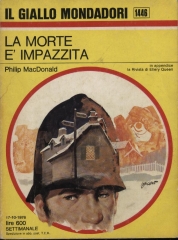
Philip MacDonald : Murder Gone Mad, 1931.


When you speak about great writers of detective novels, generally you speak about the great triad - Carr, Christie, Queen - forgetting many other names, sibling, if not quantitatively, at least qualitatively. Among these others, there are what I call the "innovators", the writers who have innovated the genre, not at the variation of plot, but at the invention of a different narrative structure. Among the innovators, securely I must remember Philip MacDonald, english writer..

He was definitely one of the most important writers of the twentieth century detective: I would say that of his production many are masterpieces, worthy to be authoritative in any ranking of the best novels of all time: The Rasp, The Noose, The Link, Rynox, The Choice, Murder Gone Mad, The Maze, The List of Adrian Messenger , X v. Rex (aka: Martin Porlock). Why? Because he has got ever originality and almost every time he writes a novel, makes some surprising stylistic changes to the whodunnit: writing a novel about the serial killings, Murder Gone Mad, he met a huge success and it was repeated with another on a more series of crimes committed by a killer, X v. Rex; he subverted the rules of the English whodunnit in The Maze; I didn’t introduce the murderer in the Warrant for X; in Rynox, he began with the epilogue; still in seventies, Barzun and Taylor described  The Rasp, a "epochmaking": in it was all: the murder of a head of state, clues, extraordinary ambience and atmosphere and a variety of psychological thrill.

Our novel is of 1931. John Dickson Carr, who at first was called The Rasp, the debut novel of the Colonel Anthony Gethryn, “one of the ten greatest detective novels”, he later replaced it with The Murder Gone Mad, to enshrine the importance that " The Murder Gone Mad " has and that was already recognized eighty years ago.

The novel is a precursor, one of the first to talk about serial killings, in a time when The ABC  Murders of Agatha Christie was yet to come: a novel counter, whose mere mention would be enough to erase all an annoying literary criticism, which tends to frame the Mystery as a genre dead and buried, unable to generate tension, and prepending to it a paraliterature; forgetting that the serial murder genre was born with Steeman and MacDonald. But if Steeman, with "The démon de Sainte-Croix" opens the strand talking about a series of crimes apparently disconnected and then that prove joined by a particular truly surprising, and if Christie christen the murder multiple that must conceal in the series apparently disconnected interest to a single murder (as if concealing something from other things like that and putting everything under the sun becomes it unknowable), Philip MacDonald provides to exaggerate the genre. In fact, for the first time ever, we see a litany of murderers, quite disconnected from each other, can be associated only in the unknowable depths of a sick mind who likes to kill for the sake of it, keeping police at bay .


So slowly, then more quickly we witness the horrible business of "The Butcher", the psychopathic murderer that, in the charming town of Holmdale, a few miles from London, sowing chaos is the discovery of the bodies, all killed with a bloody same technique (using a sharp knife blows, usually to the stomach), to dictate the pace, and especially through authorship of the letters to the police, the pathos and tension. Thus, where in many other examples of contemporary thriller, the tension is crystallized in literary devices, for example in the construction of floors and temporal narrative that often run in parallel and then intersect (for example the Lee & Child’s novels starring Aloysious Pendergast), here the tension is a characteristic of wisdom literature that articulates the writer with a relentless procession of the deads, before with frustrating attempts , then more more specific and more selective for identification of the murderer, with the growing dissatisfaction of the public, represented by newspapers, politicians, and less and less popular demonstrations peaceful, and the sardonic safety sported by the murderer in  mock and ridicule of established even in charge of the investigation, Arnold Pike, superintendent of Scotland Yard, which, like a bloodhound, regardless of the tricks of the murderer and reproaches of his superiors, leads his investigation made by attempts, each one different, but always more effective to end once and for all the carnage. So to mark the time of novel are more extensive tables that contain the likely suspects. As a corollary, a series of unlikely assassins arrested: the boeotian, the director, the famous doctor.

Without doubt the most curious and interesting history, is that a procedural analysis of the survey, lack any evidence that in an usual survey that was based on abduction of Sherlock Holmes, should abound: instead they roam here. In the painful deaths (Lionel Colby, promising young man, from  middle class family; Pamela Richards, rich bourgeoisie; Amy Adams, bartender, working class; Albert Rogers, skilled worker, about to become a soccer player; Marjorie Williams, nurse), relentless and ferocious in its impartiality, as if death is common to all, a "leveling" relentless, you do not see nothing but the absence of any motive: unknown to each other, elements taken at random, whose unique common reasons are the horrible gash in the belly and enjoy the chilling of the murderer about the death of one and about the pain of those who loved this victim. The killer comes even to send a letter to the police, promising that he will hit on December 7, this time enjoy pain just of Pike who finds the mother of a girl with which he enjoyed playing with the train, Molly Brade, curled up next to a wall and behind the chair where he sleeps unaware her daughter Millicent.

She will be the last to fall.

After Pike will ariive briskly, with a series of insights on how to proceed, that have nothing to do with normal investigative inquiries, as here, there is no evidence that helps to discover the killer. He is discovered because Pike is increasingly resorting to the help of improvised means of investigation: reflectors located in the town, they will turn on randomly illuminating different parts of the city; lights that are lit in the post office where the yellow envelopes with the offending oblique black handwriting, are wrapped and then fall directly on the table in front of employees and policemans; cameras, as cameras are today, they control the various streets of the city .. But Arnold Pike, with an idea as old as the world, he will manage to reveal the true identity of the murderer: creating a false butcher eager to take the fame of the real and the true is induced  not to resist the temptation to see who has the will to emulate
himself

And so from an entire city sifted, he will lead to narrow the grid of the suspects in only 4 suspects, one of which necessarily will be "The Butcher". But the truth will surprise all. Because once the killer will be again the least suspected, and the weapon .. the least suspected.

A novel in conclusion, of a disarmingly modernity, that in the absence of any indication enlightening and rambling in the theory of serial murder victims, clearly does justice to the title Murder Gone Mad.

A masterpeace.

Pietro De Palma

Sunday, April 8, 2012


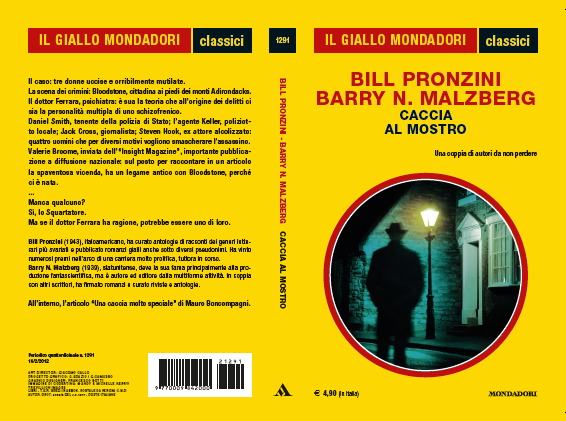
Bill Pronzini-Barry N. Malzberg : The Running of Beasts, 1976

 I must admit that if I didn’t buy and if I didn’t read detective stories for sale two months ago, in italian newspaper stands, I never knew who was Barry N. Malzberg. The other author, in return, yes I know! And who doesn’t know Bill Pronzini?
Mauro Boncompagni, who signed the notes in the afterword, largely about the two writers spokes, and cites facts and circumstances which, as he told me in private, has been told by two authors: he  knows both but Bill Pronzini least I know for sure. The result is a vivid and fascinating portrait. I do not deny that, thanks to Mauro notes (that I know myself well enough), I would have wanted to read the essay by Malzberg on Cornell Woolrich: Mauro speaks of it as the best piece ever written on Woolrich.

The novel in question is The Running of Beasts. It 'a thriller and it's raining there. But it is not just a thriller, is a masterpiece of a thriller.
The story itself isn’t very original: in an U.S. citizen there is a series of deaths: three women were killed, and disembowelled. A psychiatrist, Dr. Ferrara, thinks that the murderess is a schizophrenic with multiple personalities: in other words, someone who kills perhaps not even then knowing that I did, or remembering fragments of memory that can not properly fix in his mind.

The fact is that five people want for its own reasons, get your hands on the murderer:
Daniel Smith, a state police lieutenant, Steven Hook, a former alcoholic actor, Jack Cross, a journalist rampant; Keller, a local policeman, Valeria Broome, known journalist who was born in the town. The fact is that, if attention is focused precisely on these people, it’s because obviously one of them is the murderer. Already in this, the two authors diverge from the usual survey: you would normally have had to come gradually to five suspects. But here, the five actors are already on the scene from the very first pages: they are presented individually, in their stories, in their weaknesses and in their aspirations.
And almost immediately the five begin to be attracted to each other: Cook falls in love (paid) with Valeria Broome, Keller begins to suspect Cook, but more bias than for conviction based on evidence, and Smith begins his duel with Keller. This in his turn hides the skeletons in the closet: he killed a demonstrator many years before for "excess of zeal" if not "violence" and then he preferred to take refuge in the quiet town of Bloodstone to rebuild its reputation. Bloodstone, which strange name, it has :  the blood recalls. But is not the only strange thing. I say no more.
The fact is that after a while the current deaths perk: there is an attempt of murder (odd), a strange sight, and then two killings, even with the same features: two women disembowelled, and then cut with a diamond-shaped a knife on her thigh.
What you notice is the way to accentuate the tension: the actors are presented individually in great detail, the amount of space of characters is not secondary : in fact the rate is exactly given by the progressive decrease of the space given to each character in the book. First large, then - gradually - increasingly restricted, the character whose turn is appointed, does something and immediately the action and the attention of the two authors go on another. And all of this, according to the flow of a chain of events, the one after the other, the one resulting from another, perhaps that seemed unconnected, but then slowly tend to develop in a predetermined order, that given by the suspicion which tends to materialize at a certain point. And the tension becomes frantic when paragraphs, each devoted to a different character, they become almost like flashbacks.
But is he really the murderess? This is the point.
Because Pronzini and Malzberg tend, when they point to the reflector, to take a step back and say that maybe the spotlight should have been focused on another. In short, everything and its opposite. And when the test is given, and the killer is located, and hunting seems to end, with a change of scene really amazing, the killer is identified in another. That would seem to have understood that he was the killer (the famous multiple personality), and dies. All gone? No. Because with a double final, the two writers show once again that you should never trust appearances. The fact is that "The end" of the novel is really surprising, as an ending of a novel by F. Brown or Thomas Harris almost. The true ending will remain on the stomach.
What I like to emphasize is the so-called stylistic mimesis Pronzini & Malzberg take: when identifying the murderess (which is true) underestimate him, present him with words and descriptions that tend to corroborate the fact that the murderer can not be him, despite the overwhelming evidence against him would seem. It seems almost a conviction sub-liminal. And when they point the spotlight on the fake murderess, present it in such a way that the reader becomes convinced that he is the murderer and not others. The operation of mimesis is needed to prepare the surprise ending, which would not have the force of a punch in the stomach, if you do not give for granted that the murderess had already left the scene.
Finally I would like to recall that Bill Pronzini and Barry Malzberg must have at least watched "Murder Gone Mad" by Philip MacDonald: the same journalist recalls other journalist who was there, but she hasn’t the same function and the same role, and if the atmosphere is rarefied in both the novels and the victims are killed under cover of darkness, is also to say that MacDonald generates power only with the atmosphere (like the great masters of the past, for example Connington or Rinehart and Rufus King), while two writers also resort to stylistic and technical processes. It is also to indicate the ability of visionary Malzberg (well highlighted by Boncompagni in afterword) that more than one occasion, with its baroque descriptions, convinces the reader of the insanity of the murderer.
An extraordinary thriller.

Pietro De Palma

Tuesday, April 3, 2012

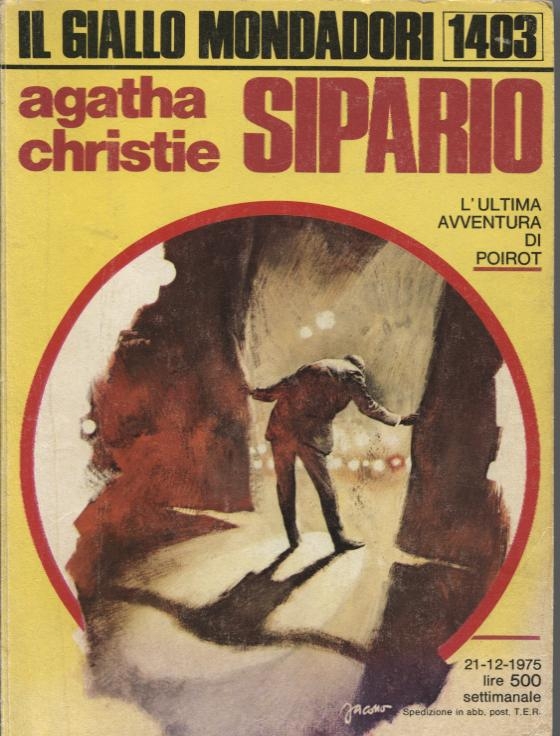
Agatha Christie : Curtain – Poirot’s Last Case, 1975

Styles Court always had a certain importance for Agatha Christie.

Witness the set having 2 important novels in his writing career: The misterious affair at Styles, his debut as a writer's career (1920), in addition to the character that made universally famous, Monsieur Hercule Poirot, the Belgian detective; Curtain - Poirot's Last Case (1975), Poirot novel farewell.
Curtain - Poirot's Last Case begins when the first was over to Styles Court. Now Cavendish has become the home of a pension, and Poirot has a room for rent. He is worn out by arthritis, and lives in practice on a wheelchair. But Poirot to Styles is not out of nostalgia, but to prevent a murderess to continue to kill, as he wrote to his old friend Hastings. The show, alone, amazing coincidences, events which, taken individually, are of no value, and then, however, compared to each other and respect each and every one under certain circumstances, take on sinister side dishes.
In other words ... there was a very strange series of deaths.
Leonard Etherington, dead apparently rotten food, after the autopsy was discovered to be killed with rat poison with arsenic. Accused wife, she had been acquitted. However the general opinion was unfavorable, and two years after the trial, had committed suicide with barbiturates.
Miss Sharples: died from an overdose of morphine. Insufficiency of evidence against the nephew, Clay Freda.
Ben Craig: Mrs. Riggs assassinated along with a gun belonging to her husband, Edward Riggs, jealous of the relationship between the two. Riggs was sentenced to life imprisonment, after being sentenced to death.
Derek Bradley threatened by his wife for his affair with a girl, was killed with potassium cyanide dissolved in beer. His wife was sentenced to death and hanged.
Matthew Litchfield tyrannical father of four daughters, killed by his eldest daughter Margaret, who would thus allow the sisters to start a new life: interned at Broadmoor because she was incapable of consent, there she was dead then.

Cases that do not appear to have had anything in common, too many to suggest a common matrix, identified only by Poirot. Mr. X is the common denominator of all cases. He too is in Styles Court, became a separate board. And Poirot is there.

He feels compelled to take action, because he suspects, based on all existing connections, another murder is about to take place at Styles Court, where fifty years earlier, had been killed Emily Inglethorp.
George Luttrell, retired colonel is the new owner of Styles Court. He administers the pension and lives there with his wife Daisy. Guests of the board, and so essentially characters in the novel, as well as Poirot, are, at the time when Hastings arrives with his daughter Judith, Sir William Boyd Carrington, Stephen Norton, Elizabeth Cole, John Franklin, the scientist (who has a laboratory ) and his wife Barbara, the waiter Poirot, Curtiss, and Miss Cafres nurse. All the characters, more or less, will have a role in the drama. Between these lies the murderess, Mr. X, and his victim.
Poirot would save the sacrificial lamb, who does not know who he is, and as such seeks the help of Hastings, who ran, together with his daughter, in aid of his friend. But soon there will be a homicide, based on the judgment of Poirot that if one swallow does not make a summer, a murderess makes a crime instead. But first there will be a failed attempt to kill the wife of Colonel Luttrell: he shoots to a rabbit and a bullet grazes his wife.

The bullet was apparently fired from the rifle of Colonel, but is it true or was fired from a rifle similar to the same caliber?

The fact is that, after a death occurs: Mrs. Franklin is poisoned with a lethal dose of physostigmine sulfate. The dose is from the laboratory of her husband, of which both as he as the assistant have a key. It clarifies that the victim suffered from depression, and there's more to an eye witness above all suspicion that he swears to have seen come out clutching a bottle: he is Hercule Poirot. The investigation of the coroner's verdict was suicide. But Poirot has really seen what he has confessed? He knows that the woman was murdered, but since it has no evidence of X is the murderer, Poirot makes the investigation is closed so that he and Hastings are free to work "undercover", we would say today. Moreover, he confesses that he testified, but "not under oath."
Hastings is afraid that something else will happen. In fact, a second murder occurs, and this time under impossible conditions: Norton is found with a bullet in front of her room, locked from the inside, and the key is found in the pocket of his robe, once the door is forced . The window was found locked from inside. This can only be suicide.
Hastings swears to Poirot that he saw Norton (limping) wearing his robe, closed room. But despite Norton has been found with gun in hand, according to Poirot it was murder.

From who? And how?

Following are just fireworks.
And one of these concerns Poirot. That dies from a heart attack.
Then, four months after a letter delivered to Hastings will explain everything: how are the three deaths occurred, as there was an attempted murder, but two, as until to murder of Franklin, there were two murders and a real potential. After the murder of Franklin, there were a potential murderer and two real. After the murder of Norton, there were two killers. After the death of Poirot, only a murderer there was. However, he isn’t X but…
I do not know how others think, but I think the Queen had read and enjoyed The misterious affair at Styles, when they wrote The Siamese Twins Mystery. Agatha Christie was in fact the story of two brothers and a stepmother, who was then remarried to a younger man, and murder her, of which he is falsely accused one of the brothers, the Queen, the story of murdered a surgeon, and 2 twin brothers are falsely suspected. In both come into the picture two possible murders of spouses.
But, then, just as Christie would probably have read the works of Queen. For the last four words of the novel, Mark of Cain, we refer to Ellery Queen, to many of his works: the radio play The Adventure Of The Mark of Cain, the novel The King is Dead, a chapter of "Once Was a Woman" , which is called "The Mark of Cain". but at the same "The Siamese Twin Mystery" to "X."

X refers us to Dr. Xavier, but also to twice. A Janus-faced: and this, Curtain - The Poirot's Last Case, is another novel on the double, we could say the novel on double Christie's: because there are four murders, and these four until the end does not seem so. One has never killed, but killed many, and another killed one out of necessity, to save lives, but has not been indicted even praised, and now kills still need to save lives, but no one would think that killed and another still kills, but does not know who killed, and the fourth, which would kill another, ends up a mistake, not his, .. to kill himself.

We could call it, as for Ellery Queen, a "Tragedy of Errors". It certainly seems that those who read the novel, because much more happens, and in this much, many other errors and misunderstandings and characteristic behaviors , that are explained in the cathartic final. Among the behaviors we point out, the "strange" resume the limp of Poirot, who limps as fifty years before.
The limp enters by force in final explanation.
Why to Styles Court, Christie decided to set his first and his last novel in the series of Poirot? I do not know, but certainly Styles Court, had to play in the Christie almost a symbolic value: there he began his fortune, there had to end.
Few people know that when she wrote her first Poirot, the house where she lived with her husband, Colonel Christie, was called Styles, in Sunningdale, Berkshire. And from the house before her husband went away in 1926 stating that he had a lover, then she ran away (the famous escape and temporary disappearance).

The melancholy of Poirot, in this last novel, is very strong: we see him suffering, and for the first time unable to make reasonable decisions in respect of a murderer who doesn’t dirty his hands ..

That of perfect murder is a way that comes from afar, and that, through various shades, Agatha has explored several times, also engaging fictional experiments, which were not really peculiar, belonging to other British authors (Heyer, Crispin, Wentworth, eg.). For example, the possibility of spreading hate and resentment through the correspondence. For my part, I see a very strong similarity between these odious systems to bring the evil in the community (the weakest inducing killing or causing others to kill), and the system adopted by the assassin X present in this novel through a psychological sensitivity very strong, and doomed to evil, he causes certain people to kill others, touching the right time "some string".
In short, a novel that seems to say so anything, but in reality is, in my opinion, a true masterpiece.


Pietro De Palma


Friday, March 30, 2012


The Blue Dahlia, 1946. Directed by George Marshall; Produced by John Houseman; Written by Raymond Chandler. Cast: Alan Ladd, Veronica Lake, William Bendix, Howard Da Silva, Doris Bowling. Paramount, USA, 94 min., b/w.

As you know, Raymond Chandler, like many of his time, was busy as a writer, the celluloid industry, however, the only specially prepared script for a film, that was for  "The Blue Dahlia ", directed by George Marshall.
George Marshall was a director rather eclectic film ranged from comic to film westerns, crime movies.
In our case, signs a delightful film, by that strip of film noir in 40s, that respects the canonicity of similar films (the unfaithful woman, the man betrayed the gangster, punch, smoke and alcohol in abundance, and a good offense, and of course the innocent who must prove his innocence against all), but enriches it with the motif strongly felt in those years, the veterans returned home as heroes, and then prevented by circumstances other than back into the everyday world. It almost seems the plot of Rambo: even there, in the first of 4 movies, the theme was the failure to return to work and to normal life of the veteran, rejected by the very people who ought to have a hero's welcome.
Here there are three veterans: Captain Navy aviation, Johnny Morrison, who is the protagonist of the story, his subordinate and his friend Buzz Wanchek, that due to a bullet in the skull suffers from hallucinations, severe headaches, moments of absence and severe amnesia, and their friend George Copeland. Johnny returns home, hoping that his wife Helen is waiting (but in a sense predicting the opposite), and locates her in the middle of a party in his apartment, in a bungalow hotel complex, with friends who he doesn’t know, and he betrays a certain Eddie Harwood, owner of a local, “The Blue Dahlia”.
But it’s not so much to discover that his wife has a lover but that she was the cause of death of their only son, the spring that triggers an argument between the couple, after which, Johnny leaves his wife for ever, that could have killed, together with his pistol, a 45.
It's raining cats and dogs: Johnny comes out of a second and disappears. Located randomly on the street - look at the coincidences - a beautiful blonde who gives him a ride (Joyce Harwood) to turn his wife Helen's lover. But while the two travel by car, someone really wants to kill the wife of Johnny, which is thus suspected to be the perfect murder. At this point he should try in every way to find the murderess of his wife and prove his innocence, the right help Joyce, fell in love with him, and broke with her husband.
At this point, Johnny collides with Eddie and his partner, a scoundrel with whom he has robbed a bank messenger boy killed for nothing: the two are wanted for many years, but they changed their names and now they are protected from any investigation, as long as Johnny does not understand, warned from the back of a photo, taken at the home of his wife, that Eddie is actually the false name behind which lies a murderess: it would seem at this point that the two were involved in 'murder of his wife, but it is not. And so the final will be a confession of the unexpected unexpected, as is the recognition that what seemed a confession (Buzz Wanchek fails to focus on what made the night of the murder, and is prey to terrible memories: Helen tore the petals of a flower one by one, a frightening noise and loud music) really is not.
Of course the film ends with the two main characters Johnny and Joyce greet you but what you say makes you think that a little later will meet again.
The film, beautifully directed and acted, he entered the quintet of eligible candidates for an Oscar for best screenplay in 1946. As for the players, we must especially mention Johnny and Joyce, who was Alan Ladd and Veronica Lake, very close-knit pair at the time. At the time, Lake was on the crest of the wave, so that the hairstyle that she had launched (a fringe falling over one eye by hiding it) had infected a lot of the female audience. As that hair had caused many accidents, especially among workers, whose hair was drawn between the gears of the machinery, the government asked Lake to change her hairstyle.
Ladd hand, while being appreciated, especially because of the low-budget movies they always sell a lot, really became famous a few years later with the interpretation of  “Shane” (1953).
The third actor in this poster along with Ladd and Lake, was William Bendix, characterizations of the time, whose role in the film would not seem to be on the same plane as the first two, so why was placed next to them? For the popularity? Bendix is
​​true that some years before he was nominated for an Oscar for Best Performance by Actor in Wake Island (1942) by John Farrow, and had been with Ladd and Lake in “The Glass Key” (1942) from a work by Dashiell Hammett (screenplay by Jonathan Latimer), and then a magnificent interpreter of Alfred Hitchcock's Lifeboat (1944), a film in half and psychological warfare.
Here she seems to play a role all its own. Indeed, as the film proceeds, a not inconsiderable part focuses on the characterization of the veteran with shrapnel in the brain and prey to strong amnesia and hallucinations, for how he behaves and what he says, at some point it would almost seem to be in films the murderer. In reality, it was learned that Chandler had in fact intended that, the part of the murderer (he had to kill the faithless Helen, because very attached to her husband Johnny), until it was - by American military authorities - refused that a veteran and for more disabled, could be attributed to the characterization of a murderer. So Chandler changed the identity of the murderer. But as the film progresses, I repeat, it seemed to me that this shift had not occurred before the beginning of the film, but along the way: in fact, the drama tends to Buzz, which would be an ideal guilty, and with a strong psychological, until a sharp turn at the end, the less likely it is identified with a motivation of the killers and truly laughable: blackmail. The murderer would have blackmailed for her affair with Eddie, threatening to reveal everything to her husband, but she refused and so, fearing that she revealed all to Eddie, he would kill her; everything now when Helen was left forever by Johnny and she also broke up with Eddie, played by Howard Da Silva
And Raymond Chandler?
Judith Freeman, "The Long Embrace", Random House (2008), says that Chandler had interrupted the wonderful script and he didn’t  know how to continue it and finish it. In fact, become a teetotaler for a cure from too much alcohol that he sent down, he could not break in more, as it were alcohol gasoline engine of his brain. The fact is that he agreed to finish the script in exchange for a crate of bottles of Scotch whiskey, and drank every day, until a few weeks later he managed to finish it and hand it over.
A final curiosity: Raymond Chandler's hostility to on many occasions Classic Mystery, the Twenties and Thirties (Christie, Sayers and especially among the American Van Dine and his followers) and the understanding of the police investigation, preferring realism the imagination, suburban environments to those of the rich bourgeoisie and the aristocracy banking business.
However, in a passage of the film, we see how this intellectual detective story, although in words challenged his colleagues brain more sensitive to the survey, it probably subliminally he copyied the styles. In fact, the photo of his wife that he takes away from the clamp system where there is also that of her dead son, back behind the words: Johnny, of anything happens to me, Harwood Eddie Bauer's name used to be. The New Jersey State Police would like to know. The charge is murder. Helen.” .His wife wrote it because he feared being killed by Eddie. Then she died.  
This message is or is not adying message”, trademark of Ellery Queen?

Pietro De Palma