Saturday, May 12, 2012

Anthony Abbot : About the Murder of A Startled Lady ,1935


In America, at the time of Van Dine, Abbot was one of his most important followers.
He wrote eight novels since 1930 :  About The Murder Of A Startled Lady, 1935, is the fifth.

Anthony Abbot (very name Charles Fulton Oursler ) was a knowed writer and pressman: with other writers, connected to S.S. Van Dine, he partecipated to a legendary mystery (legend, certainly not a masterpiece, but more like a curiosity): the novel was born from a bet, in 1935, during a dinner with the then U.S. President Franklin  Delano Roosevelt. The same Abbot was present, which with his real last name was  Director of the New York Newspaper "Liberty": He thought from the innocent subject of the U.S. President could have derived a novel, and then alerted a number of writers to write the chapters:  The first chapter was the turn of Rupert Hughes, Samuel  Hopkins Adam the second, then came the turn of the same Oursler; then succeeded the comedienne  Rita Weiman, and the famous S. S.Van Dine. Finally John Erskine.
The work was serialized in Oursler's Liberty Magazine in 1935, and the book was published in 1936. After thirty years Erle Stanley Gardner (creator of Perry Mason) remembered the story and he wrote a final charter, an Appendix in which Perry Mason and Paul Drake pulled the threads of the story. The book was reprinted in 1967 and retitled The President's Mystery Plot.
But we go back to our novel, to About The Murder Of A Startled Lady .
The story begins with a seance: Mr and Mrs Lynn, self-styled spiritualist, refer to Professor Gilman, a scientist who converted himself to parapsychology, had learned from a spirit of a crime happened long before: a certain Madeline would have been killed, dissected and closed in a box thrown in the waters off a popular beach.
Thatcher Colt, High Commissioner and Chief of Police of New York, only for the sake, without believing all the mediums and the like, secretly sends his men and a diver to check the news, and to his astonishment, the case is found , and in it they find a totally decomposed corpse, a skeleton in short, at a lot of pieces: 200 or more bones.
In Colt's own house is reassembled the skeleton, but are not data that may be valid for identification: the clothes are almost completely destroyed, the case is cheap, the victim's teeth are perfect.
The victim was shot through the forehead, and in fact the skull is a rattling noise when you shake: is the bullet of a caliber 32. And since it does not appear to have been any complaints regarding disappearance of a young woman, Colt decides to rely to Imro Fitch, a failed sculptor but a genius at the same time that mixing anthropomorphic knowledge and sensibility of an artist basing on accurate anthropometric relationships, reconstructs the face as it presumably would have been.
Fitch makes a true work of art and life to the skeleton. Also, basing on the few remnants of clothing, he find any similar clothing, one that should have been wearing Madeline in his last days of life. From here begins the survey itself: you get to the victim's identification: Madeline Swift, 22 years.
Close relatives of the girl revealed a strongly suppressed family. Father and paternal grandfather fanatical religious: the grandfather, manufacturer of amulets; the father, a dealer in sheet music and records; her mother, a milliner, enslaved to his father; her sister, Verna, had been hospitalized for exhaustion nervous. In short, an environment that could not stand the exuberance of Madeline, girl described so old too modern for that environment (a reaction?): Smoked, drank and collected stories of love. Until .. until you fell in love with a certain Alfred Keplinger, a university student. And here was derived from a furious argument with his father, who did not want her daughter frequented such an individual .. Well .. the first motives emerge and the first suspect.
Apparently the girl was frightened by whom? It is not known. He said that a mysterious person followed her: policemans find a taxi driver who had brought the girl, but he does not know where she went but he knows from where he had taken her in the car: the house is that of an influential Democratic politician, Daniel O 'Toole, connected to the District Attorney, whose elections are short term.
Then, interrogating Keplinger, we learn that he was a medical student, who tells how her Madeline was misunderstood. But does not say everything. Colt finds out and put under surveillance, the switchboard of the building where home is here and confirmed his suspicion: the young man talks to his sister he did not say anything. Bottom line: Keplinger is stopped.
From the investigation you transpire that some of his entourage and even a politician, harbored resentment. And that the same seance had been rigged: Colt discovers that the voice had revealed to the medium where to find the chest with human bones, he had not felt in a trance nor had dreamed, but had a presence in her room . The strange thing is that when she heard these things she was alone: there was no one else, not even her husband, and the door was closed by a bolt inside. An inspection is done: if at first you think of a concealed microphone and connected to the antenna cable, it turns out that the branch was covered with a cobweb, a sign that was placed at the corner of the window at an earlier time 'arrival of Lynn. This leads to looking further at Colt's room, finding a removable panel and a hole in it that communicates with the adjacent apartment.
So as you can see, many suspects and little evidence.
Colt understands who the murderess, but has no evidence.
Then he tries going for broke: relying on improvisation. Who could he be?
Abbot begins this novel, the same way as “About the Murder of the Clergyman's Mistressher second novel, in which a corpse is found not identified. Since the discovery begin the investigation: the atmosphere in both is left with the tips of "macabre" inAbout the Murder of a Startled Lady” quite pronounced tones reach. However, if we could say that the beginning is much the same, from that moment on, the two novels differ considerably.
Let's say that the murderess is imagined long before those who may be: Abbot differs quite significantly from the earlier novels, where the revelation came in the final pages.
It’s common knowledge fact that the Abbos novels follow two distinct ways of conceiving: the first four novels (all written before 1932) are more or less all attributable to vandinian writing (plot very spectacular revelations in the last pages, detailed descriptions, investigations in well-defined structure of the novel in which you give a lot to the deduction of the subject and little scientific evidence): About the Murder of Geraldine Foster (1930), About the MUDER of the Clergyman's Mistress (1931), About the Murder of the Night Club Lady (1931), About the Murder of the Circus Queen (1932). Those that are written after 1935, though they differ: plot less spectacular but more complex, the deduction is put into a corner in favor of a survey tighter, the style is less elaborate and more fluid, the scientific evidence are more and more police in the investigation: About the Murder of a Startled Lady (1935), About the Murder of a Man Afraid of Women (1937), The Creeps (1939), The shudders (1943).
The abandonment of Vandinian writing you can clearly also constructive abandonment of the formula of the title, which is typical of both novels greatly SS Van Dine, Ellery Queen both of those up in Halfway House, "The house of the metamorphoses" (whose first title was supposed to be The Mystery Swedish Match): if it is visible from 1937, it is equally true that even before Abbot that date had changed his style in the making of a detective story: the police investigation more space (formerly Abbot tends to differ from Queen and Van Dine, when he created his first novel, because the protagonist is not an amateur educated, snobbish, even as the Chief of Police: Van Dine if the Police were represented by the investigator who had shoulder if anything, true deus ex machina of the survey, the figure of the District Attorney Markham, Ellery Queen and the investigator father, an Inspector of Police, and if other authors, born in the wake of Vandinian writing, the first detective was still a detective from the wealthy, educated, and that helps the police (Rufus King, Stacey Bishop, Rex Stout , Rufus Gillmore), we must recognize that the Abbot had opened another branch which shall Vandinian conform other authors, for example, the Lord Lieutenant of King Charles Daly, whose first novel was in 1932, Obelists at Sea and 'curious experience, but clearly shows a change of taste from the abundant second half of the thirties, the fact that Abbot, both Ellery Queen, King C.Daly is the same, all authors born in the wake of Vandinian writing pure mutate the way to build title of the novel: in fact even C.Daly King, which we discuss in more detail one day, until 1935, the applicant shall repeat "Obelists" which follows the noun it identifies the novel, but dating from 1937, roughly the years when the other two change their way of naming their works, the change in naming: the fact that year Careless Corpse: A Thanatophony.
What emerges from About The Murder Of A Startled Lady, is the investigative action that is not exclusively the investigator on duty, what is the summation of a series of parallel investigations that can be misleading but also tangible results: Abbot opens in essence a kind of Procedural, which alleviates a lot of reading, as though not a Hard Boiled, approaches him greatly, as "acting" is unclear how this new genre in some writers tend to influence the creative outcomes: However, if the reading is much easier, it is equally true that the spectacle of the plot undergoes a decisive blow: the atmosphere is never the same criminal who can be expected and found in his first two novels, or even in the third.
The novel was nevertheless, as we said in the presentation, chosen by Roland Lacourbe for his “99 Novels for a Locked Room Library”: so there is a Locked Room? Yes, but although important for the solution to the developments that follow, however, is not closely related to the crime itself: if I have to express myself, in my opinion the choice of this closed chamber seems to have been a little 'forced as if it were another story for all of these could be fully inserted in the list. Moreover, the presence of a hole that communicates with the other room, hidden by a removable panel, inside a closet, it seems a particularly pretty laughable, because you can talk about Locked Room: it is as if they would introduce Also amble of the secret passages, ways to get himself between the hook!
However, the manifest impossibility is given by a bolt inside the door that closes, the absence of other people across the medium, that might connect any microphone to the radio antenna cable had not been found and that There was even a cobweb on copper cable outside the box to signify that no one had busy for a long time, long before they got to live there the Lynn. The presence of a web logically remember us a Paul Halter’s novel, that is clearly derived from this:
La toile de Penelope in which a spider web on a window, however, is directly connected to the closed chamber.
If, however, I doubt that this closed chamber could in effect compete with all other submitted on that list, however, is primarily a psychological reasoning: Carr, although the U.S. was British by adoption, and the British were behind a whole literature supernatural (Fantasy literature, gothic ghost story) whereby the impossible situation of a Locked Room, if it is subsequently reduced to rational bounds of reason (except to propose a parallel solution Court in The Witches), initially with good reason may have a characterization of the supernatural: it is realized so that clash between opposing natures, which causes an interesting development of the action in the plot. Therefore even a development as that established by Abbot, if it was practiced by Carr, maybe, just maybe, however, could have an excuse. Instead, for Abbot, U.S., too, Thatcher Colt is a character too rationalistic and too contemptuously antispiritualist because a gimmick like "seance" might here, in this novel, could to have an influence on the reader, and on the novel's atmosphere. So if it occurs a seance in Christie or  Carr, the reader feels a certain uneasiness, if the same occurs in Abbot, at least in these early novels, the reader does not think the slightest possibility that the seance may have been true, it assumes that the voice heard was the product of some device hidden.
That's because being the same impossible situations, for me is much more interesting as a Locked Room, the one in About the Murder of the Night Club Lady (1931) which, although resulting from it found invented by Edgar Wallace The Four Just Men (1905 ), it differs a lot.

Pietro De Palma

Saturday, May 5, 2012

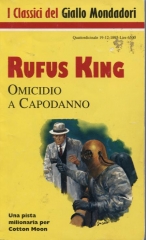
Rufus King : Holiday Homicide, 1940


Rufus King (1893-1966) was a novelist very active since the late '20s to late '50s early '60s, and very famous and  all in all retired life: in life, nothing much was known about him, besides the fact that he lived in rural upstate New York, who was single, and had every yearproblems caused by snow”, so much so that he bought a house in Miami ( the rest just he set there some of Miami his stories).
 Another thing we know it’s that he had studied at Yale. It is curious that in those years at Yale were studying both “King of Mystery”: Rufus and Charles Daly, and that they both graduated in 1916. It’s possible that they did not know? Both King, both followers of Van Dine (but Reginald De Puyster of Rufus King made
​​his debut in 1926 as Philo Vance, the two are very similar. Normally it is said that Rufus King has copied Van Dine, but .. is it really so?). Rufus King in 1916 he enlisted for the Great War and when after war he turned home, he worked for some time as a radio operator on ships
Today is very little known and his novels are rarely published, but the time was well known: it was a fine exponent of that school of American writers (as JDCarr, Mignon Eberhart) who refused to give up the English Mystery, rather in favor of the Hard-Boiled, born in American environment. Mike Grost believed to have heavily influenced the first novel of two cousins
​​Dannay & Lee, who became known for signing a brand internationally recognized and appreciated: Ellery Queen: “Rufus King’s first Lt. Valcour novel, Murder by the Clock,had a simple plot idea involving men’s hats…It is possible that EQ used King’s work as a jumping off point and subsequent works. One wonders if the name “Rufus King” affected EQ’s choice of the pseudonym Ellery Queen”.
 In other words, according to him, Ellery QUEEN would be influenced by the success achieved by Rufus KING’s Murder by the Clock. The report QUEEN-KING could mean more than that a subsidiary, the recognition of the fact that King, by the time they released debut of the Queen, was more important to them or two cousins considered him so. 
It ‘s good to say, however, that Rufus King achieved considerable success over time for reasons other than for being a follower, a little unusual of Van Dine. Rufus King in fact, having for the time worked as a radio operator of ships, brought that maritime environment in many of his novels: Murder by Latitude (1930), The Lesser-Antiller Case (1934), Murder on The Yacht (1931), are all novels that are built so. And it’s to mention the fact that some time before he began his career as a novelist, Rufus King had written the original story of The Silent Command , a film from 1923 directed by J.Gordon Edwards and starring Bela Lugosi: the final scene took place on a ship during a storm
The reason, however, is also psychological-descriptive: Rufus King was very keen to describe the characters and moods, and to concentrate the action in a closed space (the ship so to speak are the extensions of a Locked Room), and this gave him the opportunity to emphasize the drama and anguish of changing situations and characters, before the stillness of the sea, with a very effective contrast effect.
Also in Holiday Homicide, the story takes place on the sea.
The novel is required for entry of a new protagonist, Cotton Moon, a wealthy investigator who spends all his money in search of rare nuts, and his assistant-secretary Bert Stanley and is followed by an expert chef, Walter: it is clear that in this case, Rufus King has created a character referring to Nero Wolfe, his secretary-assistant Archie Goodwin, and the Swiss chef Fritz Brenner. It follows that this is one of those novels in which Rufus King began to denounce the influence of other mystery writers: in essence begins to lose its originality. However, the King's writing is great.
In this case, Rufus King plays down the action humor found: Cotton Moon comes here did begin, in an almost comical manner: a nut of Sapucaia, set by a man a board of  Aliseo, a luxury yacht anchored near the yacht of Cotton Moon, hits him on his forehead: Bruce Jettwick, wants to get his attention, because there was a murder on board and he is afraid of being accused. To be killed is the uncle of Bruce, the wealthy building contractor Myron Jettwick. On board the yacht, there is also
 the mother of Bruce, Helen Jettwick former wife of Myron (Bruce is the son of Helen's first marriage); Myron's sister, Emma; McRoss Jepson, secretary of Myron, a business woman, Harriet Schuyler together with his daughter Elisabeth. So it's a strange and varied wildlife of characters, all ambiguous and reticent .. interested.
From the cabin where he was found dead Myron, disappeared a metal box with compromising documents. Where ever may have been "placed", if it is not?
Here, then, that to Cotton Moon is the idea of
​​using a diver. Note carefully: a diver. This Rufus King, in spite of the influence of affected mystery writers "more square" as Stout, may have been a good model for other novelists: for example, Jonathan Latimer.
And the point of union with Latimer may be just a diver. At this point should be introduced which would be affected by Latimer: the novel in question is Headed for a Hearse, 1935.
Fie, there must be an error: why King had influenced by a Latimer’s novel in 1935, when his was in 1940? The fact is Rufus King had published The Lesser Antilles-Case, one year before the novel Latimer, in 1934. In all three novels, the previous and the next King to Latimer that arises between the two, in time, we find ... a diver. In fact, is this singular figure that is in charge of finding incriminating evidence under the sea. However next to the diver, we find other elements that allow us to say that King could have influenced Latimer: for example, the opening scene of the novel by Latimer (the man who is waiting in the cell death his last hours) is very similar to a story by Rufus King (The Weapon That Did not Exist ,1926), in which an Ireland girl awaits his fate in prison in New York.
Returning to Holiday Homicide, H.H. (Also Headed for a Hearse by Latimer is .. HH: curious!), we see essentially just nuts of Sapucaia are used to build the evidence of the guilt of Bruce. Followed by two more deaths, the last of which will it’s that of secretary of Myron, Jepson McRoss, appropriately out of the way through a razor sharp, because It thought that he had committed suicide for remorse of killing. The real murderer, will be the least suspected, only this time, and this is the real weak point of the novel:  the guilty will not be identified on the basis of precise indications, but according to the intuition of the protagonist without the reader will have no had, during the course of the story, the slightest consciousness of it.
Beyond this .. it is a great novel, with a decent plot, English humor, and, despite being essentially a pastiche of Rex Stout’s novels , is very well written, with great descriptions, and an engaging storyline.

Pietro De Palma

P.S.

In these days, in Italy, it's now available again the extraordinary Rufus King's novel, Muder by Latitude.

Saturday, April 28, 2012

John Dickson Carr : The Plague Court Murders, 1934

Not everyone knows that The Plague Court Murders, Carter Dickson’s novel (John Dickson Carr) published in 1934, has a pretty revealing subtitle: “A Chief Inspector Masters-Murders”. It means, that Carr at first, probably, had decided to create a series of novels (including the aforementioned novel would have been the first) not based on the character of  Merrivale but on Chief Inspector of the CID, Masters. Besides the fact that in this first novel, Humphrey Masters should have at first a much greater role than that of Henry Merrivale, it also follows from the structure of the novel: it is much more Masters dropped into the mystery, he is interrogate several witnesses including you find the culprit, Merrivale and the same appears on the scene of the crime after at least a good half of the book.
It would suffice, however, only the characterization of the character Merrivale to understand even the most doubtful that, in this first novel in the series, the figures of Merrivale and Fell, morphologically, are not very much different. Carr, the beginning is not that he had already given a well-defined characterization to his character. In contrast to Masters, which is presented to the reader on two separate occasions: the first is when it is presented as a hunter of fake mediums and false occult scholars saying that during the period of spiritualistic mania that had invaded England after the end of the war, he was a sergeant whose main task was to unmask the false medium, and that his interest in these practices had never died out, so that he "had actually turned into a hobby, by constructing sophisticated tricks and sleight of hand, in the workshop of his house, "surrounded warm approval of the children"; and the second is when it becomes a physical characterization of Masters: tall and stout, expression inscrutable, wrapped in his dark overcoat and a bowler hat to his chest as if he beheld “the passage of a procession”. To emphasize the fact that at the beginning Carr (but not to inflate more his name, he adopted with all the Merrivale novels in the series, the pseudonym Carter Dickson) had not fully characterized the figure of Merrivale, you can see how the Old as it is also called, was presented as a man of law, but also a doctor, and especially in the early novels such as Head of the Military Intelligence Service (also known as MI6), although, when it is presented for the first time, is said to be was previously head of the Military Counterintelligence (also known as MI5). Being at the head of "Intelligence" Military, could explain the title of nobility that we often see prefixed to his name: Sir, though in his case the noble title is not acquired as a function of its operational excellence rather than by descent.
Conan Doyle's influence on Carr is detectable, in many cases: in the case of the duality Bencolin investigation, represented by Holmes and Watson, is masked and not clearly visible and if anything it is only understandable in the pair Bencolin and Jeff Marle, in two other major series, those of Dr. Fell and HM, the influence is much more visible, if not canonical. In fact, Dr. Fell is apparently opposite, but in reality it goes, the Inspector Hadley, and if HM in a sense embodies Holmes, Dr. Watson is represented by the unfortunate (which makes tenderness in some way) Master Chief Inspector. That seems to me to identify one of the most characteristic and brilliant of Carr’s writing: the characterization of the characters. Since it is an indisputable fact, that the pair of investigators, but in general the pair of players, attract most of the individual (Stan Laurel & Oliver Hardy, Fred Astaire & Ginger Rogers; Starsky & Hutch, etc..), Carr invented the characters , we can say that he has often used them.  Although it’s undeniable that the shoulder reinforcements support and finish to put under the spotlight the protagonist, the deus ex machina of the novel, it is also undeniably true that the “shoulder”, when it is broken so as to soften, become very sympathetic to readers, because in some way all of them tend to identify with him. Indeed, in this case, Masters becomes, with his bad luck to run into impossible crimes and locked rooms, a character almost more fun than the same HM looks. The fact is that both appear in The Plague Court Murders and their combination will feature the best of Carter Dickson’s production.
The first of the novels in the series, sees the entrance of HM not at the beginning but when the crime has already consumed: in fact the entrance of HM follows the lines of an entry into the scene with great fanfare of the protagonist, such as during a theater play, after a sort of introduction, here represented by everything that happens before HM appears on the scene to solve the riddle. And H.M. appears for the first time just because Major Featherton think about it, by contacting Ken Blake (who is the narrator), to put the investigation in the hands of that who is, a true expert, in the hands of Henry Merrivale. And by doing so Carr speaks for the first time about Merrivale, and does so, looking at Fell: garrulous, always lazy, lawyer and physician, vain, fat jokes and talk about pressures.
The investigation concerns a supernatural story from surveys, that of a dwelling, a bit far-fetched in London in the '30s (but often Carr knows how to make plausible situations that at the hands of others would laugh chickens), which says hotels a ghost, that of Louis Playge Executioner: it’s Plague Court, originally the seat of a tribunal. This home is owned by Dean Halliday and his family. Halliday has called on stage Ken Blake, his old friend, to preside at a seance, which will evoke the restless spirit of the Executioner, because you find peace, to manage the session will be a student of the occult sciences, Professor Roger Darworth, and Joseph Dennis the medium. In fact, the spirit is one of those wicked and devilishly clever, and could take over the body of a certain person to make him do what he wants: Plague in fact life was not only the executioner for activities, but also to the vocation took pleasure in hurting . So he had become the terror of those who were near; until the plague pecked too him, like all his countrymen. His brother, drove him from home, and the executioner, before dying, threw a curse on that house.
On the site of the seance there is also the Chief Inspector Humphrey Masters, whose presence is explained by the unusual fact that Darworth suspected of being a fraud, a fake scholar of the occult. The night of the séance, Darworth closes himself in Plague Court, while the séance proceeds, and there he is killed.
The fact is that crime is a classic Locked Room: in fact the door is closed and locked from the inside and the windows also, to complicate the story is the fact that Darworth was stabbed with the dagger that had been used originally by Executioner, and around the little stone house is an expanse of mud, where there aren’t footprints: it would therefore appear that the supernatural is the only possible track. In fact there would be a centenary tree, with its branches reaches the roof of the house, but its wood is so addled, that would not hold the weight of any person who climbed up there, as evidenced by good police Sergeant Bert McDonnell.
The protagonists of this drama, that is, Lady Benning, Marion Latimer, his brother Ted Latimer, and Major Featherton, astonished and frightened to attend events, the more that comes a cat found with his throat cut and a large stone vase is launched overhand: these facts show that all the spirits in place does not grant to any discounts of any kind.
At this point, and here ends the introduction to drama, enters H.M. It is a dramatic entrance. H.M. is presented as a bald, fat, smoking bad cigars (which Carr model runs is Winston Churchill), who prefers to wear hats of any kind, that is not taller than five feet seven, and always wears white socks, and who knows an industrial quantity of dirty jokes. From this point, Merrivale will remain  until the end. But not before he had probed the past Darworth, because that's where you hide the origin of the drama, and that a second crime, even more terrible than the first, upset everyone will be killed Joseph, medium, Darworth mate. Not just killed, but also full of petrol and thrown into the boiler of a house. The explanation of Merrivale, a real masterpiece, will leave everyone with his mouth open.
Actually, as any first novel, this one is structured almost like the first and only, or that the same Carr hadn’t clear ideas on the continuation of the series: in fact, not only the fact that, after almost 150 pages , Merrivale appears in the novel, is a test of a different construction gained during the course of the novel, but especially that mysterious expression which appears after Merrivale’s apparition and about it you can not find any next justification. Why Carr feels the need to say that you are violating the rules of the detective story? And why right after he says that the person who premeditated the murder, she conceived just as a detective story?
In my opinion, is the affirmation of who (precisely Carr), not knowing yet whether the smile on the success or otherwise after the publication of this novel, claiming for himself the authorship of to have created a perfect novel, maybe the solution to most brilliant moment he had thought: who could premeditate a crime, conceiving it as if you were writing a detective novel, if not a writer of detective novels, and particularly one who wrote the novel in which we find these reflections? Only a writer who sets up the plot, and  invent an ingenious crime that works on paper and of which he, speaking by the mouth of Henry Merrivale, can reveal the explanation, could premeditate the crime, and he should conceive it in a frame mystery novel.
In short, John Dickson Carr could do it, only!
Because, despite the explanation leaves at open mouth, this is one of the many crimes whose explanation can be accepted only in the pages of the greatest inventor of locked rooms, in a literary context and invention, taken to the maximum expression.


Pietro De Palma

Tuesday, April 17, 2012


Philip MacDonald : Murder Gone Mad, 1931.


When you speak about great writers of detective novels, generally you speak about the great triad - Carr, Christie, Queen - forgetting many other names, sibling, if not quantitatively, at least qualitatively. Among these others, there are what I call the "innovators", the writers who have innovated the genre, not at the variation of plot, but at the invention of a different narrative structure. Among the innovators, securely I must remember Philip MacDonald, english writer..

He was definitely one of the most important writers of the twentieth century detective: I would say that of his production many are masterpieces, worthy to be authoritative in any ranking of the best novels of all time: The Rasp, The Noose, The Link, Rynox, The Choice, Murder Gone Mad, The Maze, The List of Adrian Messenger , X v. Rex (aka: Martin Porlock). Why? Because he has got ever originality and almost every time he writes a novel, makes some surprising stylistic changes to the whodunnit: writing a novel about the serial killings, Murder Gone Mad, he met a huge success and it was repeated with another on a more series of crimes committed by a killer, X v. Rex; he subverted the rules of the English whodunnit in The Maze; I didn’t introduce the murderer in the Warrant for X; in Rynox, he began with the epilogue; still in seventies, Barzun and Taylor described  The Rasp, a "epochmaking": in it was all: the murder of a head of state, clues, extraordinary ambience and atmosphere and a variety of psychological thrill.

Our novel is of 1931. John Dickson Carr, who at first was called The Rasp, the debut novel of the Colonel Anthony Gethryn, “one of the ten greatest detective novels”, he later replaced it with The Murder Gone Mad, to enshrine the importance that " The Murder Gone Mad " has and that was already recognized eighty years ago.

The novel is a precursor, one of the first to talk about serial killings, in a time when The ABC  Murders of Agatha Christie was yet to come: a novel counter, whose mere mention would be enough to erase all an annoying literary criticism, which tends to frame the Mystery as a genre dead and buried, unable to generate tension, and prepending to it a paraliterature; forgetting that the serial murder genre was born with Steeman and MacDonald. But if Steeman, with "The démon de Sainte-Croix" opens the strand talking about a series of crimes apparently disconnected and then that prove joined by a particular truly surprising, and if Christie christen the murder multiple that must conceal in the series apparently disconnected interest to a single murder (as if concealing something from other things like that and putting everything under the sun becomes it unknowable), Philip MacDonald provides to exaggerate the genre. In fact, for the first time ever, we see a litany of murderers, quite disconnected from each other, can be associated only in the unknowable depths of a sick mind who likes to kill for the sake of it, keeping police at bay .


So slowly, then more quickly we witness the horrible business of "The Butcher", the psychopathic murderer that, in the charming town of Holmdale, a few miles from London, sowing chaos is the discovery of the bodies, all killed with a bloody same technique (using a sharp knife blows, usually to the stomach), to dictate the pace, and especially through authorship of the letters to the police, the pathos and tension. Thus, where in many other examples of contemporary thriller, the tension is crystallized in literary devices, for example in the construction of floors and temporal narrative that often run in parallel and then intersect (for example the Lee & Child’s novels starring Aloysious Pendergast), here the tension is a characteristic of wisdom literature that articulates the writer with a relentless procession of the deads, before with frustrating attempts , then more more specific and more selective for identification of the murderer, with the growing dissatisfaction of the public, represented by newspapers, politicians, and less and less popular demonstrations peaceful, and the sardonic safety sported by the murderer in  mock and ridicule of established even in charge of the investigation, Arnold Pike, superintendent of Scotland Yard, which, like a bloodhound, regardless of the tricks of the murderer and reproaches of his superiors, leads his investigation made by attempts, each one different, but always more effective to end once and for all the carnage. So to mark the time of novel are more extensive tables that contain the likely suspects. As a corollary, a series of unlikely assassins arrested: the boeotian, the director, the famous doctor.

Without doubt the most curious and interesting history, is that a procedural analysis of the survey, lack any evidence that in an usual survey that was based on abduction of Sherlock Holmes, should abound: instead they roam here. In the painful deaths (Lionel Colby, promising young man, from  middle class family; Pamela Richards, rich bourgeoisie; Amy Adams, bartender, working class; Albert Rogers, skilled worker, about to become a soccer player; Marjorie Williams, nurse), relentless and ferocious in its impartiality, as if death is common to all, a "leveling" relentless, you do not see nothing but the absence of any motive: unknown to each other, elements taken at random, whose unique common reasons are the horrible gash in the belly and enjoy the chilling of the murderer about the death of one and about the pain of those who loved this victim. The killer comes even to send a letter to the police, promising that he will hit on December 7, this time enjoy pain just of Pike who finds the mother of a girl with which he enjoyed playing with the train, Molly Brade, curled up next to a wall and behind the chair where he sleeps unaware her daughter Millicent.

She will be the last to fall.

After Pike will ariive briskly, with a series of insights on how to proceed, that have nothing to do with normal investigative inquiries, as here, there is no evidence that helps to discover the killer. He is discovered because Pike is increasingly resorting to the help of improvised means of investigation: reflectors located in the town, they will turn on randomly illuminating different parts of the city; lights that are lit in the post office where the yellow envelopes with the offending oblique black handwriting, are wrapped and then fall directly on the table in front of employees and policemans; cameras, as cameras are today, they control the various streets of the city .. But Arnold Pike, with an idea as old as the world, he will manage to reveal the true identity of the murderer: creating a false butcher eager to take the fame of the real and the true is induced  not to resist the temptation to see who has the will to emulate
himself

And so from an entire city sifted, he will lead to narrow the grid of the suspects in only 4 suspects, one of which necessarily will be "The Butcher". But the truth will surprise all. Because once the killer will be again the least suspected, and the weapon .. the least suspected.

A novel in conclusion, of a disarmingly modernity, that in the absence of any indication enlightening and rambling in the theory of serial murder victims, clearly does justice to the title Murder Gone Mad.

A masterpeace.

Pietro De Palma