Friday, March 25, 2022

Alan Green : What a Body !, 1949


 For those like me who have diet problems, gyms and a health regimen have always been a bugbear: one would like to have a physique right from birth that a few more pizzas do not necessarily mean heavier weight, an efficient and accelerated metabolism so as to dispose of excess fat, but then invariably falls back into the call of the throat. A novel, therefore, in which we speak of an island in which a health and diet regime is practiced and in which the founder of this oasis is killed, well he could not go unnoticed. Especially since it is a closed chamber!

The author? Alan Green. Born in 1906 and died in 1975, he was an American writer. He wrote only seven novels and one short story with which he began a short but significant career: Beauty on the Beat, 1932, novella; Death on the Limited, 1933 (pseudonym Roger Denbie); Murder to Music, 1934 (pseudonym Glen Burn); How To Do Practically Anything, 1943 (pseudonym Alan Jack); What a Body !, 1949; They Died Laughling, 1952; Mother of Her Country, 1954. Just with What a Body! he won the Edgar for Best First Novel in 1950.

Roland Lacourbe entered What a Body! in his list of 99 Chambers.

WARNING: SPOILERS !!!

The novel takes place on an island where the guru of diets and exercise to the bitter end, Merlin Broadstone has placed his headquarters in a village with hotel, swimming pool, theater and solarium, and where whiskey and smoking are banned and where all those who want to get rid of extra pounds come from all over the States. Merlin lives there with his family, which he dominates with his undisputed personality and with his money; and since not everyone lives happy, but everyone would like a different life from the one that leads there, it ends up that reasons why Merlin would like him dead, so as to ensure unexpected liquidity for his relatives, there are galore. All the more so now that Merlin would even like to open a clinic, and use all the money he has.

In short, in short, on such a day, Merlini, instead of going down for breakfast at seven, does not show up. So his relatives are alarmed, the bedroom is closed from the inside and no response from Merlin to his cries. When he manages to open the door with a passe-partout, he is found dead with a wound in the back: the bullet has reached his heart. Being a colossus, it is clear that for having reached the heart passing from the lower back, whoever shot him did so from below.

Lieutenant John Hugo, a policeman with certainly not brilliant skills, is sent to the scene, especially since he seems a bit the anti-detective par excellence: as soon as he arrives, without even going through the various depositions, he goes to get a crush for one of the major suspects, Sandra Lockhart daughter of Martha (sister of Merlin) and therefore nephew of Merlin, and makes her his assistant in a certain sense, thus betraying every elementary caution. Moreover, he is very clumsy in the investigation.

Of course, it must be said that the investigation is not easy: in fact, besides Sandra, there are all the other heirs to be screened and all, more or less, had reasons to kill Merlin, who was certainly not much loved; in addition there would be the indirect heirs: Arthur Hutch husband of Hester Hutch, sister of Merlin; Nancy, the maid Carl promised to marry (after making her his mistress); Daniel Joyce, Merlin's lawyer, who, in addition to having a grudge against Merlin for a bad deal, should be his will executor and in that case pocket a nice fee; and finally Ned Dumbrow, a Republican senator who is courting Joanna, who, like Joyce, has also been swindled for a real estate speculation gone wrong, indirectly inspired by Merlin. In short, there are plenty of possible killers.

The story is moreover confused due to the same dynamics of the murder: having been hit from the bottom up, it would be assumed that the murderer had hit Merlin while at least crouching if not on his knees or lying down. However, there are two facts to disturb the dynamics even more: first, the room was found locked from the inside (there was the key in the lock which made it impossible to open even with a passe-partout without first dropping the key from the inside. of the room); second, the victim, after being killed, was dressed in pajamas: in fact, it does not have holes in its back. But why did the killer go to the trouble of dressing the body? Meanwhile, other things occurred before the arrival of the clumsy lieutenant and among these there is someone who says he saw a flash coming from the pool at 6.40 am.  

So there is no Locked Room? No, that remains, because no one explains how at the time of the discovery the corpse presented a pajama without the bullet entry hole, a .38 caliber. So it is evident that after the shot, the murderer or an accomplice entered the chamber of Merlin to dress the corpse of the pajamas, then leaving the room closed from the inside

The depositions of the various suspects moreover, instead of clearing the clouds, do nothing but thicken them and moreover, having found the cartridge case, the policeman puts it in his pocket and loses it. Despite everything, the super clumsy policeman will be able to solve the matter. 

THE END OF THE SPOILERS

I will say the novel right away, it seemed to me a parody, a triumph of parodies, a very successful attempt, moreover, to desecrate a genre and in particular that of the 1930s detective: there he was highly cultivated, expert in numerous scientific branches, fine esthete and collector of the most precious artifacts possible, he was able to probe the human soul through very elaborate processes of psychology (Philo Vance, the first Ellery Queen, Rufus King's De Puyster, Daly King's Lieutenant Lord etc), here instead we find the 'antidetective: very clumsy, wrong all possible hypotheses; instead of keeping the suspects at a distance as Archibald Hurst would do at least, he flirts with one of the most suspicious suspects, informs her of his investigations (but where is the official secret?), even finds evidence with her (the cartridge case they find it together in the pool).

However, Green's desecration embraces several fronts.

It has never been seen before in this novel that the detective, instead of examining the characters and the evidence, starts exercising, having in his pocket, in his trouser pocket, the cartridge case, whom he then loses, and is found by another person he accuses of having stolen it from his pocket; a police officer on duty has never been seen not only drinking whiskey but even getting drunk;

it has never been seen that the police officer who is the one who seems to be the deus ex machina, is put on the right track by his lover's uncle, who becomes so to speak the Sherlock Holmes of history while he demotes to Doctor Watson indeed in Lestrade, even worse.

But if the detective is light and inconsistent, the same thing are all the other characters who move in this ballet, in this operetta where the action is not static, characteristic of the mysteries, but is not otherwise dynamic like the hard-boiled ones: it is a middle ground, because everything happens inside the hotel: here there is the action, but it is the action of room doors that open, close, reopen and close. And the beauty is that like any vaudeville comedy, here as a corollary of the dramatic action (i.e. murder), there is a set of lighter actions, inconsistent like the characters who produce them, and which have no direct connection with the 'homicide; if anything, the very fact of not having links with the action under investigation has the purpose of enveloping the main action like a vaporous but insubstantial cloud, diverting attention from what should be the typical lines of an investigation. But when it abounds in details in the explanation of the guidelines of physical beauty and in dietary rigor, it desecrates the healthy vein of beauty at all costs, of the perfect body, of diets. All with an irresistible rhythm, from turn-of-the-century vaudeville, with countless gags bordering on the comic if not the surreal.

John Hugo is a truly unique character: if he can't be an idiot (because then you would have to think that having become a lieutenant, other people higher than him, would have had to be much more than an idiot to promote him to lieutenant!), He is definitely a character walking on the clouds. Moreover, this levity and surreality is not only characteristic of the main detective, but also of the suspects: their stories, their behaviors, which generate continuous misunderstandings, as in the best comedy at the end of the century, are at the basis of certain events and in the same time cancel the effects of others: eg. the letter that the republican senator writes for Joanna is at the basis of an irresistible subplot, which has nothing to do with the culprit, even if he too has a part in it: the letter that relates to a series of characters, which lead to a situation of generalized chaos.

I would also like to recall a parallelism present in the novel: just as a light character is Lieutenant Hugo, so a light and naive character is the revived illegitimate son Lovechild Jones, who lived for twenty years on his grandfather's farm, huge, muscular and with the sensitivity and purity of a child, who knows animals very well but women for nothing, who appears dressed in a Roman toga and with coturni on his feet (if he were a demigod).  

The surreal plot of this novel and all its variations must also make us consider the fact that if all these narrative segments had been inserted in a comedy, they would not have aroused any surprise, while they generate dismay and amazement if inserted in an enigma detective novel. which should have a certain distinct bearing at least and not grotesque.

Despite this surreal but really funny perspective, the enigma is really interesting, and although the solution of the Locked Room is trivial, how Merlin is killed and how you can explain the pajamas with no trace of a shot, it is brilliant, and brilliant is also the explanation of the real place where the shot was fired, which would refer us to Carrian solutions based on optical physics, if Commings himself had not exactly exemplified the principle on which the solution of this novel is based in one of his stories, explaining in turn thus an impossible disappearance. Surprisingly, the two works, Commings' short story and Green's novel, which resolve bis-location in the same way, were published in the same year, 1949.

Pietro De Palma

Wednesday, March 23, 2022

Quentin Patrick : Murder at the Women 's City Club, 1932


Patrick Quentin was a literary case rather than a pseudonym. In fact, under it there was a main author, who remained the same until the 1950s, and a series of other less fixed authors, who alternated, until arriving at another who then formed a pairing with the first.

As we have said elsewhere, Patrick Quentin or Quentin Patrick was not only a pseudonym, but also a company, formed from time to time by the union of 4 couples of writers, who signed differently: the most prolific one was formed by Richard Wilson Webb (1901 - 1966) and Hugh Callingham Wheeler (1912 - 1987), who signed together some novels with the initials Quentin Patrick, almost all with Patrick Quentin, and all with Jonathan Stagge: in practice, the beginning of this very successful collaboration dates back to 1936, when Webb, who, signing himself Quentin Patrick, had written some novels with both Martha Mott Kelley (1906–2005) and Mary Louise White Aswell (1902 - 1984), found Wheeler, an old friend of his. It must be said that both Webb and Wheeler were British by birth, but then, later, emigrating both to the United States, they became citizens.

The very first novels were written under the pseudonym Quentin Patrick. The authors who signed the first two Cottage Sinister of 1931 and Murder at the Women 's City Club of 1932 were Richard Wilson Webb and Martha Mott Kelley. Of the two 1933 novels, one was written by Richard Wilson Webb and Mary Louise White Aswell , S.S. Murder, while the other, Murder at Cambridge, by Webb alone.

Quentin Patrick's series consists of 12 titles:


1931 Cottage Sinister,

1932 Murder at the Women 's City Club

1933 Murder at Cambridge

1933 S.S. Murder

1935 The Grindle Nightmare

1936 Death Goes to School

1937 Death for Dear Clara

1937 The File on Fenton and Farr

1938 The File on Claudia Cragge

1939 Death and the Maiden

1941 Return to the Scene

1952 Danger Next Door

Among these 12 titles, The File on Claudia Cragge, like the previous The File on Fenton and Farr, is not a real novel, but rather a dossier complete with material evidence, photographs, testimonies and finds, which should have brought the reader to formulate an accusatory hypothesis.

According to novels signed as Quentin Patrick, Murder at the Women 's City Club is from 1932.

In essence, the action takes place at the Desborough Women's Club.

 WARNING : SPOILERS !!!!

The Women's Club is a boarding house where males are not allowed, except Rudy the black handyman married to Cornelia, the black maid.

Males are not welcome as all or almost all of the pensioners have had a more or less disappointing past, either because of them or the other sex, with the male sex. The Club is chaired by Mabel Mulvaney, a rather wealthy woman. Mulvaney is hostile to another boarder, Diana Saffron, Doctor and Professor of Medicine at the University, well known and appreciated in the world for her honesty and inflexibility, an incorruptible and just woman, but now forced to bed due to a very rheumatoid arthritis. advanced, and for serious heart problems.

Diana Saffron is very attached to Doctor Freda Carter, a beautiful young girl whom she, with her help, her advice, and her small income, managed to graduate and is now well regarded for her activity in the hospital. citizen. However, she is contrite with her, because, contrary to her expectations, Freda has joined in an engagement with Sebastian Thurlow, a young scion, used to the good life, but with little ambition.

Sebastian was introduced to Freda by Deborah Entwistle, the third power of the pensioner: a close friend of Thurow, in the past Deborah had participated in plays and there she met Sebastian. In her room, which is a sort of neutral territory, the other boarders meet to talk, discuss and make peace: Miss Hoplinger, mystery writer, known under the pseudonym of Gerald Strong; Miss Millicent Trimmer, secretary of the Club, a very rich woman in her youth but then unexpectedly found herself in a bad way after her father's bankruptcy and consequent suicide; Amy Riddle, social worker.

The seven women live in rooms located on the various floors of the Club: the rooms have no bathroom, and therefore the boarders use a common one on the floor; the one on the second floor, however, is broken, under renovation and locked, and therefore the boarders often use the one on the third floor.

The locked and uninhabitable bathroom is the one marked by an X in the sketch subsequently prepared by the Inspector of Police Boot. Yes, because, on a given morning, the lifeless corpse of Doctor Saffron is discovered in her gas-saturated chamber. It is Dr. Freda Carter, his protégé, who had had an altercation with her protector the night before regarding her relationship with Thurow, who discovered the lifeless body, turned off the gas tap, opened the windows and broke the glass by throwing it. something against, so as to disperse the gas.

Since Dr. Saffron was unable to walk on her own due to the very advanced stage of arthritis, and even if she did, it would have caused a series of noises that no one had heard the night before or during the night, it follows that it must be it was someone else who turned on the gas tap and closed the windows, since when Dr. Carter went, the fireplace was out and the windows were open. It is therefore a question of murder. The police are then called, and in charge of the investigation, the least indicated person of all is called, the misogynist Inspector Boot. Which immediately finds a hostile and conspiratorial environment.

The number one suspect would be Dr. Carter, but coincidentally it was she, together with Dr. Sibley, the coroner, who formulated the hypothesis that she was murdered: for what reason would she have to reveal that the fireplace was out and windows open if she was the killer? It would be enough to say that the windows were closed and the fireplace lit: due to a fatality it would have gone out and therefore… the accident.

Ms. Mulvaney is not present at the time of the discovery of the body, because shortly before she left for the city for matters related to the Club; Miss Trimmer has been absent for a few days; Mr. Thurow was not there (will come later). So essentially the suspects at the moment are Riddle, Hoplinger, Carter and Entwistle.

The inspector begins to question them but does not dig a spider out of the hole. Furthermore, all boarders have a habit of locking themselves up from the inside, and therefore either it was a strange suicide (the crutches are abandoned in a corner of the room with a thin layer of dust on them) or it was a murder and the Doctor trusted her killer. He had no other good relations, however, except with Miss Entwistle.

The night before the tragedy, before Dr. Carter arrived, the victim and Mrs. Mulvaney should have talked about something important: this is because the relationship between the two women (La saffron was the treasurer of the Club, Mulvaney the president ) were almost non-existent, and therefore a face-to-face meeting in the room of one of the two assumed that there was something extremely important to talk about.

Mulvaney then went to consult an agency that was in charge of reporting the Club's accounts, and it will be known why an important shortfall was found. The newly arrived Mrs. Mulvaney expresses the desire to talk about it, exercise book in hand, to Inspector Boot as soon as possible, but in the night, despite a policeman guarding the entrance, footsteps can be heard on the stairs.

Miss Entwistle, who has premonitions from time to time, connects those footsteps in the middle of the night (but they could also be of people going to the bathroom, although everyone denies they went) to "something that is about to happen", of which she is afraid of. Rudy himself hears them, goes to check, says he saw a figure cloaked in white in front of Mrs Mulvaney's door on the fourth floor (he came down from the attic where he and his wife have the service room), who will talk about it as much as first to the inspector. The fact is that the next morning, Mrs Mulvaney was found dead asphyxiated by gas in her room, after being stunned with a blunt object. A second assassination. Inspector Boot sees more and more red, especially since he does not like that environment of pedantic women: already one of the novels by Gerard Strong alias Constance Hoplinger, entitled "The Black Serpent", has curious resemblances to the crime of Safron and then of Mulvaney; but then he suspects that the young lady

Entwistle is hiding something from him, as he suspects that he caused the elevator that was taking them up to stop, allowing someone to sneak into the Saffron's room.

The inspector quizzes everyone present, and in the course of the meeting, the two servants are accused by Miss Riddle: Cornelia of theft and Rudy of murder, for trying to cover up his wife's crime. While Deborah engages in a passionate defense of the waitress, the inspector would like to speak to Rudy, because the accusatory hypothesis is better than his. But then, he has to turn around when Rudy is found stabbed to death in the elevator.

In the evening Miss Entwistle reveals her hypothesis to the inspector: that is, that Saffron committed suicide and a murderer killed Mulvaney in the same way, trying to make the two deaths appear connected to the same murderer. This of course is related to alibis. But the inspector doesn't believe her.

The next morning he will repeat the same theory in front of everyone, including Thurow and the inspector, and point to the killer of Mulvaney and Rudy as well.

 THE END OF SPOILERS

This second novel did not report the success of the first, and essentially brought about the end of the literary relationship between Richard Wilson Webb and Martha Mott Kelley. For what reason

First of all, the novel lacks a temporal dimension linked to the murders: it is known that they happen at night, or in the morning, but not knowing when events take place, on what day of the week, at what time of year, even in what year, undoubtedly creates a certain disorientation.


And then the reader is silenced some clues: the key that Miss Entwistle appropriates is not known what it is, except that it would be at the basis of the solution of the mystery; the fact that the keys to the rooms had duplicates is kept silent: how would the killer have made his way into the Mulvaney room which was locked from the inside, if not having an identical key and operating and trafficking from the outside? And the way to enter the room itself has something dangerous in itself: the killer could have opened the door from the outside by introducing the key and dropping the key from the inside onto the thick carpet, but only if the key, after having closed it , had been left undirected; if instead it had been turned, the killer would have had to, in extremely fast times, first turn the key with tweezers, making himself light (and lights were not seen but only footsteps heard) and then push it, running enormous risks.

There is only one clue that is left there to turn, launched at the beginning of the novel, which has no relationship with the murder, but with Saffron's private life, which will determine the final blow: that I had framed properly , and I expected the bomb to be dropped sooner or later.

There is also a pretty obvious red herring: from the floor plan you can see the bathroom indicated by an X, and Deborah steals a key. Why not think that the killer hid inside and then came out at the right time?

So in essence the novel is not bad at all: it is a more classic mystery than ever, with a rather centered solution, and the framing of the murderer works on the basis that by acting in such a way that the two deaths in the rooms were produced by a same hand, for one of the two he had an iron alibi and as such for both; and the attribution of suicide to the first death is explained on the basis of the map (the shut-off cock, is the gas stop knob that is near the bed).

However, the most interesting features of the novel are: Inspector Boot's misogynist vein who finds himself facing various women and above all one who not only deeply dislikes him, but who also has the solution he lacks; the constant bickering between him and the women; the fact that the police inspector is a clumsy and conceited colossal, who works together with a journalist, Dunn, who supports him from the outside. But above all Quentin Patrick's stylistic criticisms of Van Dine.

Here, it is precisely the way of dealing with Miss Entwistle's situation, which allows her to solve the problem: she who comes to the head of the situation on the basis of the psychological framework of the murderer (later explained by himself) and on the circumstances for which , only he, would have had the greatest possible advantage if the second death had been superimposed on the first, he is the detective; while Inspector Boot, who does not move forward because he is based on clues that he cannot find and thinks that they have been stolen from him, is the defeated element.Moreover Quentin, on purpose, when introducing a passage from Hoplinger's hypothetical novel, "The Black Snake", in which the effeminate detective is a living encyclopedia, loves purple shirts and smokes Sudanese cigarettes, elaborates accusatory theories only by feeding on mussels and grapefruit juice, he lectures on the sapphic odes and on Picasso's symbolism, and has a friend who is a proxy, evidently he makes a mockery of Philo Vance, making fun of him.

Pietro De Palma

Saturday, March 19, 2022

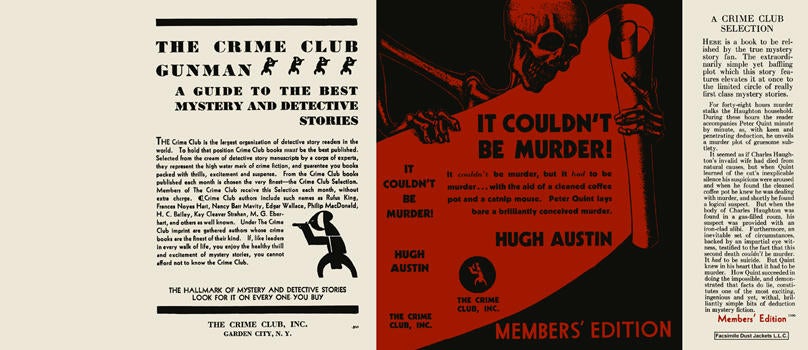
Hugh Austin : It Couldn't Be Murder (1935)


Little or nothing is known about the life of Hugh Austin.

It is known that Hugh Austin Evans was born in 1903 in America and lived until 1964, in New York., And that his wife was called Alice. Nothing else.

He wrote novels with two main protagonists: Peter Quint, Sergeant of the Homicide Squad; and William Sultan.

Of the first, 5 novels were published by the famous Doubleday publishing house

It Couldn't Be Murder (1935)

Murder in Triplicate (1935)

Murder of a Matriarch (1936)

The Upside Down Murders (1937)

The Cock's Tail Murder (1938).

Other his novels, are:

Lilies for Madame, Doubleday 1938.

Drink the Green Water, Scribner 1948 (Wm Sultan )

The Milkmaids Millions, Scribner 1948 (Wm Sultan)

Death Has Seven Faces, Scribner 1949.

The first novel was a great success, and so Austin wrote four more, all with the same protagonist, Homicide Squad Sergeant Peter Quint.

WARNING : SPOILERS !!!

Quint's direct superior wakes him up in the middle of the night, to entrust him with a very delicate investigation: at the home of a famous banker, his wife has died. The nurse called the police to whom the patient was entrusted, because the family members accuse her of the death of their relative due to negligence: in essence, they accuse her of having fallen asleep and therefore not having been able to cope with the heart attack of the banker's wife.

Peter Quint arrives at the Haughton house at 2.25am. And he finds Elizabeth Haughton dead. But he understands from Nurse Mary O'Toole's story that something is wrong; and she was the first to notice. Her sleep, which has normally always been light, that night, the very night her client died, was strangely heavy. In short, to put it short, her coffee was drugged. How did the killer drug her coffee? He did it while the victim sent for the nurse to chase the cat that had snuck into her room, and that was causing her asthma attacks which in her state of severe heart disease could be fatal. Evidently the use of the cat by the murderer is a fundamental fact, and the use of the device through which the killer managed to trap the cat at night, preventing it from meowing, will also be fundamental. After the nurse fell asleep, the killer killed the victim by chloroforming her, and leaving the window open so that the fumes evaporated and dispersed: chloroform had been used long ago to painlessly kill the cat's newborn kittens. , and then placed in the cellar.

Now the very object used to keep the cat good, preventing it from disturbing others with its insistent nocturnal meows, is found in the possession of one of the victim's family members. But soon, Quint, if he had initially framed him as the most likely suspect, must change his mind on the occasion of a second murder, which happens on the same night but which is discovered the next morning: the head of the family Charles P. Haughton is found dead, for gas poisoning, in his room locked from the inside. At first it is thought of an illness, due to careless leakage of gas; then even to a suicide, as Edgar, the Haughton's elder brother, claims that his brother killed his second wife and killed himself. For what reason? To be able to devote himself to her sister-in-law, Cora Lanthrop, Elizabeth's sister, also present in that house. Her son Vincent is in love with and loved by Charles' daughter Catherine; while Ted, Catherine's brother is kind and gallant with Mary O'Toole, the nurse. Everyone lives on the first floor of the villa, while on the second floor the servants live, including Wimitt (a butler who has a disposition to tell lies and "cover up other people") and Marge Wilson (a maid who has in her closet, clothes and shoes great luxury and refinement, unusual in his case). Based on the fact that the nurse, from her point of view, could see any people passing in the adjacent corridor, two of the most prominent suspects up to that moment were removed from the list of suspects for the second murder. Of course Quint must now find out who could have killed Charles Haughton, who did not really want to kill himself, as evidenced by some papers found on his bedside table, and from an open window below: if he really wanted to kill himself, he would have hermetically sealed all of them. Windows.

After the second murder, a third will take place: it will be the reticent butler, Wimitt, to be killed this time.

Quint, after having discovered hatred and grudges in that house of snake relatives, and also secret and undisclosed loves, and after having discovered the blackmailing manias of the maid, will succeed in a long ending, to guess who could be the murderer and kill him while he is attempting to kill for the fourth time.

END OF SPOILERS


Austin was certainly a narrator influenced by the Van Dine phenomenon and his followers, at least for this first novel of his (but unbalancing myself, I would say also for the following ones: Murder of a Matriarch, reminds me of the very clear reference to the first murder. in the Greene house). Many factors testify to this, although there is no super cultured protagonist, as instead in the very first novels of Ellery Queen, in the stories of Rufus King, and obviously in the novels of Van Dine (Philo Vance): this is because substantially the novel is from 1935, a era in which in the Mystery the protagonist with the features and culture of Philo Vance is already gone:

first of all the titles which, always presenting the word Murder, follow an identical pattern, as for the titles of Van Dine which present the scheme "The + Name + Murder Case", for the first 10 titles of Ellery Queen that "The + Adjective of nationality + name + Mystery ", for the first six cases of Anthony Abbot" About + the + murder + of + name ", for the first three of C. Daly King" Obelists + name ";

the protagonist, as for Abbot and Daly King, is a policeman;

In the crime scenes, the arrival of the police is witnessed by a number of policemen who search the house, who are identified by name and surname and appear in multiple novels and this happens in both Van Dine and Ellery Queen novels (at least the former, those with Sergeant Velie);

when the cops examine the crime scene, to collect clues, they do not forget to use the vacuum cleaners. The vacuum cleaner, which is mentioned at least in The Scarab Murder Case, as a cleaning appliance, is used in the exact same function mentioned in the Austin novel, already before, in another Vandinian novel par excellence, About the Murder of the Night Club Lady by Anthony Abbot's, a 1931 novel;

the fact that the murder takes place in the house of a subject belonging to the city jet set, as already in many of the early novels by Ellery Queen or Van Dine;

the identification of the murderer is similar in the sequences to that in The Siamese Twin Mystery by E. Queen (1933);

the ballistic reasoning of the bullet fired on the occasion of the butler's murder can be found in Van Dine's The Benson Murder Case (1926).

the "Challenge to the Reader", found here, is one of the hallmarks of Ellery Queen's early novels;

always borrowed from the first of van Dine's novels, is the use of chapters, with the time to which they refer.

A characteristic thing of the novel is the locked room: in this regard, I won the bet made between me and myself, that the solution of the locked room, in the end, was what I had imagined, and in fact this happened, already present in British novels. The characterizing element is the gas tap for the radiators. The use of a gas tap in a locked room predates the Austin novel and there are two examples: the first in Ronald Knox's The Three Taps of 1926, and later in Murder at the Women 's City Club by Quentin Patrick, 1932. I can't tell who he was referring to, but it is logical that Knox was much more famous at that time than Quentin Patrick: by 1935, five of Knox's six novels had already been published, unlike Quentin Patrick who was still unknown (which moreover in America had been published by a very small publishing house in Philadelphia, that of Roland Swain, which failed a few years later), even if the description of the solution of the closed chamber with gas in Austin is almost the same as the one used in Quentin Patrick's second novel.

The protagonist of the novel, who solves the intricate story in just forty-eight hours, will repeat himself in the next novel, solving the story in a very short time.

The style is all in all acceptable, even if there is a too recurring use of dialogues often with back and forth that in the long run tire, especially since the novel is weighty and that sometimes the dialogues are centered on minor details: over 291 pages in the Italian edition, 301 in the original of 1935. In any case, I am of the opposite opinion compared to that of Nick Fuller who years ago labeled the novel as illegible, almost not even a "brick" like Etienne Pivenne's Oberman de Senancour: the novel is excellent, very articulate and complex, in the form of a diary: the succession of chapters with the timetable generates a certain tension after all, like The Benson Murder Case,  and clearly it was created by looking at the phenomena Van Dine and Ellery Queen to make tape, but this cannot be made into a drama.


Pietro De Palma