Claude Aveline
"Reader Beware: SPOILERS"
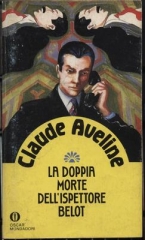
Claude Aveline: La doppia morte dell’Ispettore Belot
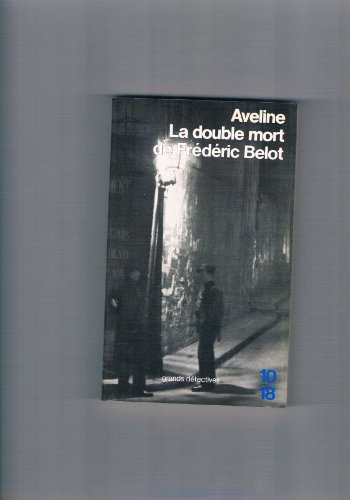
(La Double Mort de Frédéric Belot, 1932)
– Translation: Cesare Giardini – Preface: Alberto Tedeschi – in appendix: Doppia
nota sul romanzo poliziesco in generale e su questa “Suite” in particolare (Double note sur le roman policier en général et sur cette
“Suite”en particulier) – Oscar Mondadori N.
1556 – August 1982
More the time passes, more I find references to a
question that springs to mind every time, and so I can not answer: why in 1932
were born many masterpieces of crime fiction?
Why at that year? I do not know.
In 1932, they went out countless masterpieces: Peril at End House by
Agatha Christie; Poison in Jest, by John Dickson Carr, The Greek
Coffin Mystery, by Ellery Queen; Obelists at Sea, by Charles Daly
King, Murder on the Yacht, by Rufus King, Sudden Death, by
Freeman Wills Crofts, La Maison interdite, by Michel Herbert & Eugen
Wyl, The Devil Drives, by Virgil Markham, The Wailing Rock Murders,
by Clifford Orr, La Maison qui tue, by Noel Windry, etc etc etc.
Among others, the
extraordinary La Double
Mort de Frédéric Belot
by Claude Aveline.
Born in 1901 and died in 1992, Claude Aveline
was a great French intellectual, famous poet and critic, activist and
partisan during the Petain government, a friend of Anatole France and Jean
Vigo, character always on top until the last years of life.
In 1932 he wrote his masterpiece, as part of crime fiction, La Double
Mort de Frédéric Belot, but until then, he had not written anything about
detective fiction. One can therefore say without any fear of being wrong, that
this coincided with his debut genre literature.
Extraordinary novel, it is said, but also a huge success for its time. The
French public went wild for mystery novels, and you can tell a good reason
that, in France, you want to parochialism, either by the tendency of the French
to not recognize less than anyone else, soon many authors still speaking French
or had tried to write stories of mystery, and had proven to be on par if not
better than other Anglo-Saxon writers.
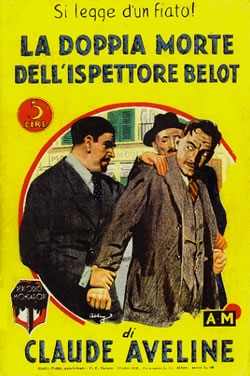
The novel had undergone many editions in France and was translated in a
short time in thirteen different countries, including Italy, where the novel
with a title quite faithful "The Double Death of the Inspector
Belot," was translated by Cesare Giardini and published in “I Libri Gialli
Mondadori”, with the number 77, in 1933.
Why this novel was so successful at home? To various factors.
The first is due to the publisher:
Bernard Grasset, founded in 1907, "Les Nouvelles Editions" and
from that moment, his publishing house was distinguished in the publication of
works by major French writers and intellectuals, including for example
Lourdines des Monsieur Alphonse de Chateaubriand, Filles de la pluie André
Savignon, and also Du côté de chez Swan of Marcel Proust. But he had also
published Diderot, Voltaire, Gide, Valéry. So, in 1932, editions of Bernard
Grasset, who as then, they are still in the Rue des Saints Peres, 61 in Paris,
were the spearhead of the French publishing and presenting works extremely
serious.
The second factor is certainly due to the novelist:
Aveline was a big name in France, already at that time. He published
several works of literary criticism, with its eponymous publishing house, and
had already distinguished friendships, including especially that of Anatole
France, who had become the most faithful follower; and the friendship of Jean
Vigo, the director of "L'Atalante," one of the most important movies
of the last century
In short, the fact that the most important French publisher at the time and
one of the leading French intellectuals of the time, together, they decided to
focus on the launch of a work of detective fiction, had its immediate echo in
the society of the time and contributed to the spread of the novel. Intention
was intentional or unintentional? Aveline makes it clear when, in his "
Double note sur
le roman policier" (as
Mercurie edition at 1963), states that if “The Double Death" had
belonged to a specialized collection, it would have gone unnoticed by critics,
who insist to ignore crime fiction. A famous editor’s name on the cover of
publisher, editor that had nothing to do, too, with this literature, caught
their attention. Reading my preface, forced them all to take sides for or
against .. I've had good allies and opponents rough. But I had reached my
goal”.
You can say, however, Aveline, put much of his own, spending many weeks at
the Prefecture of Paris, to take possession of a world that he gave in a
wonderful way. The success was so resounding that Aveline, who in 1936
published his “The Prisoner”, he thought to write another. Unfortunately
he had to die Belot the first time and even two times and thus introduced the
adventures that had taken place before he could die. In fact, as he had this to
say about his first novel ... “The ennui que c'est mon j'avais Killed
policier du premier coup, et même deux fois, je n'avais pas qu'il aurait prévu
du service à reprendre . Heureusement, je ne fait pas mourir avais the trop
jeune”. And so in 1937, he published his second work, “Voiture 15, place
7”, followed by Le Abonné de la ligne U and finally Le Jet d'eau.
Since then, long before he regained writing detective stories in the last years
of his life he wrote the last chapter of the Suite, L'Œil-de-chat.
However, his masterpiece is the first of his writings, so
that later, during the re-publication of his complete works, in the form of
Suite policière (Mercurie, 1967), he wrote a Double note sur le roman policier and a Confession policière .
How Aveline wrote, the novel “is a story that
begins at the end. If there is a book that lends itself to be re-read, this,
contrary to general opinion, it is the detective fiction. The reader has
followed an investigation, putting himself in the shoes of the investigator.
Well, now he can take it, not with the eyes of the author, but with those of
the criminal. With the eyes, the heart, the guts of the criminal. The moves of
the future conqueror, replacing the anguish of being hunted by the police, or
by their remorse. In literary fiction 'usual', the reader can only dream during
his first contact with the work ... Here, however, he is able to evoke a new
drama. Here he can create.”
Aveline imagines that Simon Riviere, a police
inspector and son, in turn, an inspector of police, the recount the most
sensational, but also the ultimate, adventure of Frederic Belot, Head of the
Special Brigade and his godfather. The fact that Belot, man always active, has
accepted a position behind a desk, he did mention several of his acquaintances,
the more so that he gave the green light to Picard, to become Director of the
Judicial Police. But the surprises do not end here: in fact Belot, bachelor,
announces the decision to marry Mrs. Déguisé. Then it happens that one evening
Belot is expected by Picard, Belot did not turn up. Riviere was sent to look
for him. It’s 4 November .
He goes home in which he dwells, in Rue de Crimée 26,
and asks the doorkeeper of Belot, feeling to answer that his godfather did not
come out. The front door is closed, and not having the keys, he need some tools
that cops like him on their back and force. When he enters into the house “it’is
pitch dark.”
Turns on the light in the hall, and he sees hung the
coat and the hat, of Belot. Finding closed the office door, he opens it, and
the study also illuminates the darkness. At the center of the room he sees
Belot on the ground, gasping .. Turn on the chandelier and it is that is
wounded in the head and also your body, and next to him it is his gun, a
Browning. Is excited to call his superiors and ask for help and an ambulance
when .. seen coming from under a heavy curtain that divides the living room
from the studio, a clenched hand. Draws aside the curtain and he founds the
body of another man, lying with his face to the ground, he dressed in gray and
he with a Browning. He revolts him and .. “I saw that this man was
Frederic Belot. But a Frederic Belot dead”.
From this discovery, starts off a story that is unbelievable, in which the “double”
is the predominant element in which these truths are until you find something
that will completely overturn, in which the events can be said to be one
leading to another, as many Chinese boxes.
First you have who is the real Belot and who is the impostor. Because it is
obvious (or seems so) that one killed the other. I emphasize “seems” because in
this novel, more than any other, must be taken with the tongs and wary of
everything that is taken for granted, because sooner or later take on a meaning
different ways.
The bodies look the same, two copies, but then you turn out, the autopsy of
the dead Belot wears a mustache hairpieces and the color of the face is given
with a foundation. So he is the impostor. At this point, it turns out, however,
the comparison of the weapon (gun Belot has the charger with two deep scars
etched File) that the gun who shot and killed at the first it is that by Belot:
why would he shoot at the first? This is the first question, which it is
placed. But it will be one of many, when you know the rest. For example., near
the fake Belot,it is found a box full of bullets open: what does it mean? What
was reloading his weapon? And why not? If he really were introduced in the
apartment, you would have to assume that he was armed ie with gun equipped with
a full magazine, ie able to kill the true Belot. But his gun is unloaded. But
it is also true that there are shells everywhere. But, coincidentally, also the
weapon of Belot is low as if they had emptied the magazines against each other.
This alone could mean another question (hidden): how ,
a cop and a killer, a short distance from each other, firing wildly against
each other, would have caused so few injuries ( even fatal) to one another? A
shot in front of the dead, the other one to the body and another to the head.
Mah.
At this point, another event which gives even less
certainty to the matter: the false Belot has the card of the police officer
with the fingerprint impression of his thumb. Why to do a false card when he
could steal the real one? Even the real Belot has one with the photo dissimilar
in a particular hair with the other but for the rest completely equal, and with
a fingerprint different. Only when you want to compare the two to the archive,
it turns out that it disappeared. Why?
A lot of questions, too many.
Belot is hospitalized in desperate conditions. Despite
the injuries is still alive, and groaning phrases insane or at least seem so.
Meanwhile, Riviere makes a discovery of the utmost importance: Belot's
apartment is split over two floors. The tragedy took place on the first floor,
now he goes to see to find clues and raides also the second and he is
confronted with something he did not know: the plan is divided into two parts
according to the length, forming two apartments . In the back of the wall of
the house of Belot, it is a panel with a safety lock, and behind the void: a secret
door of communication between the two apartments? And why?
Who is the mysterious Belot’s tenant? The concierge, Madame Morin, who had
previously told to police the photos of the dead could being familiar but she
could not say who he was, has an epiphany: he is the mysterious tenant. At this
point it is clear that the two knew each other. And why is it then that the
latter had taken the shape of the first, who he knew? Thanks to the keys found
in the pockets of the wounded, he is unable to open the panel and he goes in a
small apartment anonymous though elegant, where there is nothing but an
identity card, in a suit, which refers to the Jean Martin inhabitant 43ter of
the Rue Arthur-Rozier, which is basically behind Rue de Crimée: a house with a
floor divided into two, with a separate entrance from the main post office in a
different way. Why? And why it is above the cabinets of the two houses contain
exactly the same clothes of the same sizes and o colors?
Simon Riviére at this point makes a discovery of paramount importance to
the succession of events, supported by another, made in the archives of the
police: first, you turn that Jean Martin was never born, and the man in the
picture he is not unknown. Simon learns from invalid mother of Belot the
man in the picture is his son. This achieves an absurdum: we believed impostor
the real Belot, while the impostor is the other.
But at this point an absurdity more absurd comes forward: why Belot would
have to shave his mustache and darkening of the skin to resemble a look-alike,
who previously looked like him before? Why all this mess?
Picard, a friend of Belot and head of Riviere explains that was the same
Belot to impose this solution, the day he met his counterpart, such Ferroux,
wrongly accused of embezzlement, who looked like him as a drop of 'water. At
that moment he realized that doing impersonate Belot to his double what he
would have done from that moment onwards, the head of a division that required
him to office work, he, the true Belot, could play in disguise of delicate
police investigations.
This explains the false Belot, thus explaining the disappearance of
documents, and the creation of a false identity to police: it was all part of a
plan. But why the false Belot killed the real one?
And why the false Belot, in the moments before death (because he died in
the hospital) shouted: "Do not kill him! Do not kill him! "And
not" Do not kill me! "?
And who has delivered a letter by the prefecture to Mrs Déguisé, who had an
affair with Belot? At the Prefecture people deny. So there's a third person who
does everything to appear on the scene: an accomplice, a witness, or .. the
murderer?
Because at this point, Riviére putting eye to this fact
happened at the time of the discovery of the division of the second floor, and thinking
and thinking and especially returning to the scene of the crime and collecting shells
and making them compare, he realizes they come from a single weapon, and
especially to understand why there was "pitch dark" in the victim's
home when he found the two bodies: if indeed one of them had shot and killed
the other while he was mortally wounded and more the head, how he could go and turn
off the lamp and close the door, and why? If he really had all these forces, he
have spent them trying to ask for help. But .. none of this.
The reason for all this, leads to a third person, “X”, who would have
killed the two Belot, the true and the false, and then would have put the gun
next to the fake Belot. But here a question arises naturally: how could the
killer shoot with a gun order of the police? The gun was in the possession of
the killer or he had come into possession of it?
The reason you will find it in a love story ended in error, and
understanding of the dead will be only the result of non-screening by a false
murderess in favor of a real one. The ending will be tragic and sad, and the
final explanation, imaginative will rebuild the great puzzle by placing each
piece to its rightful place..
First, we say that the Italian edition, in 1933,
made a colossal error of perspective in the title, naming the novel
“The Double Death of the Inspector Belot,” attributed to him a degree that
Belot no longer had. Belot in fact in this novel, which is the first, but also
the least because he appears to be dead, is no longer Inspector but
…Commissioner. And the rest is just his promotion to cause his death, you might
say.
Claude Aveline, that Michel Lebrune called “véritable
novateur du roman de Mystère, a humanistic et un grand humorist” and Pierre
Boileau would have said that he had given the genre of the novel Crime “ses
lettres de noblesse”, tried on several occasions salvage the detective
story, taking the defenses:
“Il n'y pas de romans nobles appartenant aux
Belles-Lettres (qui en décide?) et de romans moins nobles parmi lesquels on
range selon l'arbitraire habituel romans populaires, d'aventure, romans
policiers”.
He, however, despite being a man of learning,
critical, he realized that would not be enough work only criticism of this kind
of groped to salvage it, but it was necessary that he give a good example,
writing a novel. It must be also proof that even a man of letters could write a
detective novel, with taste, humor and inventing a problem so abstruse that
only with an explanation beyond human comprehension it could be explained.
The learned scholar, a critic, the poet, the inventor of ironic aphorisms,
such as “La mort d’autrui soumet le vivant, résigné, aux lois
inévitables. La sienne, il la considère comme un assassinat” (= the death of others is an inevitable thing, their
death is a murder), he invented a novel exciting, tense and vibrant, devious
and machiavellian, but also deeply human, renewing the same way as other
teachers (Very, Steeman, Boileau, Vindry, Lanteaume, Letailleur) declared the
detective fiction. It unravels the veil of mystery with a rare virtuosity,
resulting in a constant game of mirrors, where the investigation takes on the
tone of almost psychoanalytic analysis and disconcerting but extremely vibrant
psychological insight.
Aveline, even, also to involve more the reader in history, he humanizes the
drama telling about the Inspector Riviére, the real detective story, Belot’s
godchild, who learns that the man to whom he was very close in human terms,
because a great friend of father and protector in Police, was brutally murdered
in his home. It 's a well known fact (and accepted) that if the protagonist is
himself embroiled in an investigation, the reader will follow with more passion
for the evolution of the story.
Not only. To involve even more the reader, Aveline imagines
himself involved in the action, since the writer is also the narrator of the
story. In this Aveline comes very close to Van Dine: in fact S.S. Van Dine was
the narrator of Philo Vance plots.
Aveline, writing a detective story, with the best
writing possible, evoking a history in the balance between the absurd and the
improbable, and resolving it in a way that the solution is the only one capable
of bringing the absurd and the unlikely to a possible dimension, and putting
into, also a love story poignant and significant psychological implications,
then creates a new type of novel, a “serious”detective story.
This seriousness of novel, puts him at odds with the serious crime
literature of his time, which normally (without touching the vertices) gives
maximum emphasis to the plot at the expense of the rest. Here, however,
everything has got an own role, all figures need: All figures represented here
have a soul.
Notice for example how he can make us extremely close, with fine psychology,
the envy of the concierge sloppy and dirty, against Mrs. Lesueur, who with her,
with a caretaker, doesn’t unburden herself her because she is superb, “as if
do half service itwas not like being a servant”.
Furthermore, here, like a Greek tragedy, the story has not solution ,
hasn’t an ending that brings the calm after the storm. No. Here the calm will
not reappear. Indeed ..
In
fact, the solution is bitter beyond measure: a suicide attempt has turned into
something else, and who had to be suicidal, he becomes, not wanting to, killer.
Then, there is someone else who intervenes and changes the nature of the
events. Just that .. he/she doesn’t understand the importance of light.
Has a small, insignificant detail all this matter?
Perhaps even more, it also has a metaphorical: light of the apartment brings
light on the case; without the light there was really a “pitch dark”.
In this novel all the characters in this absurd story ends up being the
alter ego of the Homeric heroes prisoners of fate and prisoners of whims of the
gods, forced to recite the parties and to live a tragedy that can not be
avoided because they have unknowingly put their own the gears in motion. In a
certain sense, the murderer is not really.
In the novels of the period, no one stops to contemplate death. It is only
functional in the story, but in no way its tragedy is analyzed. But here it
happens.
The story then loses the characteristics of game intelligence, to take
those of analysis of the soul. In a sense, this makes the reading not easy, and
the pace quite heavy.
Moreover, as evoked by the same title, here everything is double, one could
say this is the Aveline “triumph of the double” in crime fiction: real
Belot is a double (what appears and what it is); Belot is double as an
individual (the Belot true and false); the Picard truth is double: the untold
truth and revealed truth; the house is a double: two floors, two separate
entrances, and a plan is divided into two; the murderer is double: the true and
the false; the gun is double; the collection of clothes is double; the same
identity card is double; false Belot is double: his true identity hidden and
the false assumed and demonstrated to other as true; the story of Mrs. Diguise
is double because she believes to love Belot and instead she fells in love with
Ferreux, false Belot.
The
murderer is double, also: a false killer who pretends to be true, and then the
true murderer. The same Mrs. Diguise is double because in real life has
different surnames, and she is doubly double since last lines of the story it
is clear that she is a friend in common (double friend) as the narrator
(Aveline) as the detective ( Riviere) among their, friends.
I end with a think of Aveline, taken from the Double note on crime fiction
in general and on this suite in particular:
“As for the novel, it raised - after a unanimous praise
of writing that moved me and which I have not kept any account (this edition
offers the reader a text completely redone) - the most contradictory comments.
Realized and betrayed the promise of the preface. It broke with the old
formulas and it didn’t bring the slightest news. It was
"super-police", algebraic, and sacrificed the interweaving to
psychology. On two points, as I expected, he had to find "against"
the majority of jury.
1° Despite my prior statement, I wanted to write a
detective novel;
2° The theme of the double ... it was incredible”.
Pietro De Palma