
James Ronald, despite the considerable literary
production output also to impossible crimes and locked rooms, is not widely
known: neither in the Anglo-Saxon world, where you can say only two novels are
set in the rankings, nor even in Italy, where no his book, before today, had
been published. Recently has taken of this, the publishing italian house Polillo,
that has published They
Can’t Hang Me, novel that, together with Six Were to Die,
has defied the time, even finishing in the special ranking by Lacourbe,
compiled few years ago.
James Ronald was born in 1905 in Scotland, in Glasgow. It was in Britain that he began to publish his novels. Its very cool prose was praised by writers of the time, like August Derleth. In 1938, when he was already a writer widely known, he moved to the USA in Fairfield (Connecticut) where he remained until 1955.
Despite having written 38 original novels, there is only one recurring character in his novels: Julian Mendoza, one of the London Morning World journalist, who appeared for the first time in Death croons the Blues, 1934.
Also signed novels with two pseudonyms: with that by Kirk Wales he revisited, in 1941, Six Were to Die, with different title: The Dark Angel; with the other pseudonym, Michael Crombie, he signed six novels. Finally with his actual name, James Ronald, he signed thirty-one novels. From the novel This Way Out (1940) was made the film The Suspect (1944) directed by Robert Siodmak, with Charles Laughton.
The last novel in 1953, was Sparks Fly Upward.
It was a novelist linked to the golden age of the Mystery who could not write
much after the end of World War II. His last mystery, was a tale, A Tired Hearth,
published in 1958 on E.Q.M.M. Since then, until his death
in 1995, he did not write anything.
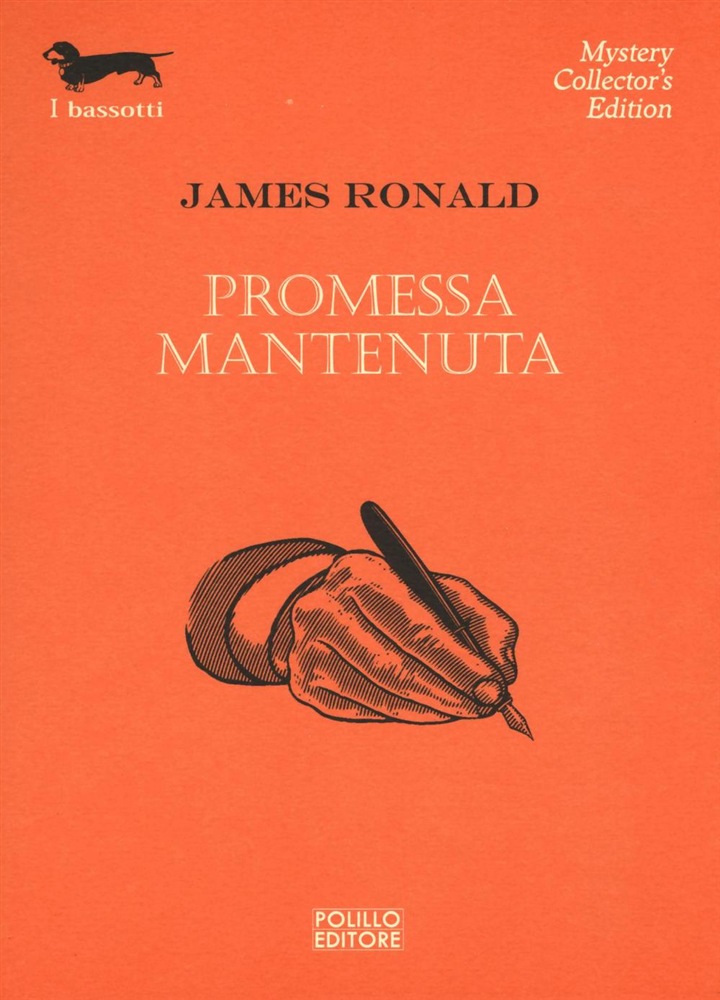
They Can’t Hang Me is about a revenge
oath.
Lucius Marplay is a successful publisher. He founded and directed The Evening Echo, the most read newspaper in London, bringing it to success. At that point, married and became father, gradually he abandons his commitment in the head, delegating it to four of his associates, who, instead of strengthening it, destroy it, bringing the journalistic head to ruin. And with it also its founder who, burdened by debt and tasks, it gets a nervous breakdown such that he should be admitted to a psychiatric clinic. Where he has remained for twenty years.
The daughter has become a beautiful girl in the meantime and ignores that the father is alive: in fact, her mother has died of a broken heart, and entrusted to a guardian, for delicacy to her, it was not revealed the bitter truth, and instead was told her father died. However she learns by chance the truth and she wants to meet him here, and her guardian must come out and he must confess because her father is still kept under observation: it is gripped by a homicidal mania. He believes his employees, who in the meantime have found the head bringing it to the ancient success, they have deceived him and have caused all his misfortunes, and therefore has warp very detailed plans to kill them. However, as long as they remain in the demented mind, nothing can harm. But when Marplay escapes from the clinic and loses his traces, taking refuge in the old abandoned headquarters of the newspaper, in a secret chamber of which he alone knows the opening mechanism, the threats of many years seem awaken the fears of the four partners. More so, one by one, they actually die by violent death: every time is found a note by Marplay that confirms he has kept his promise.
The first time is killed Ellis, with such violent
truncheon blows to smash his skull; the second time is Partridge to be killed,
in a room considered safe at one hundred percent, a concrete shell without
places to hide, and outside guarded by policemen, with a gunshot, from a ghost,
as surely Marplay he has not joined, but has left the second message; with
policemen who do not know how to get, the third partner, the slimy Craven,
whose occupation is luring secretaries promising them an easy life in exchange
for sexual attention - and who attempted to lure Joan, the daughter of Marplay,
shewn assume for intervention of Lord Nigel felt in love with her in
order to procure evidence on the unfair and willful misconduct of the four at
the expense of Lucius Marplay - in turn he’s poisoned with hydrocyanic
acid, but nothing has been found capable of causing the poisoning.
In short three impossible
murders: the first, for the killer impossibility of passing the barrier of
policemen (but passed by the possibility that the same Marplay was hiding in
the secret chamber of the old site, united to new by galleries); the second for
manifest impossibility, the murderer being able to vanish into thin air with
the weapon used; the third for the weapon's absence, although Craven died in
the presence of the police, the same inspector Wrenn and the fourth partner,
Peters, after have sprayed a perfume, which then turned at the analysis
absolutely free from hydrocyanic gas.
The fourth murder is in the air: it is announced, as the
previous ones, through a short article in the newspaper obituaries. It will happen
for stabbing. However this time the murder seems to go wrong, because Marplay
will be stopped and will fall into the water. However he will be rescued by a
strange character, Alistair McNab, who has carved the figure of investigator,
which is not in his life, but at the appropriate time, draws out of trouble the
police, revealing the threads of each other and causing the confession and the
killer's suicide.
Very enjoyable novel is written with a very airy and light style that delights the reader.
The story is well known: a vengeance and a promise to kill. The device does not have a validity only for the plot of the story, but also for the creation of a narrative tension, which concerns a character not bad but mad, made mad for the infidelity of his four collaborators: Mark Peters, Ambrose Craven, Sinclair Ellis and Nigel Partridge, in which he had placed his trust.
It’s created unconsciously (but I believe it was intended by the writer) a kind of reader participation in the events that sees narrated: the reader, even if he really should be on the side of those who seek good and abhorring evil, ends to root for Marplay and almost hopes that, despite all the measures taken to prevent other murders , he goes forward in his revenge. Also because the reader knows that, in the literary fiction, at every impossible murder is linked the pleasure by the reader loving the impossible crimes of paper, which they all take place. In this, the reader and the mad man, are linked by the same theme: a text, found in the secret chamber where Marplay has taken refuge: Murder considered as one of fine arts by Thomas De Quincey.
The novel is therefore a curious smoothie formed by two
elements; by Thriller (the promise to kill, completed each time with tenacity,
cold determination and intelligence) and by Mystery, which would seem to be a
Howdunnit (research of how it is done the murder ) given the evidence of who is
the murderer. However at the end we see that the Mystery was also a Whodunnit,
because the murderer was not what you thought he was, and instead he was
another person.
Also interesting is the presence of three detectives in the field: the Inspector Wrenn, Joan and Alastair McNab. This peculiarity may have been borrowed perhaps from the success of the Leo Bruce novel (Case for Three Detectives) , given that this doubling of McNab in the purported detective and in the real journalist who he is, causes the situation that takes place in the Bruce novel: three investigators which act and a fourth (the Beef Sergeant) who gives the solution.
Despite being a melting pot of good ideas and the pace does not drop and reading is pleasant and easy, the novel is not, however, a true masterpiece as it is influenced by the ideas expressed elsewhere and also the discovery of the perpetrator is not as difficult as in other novels ( like carrian and queenian novels for example), so it's pretty simple.
The fact is that the gimmick
behind the purported thriller (the promise to murder and the murderer's
knowledge) that should raise the tension, actually if it keeps high regard is
the manifestation of the murders is the identification of certain subjects,
McNab for example, is not effective for the killer, because not having created
the conditions in order that more persons may be accused, it follows that
"if it is not soup, it is wet bread", (=it’s an italian proverb) and
eliminated the first subject first, the second must be the true killer. This is
because the novel follows the current of the classic Howdunnit (although here
there is a whodunnit element masked) pointing to sensationalism and spectacle
of the staging, as in French novels, where, as here, there is absence or still
little presence of psychological elements and however a few items to suspect.The
ideas expressed elsewhere instead are to be found in the narrative devices
already being used by other novelists in vogue in the 30s: for instance the
various murders attributed to someone already certain at the start and instead
made by another person, remember The A.B.C. Murders by Agatha Christie (1935), where there is also the crazy
murderer who is to blame for several murders,
unannounced, as in this case. And again: Carr and Queen, united by the fictional
tool of the false culprit that diverts attention from the real one. We might
find a certain similarity in It Walks By Night
of 1930, where everyone thinks that the author of the murders is
Laurent, until you find that Laurent was previously killed and his
identity taken by another person. It would seem, because the most direct
reference seems to me by Ellery Queen, The Egyptian Cross
Mystery (1932): in the novel there is the promise of revenge, as in our
case; revenge that takes place three times, as here; a sacrificial victim, kept
segregated and then killed to believe a certain thing, while here this
fictional tool is realized in part. However everything else there’s.
Finally there is another idea expressed elsewhere,
although this time it is by the same author: in fact the promise to kill,
occurs in a previous novel and like this quite famous: Six Were to Die, 1932,
where a criminal threats death to the six
responsible for his downfall occurred twelve years before, and even there we
see the race between those who have to keep the promise and who should prevent
it.

As says John Norris, I also connect the intelligence in creating death
traps, such examples elsewhere expressed by others: in fact, the immediate
memory is John Rhode and the gadgets used by him to kill in his
novels, although that invented in the case of the Locked Room (Partridge
murder) seems really climbing on the mirrors: a method that is frankly too
bizarre, when the noise of a hand violently slammed on the desk, it was quite possible
to mask the muffled sound of a shot with a silencer, which it is eliminated
from the outset, instead of everything else. Even the fake dialogue between the
murderer and the victim, reminds to me some novels and short stories by
another author, where for example the expedient of ventriloquism (which does
not exist here) is used to make it appear that the victim at the right time, it
was still in life: eg. Problem at Sea by
Agatha Christie (1936) and The End of Justice,
1927 by John Dickson Carr.
In short, not a masterpiece,
but nevertheless a very enjoyable novel.
Pietro De Palma


