
Generally, in my opinion, three different stages in the knowledge of an author can be identified:
the first is that which concerns his works, without whose knowledge one cannot proceed; the second more specialized concerns the biographical treatment of the authors that can explain certain choices, while the third even more specialized concerns the aesthetics of the works - or what the author sometimes wanted to say when writing a certain work and concerns what I call metacritic - or even super-specialized studies on certain topics covered by an author. I will skip over the first, which concerns the list of works by each author and also the anthologies edited by some scholars, and I will focus on the critical studies relating to the second and third stages, which I know and therefore can speak of.I'll start with Douglas Greene.
Douglas Greene, Emeritus Professor of History of the Tudor Period and Elizabeth I, at Old Dominion University, is known not so much for his critical history studies as for the Carr Biography, The Man Who Explained Miracles, to which he refers. It is a transformation of the title of Carr's successful anthology, The Men Who Explained Miracles, from 1963, which contains various stories focused on three Carrian investigators: Doctor Fell, Sir Henry Merrivale and Colonel March. Douglas's volume, published in 1995, was nominated for an Edgar in 1996 along with Savage Art: A Biography of Jim Thompson, by Roberto Polito, which instead won it (among other things, a beautiful, very detailed study). Otherwise very detailed, full of news and references to all Carrian production (including the lost early tales, which are gradually re-evaluated), otherwise Doug's text is a must that every Carr enthusiast must have.

After Doug, here's Martin Edwards: from an unlucky Edgar nominated to a lucky one. Martin Edwards, successful British writer of Mysteries and Thrillers, and editor of the famous series of novels "British Library Crime Classics", in which he has published many of his anthologies of GAD short stories, also has to try his hand at critical studies: The Golden Age of Murder dedicated to the Detection Club, a famous group of British writers (founded in 1930 by Anthony Berkeley and Dorothy L. Sayers, Agatha Christie and Freeman Wills Crofts), of which he is currently president, was published in 2015, and the year after the Edgar won. It is a study, very pleasant to read, in which he talks extensively about the Detection Club and the writers who were part of it, with a truly exceptional anecdote (also the photos reproduced are beautiful). Martin following this critical study, published one in 2017 on Dorothy Sayers, Taking Detective Stories Seriously: The collective crime reviews of Dorothy L. Sayers. Basically it is a text that collects the reviews of Dorothy Sayers prepared for the Sunday Times from 1933 to 1935, of detective novels of the time. The list of reviews is introduced by a superb introduction by Martin that clarifies the nature and value of the reviews, which outline a kind of history of the genre for the years under review. Also from 2017, is The Story of Classic Crime in 100 Books, published in the successful series of the "British Library Crime Classics" and which deals with a literary history of detective fiction of the first half of the twentieth century, mainly based on authors whose various carefully selected stories. In 2020 his fourth study was released: Howdunit: A Masterclass in Crime Writing by Members of the Detection Club, winner of the H.R.F. Keating Award for Best Biography / Critic Book Relating to Detective Fiction and nominated for Edgar Allen Poe and Macavity Awards. It is essentially a series of advice from English historical authors not only of mystery but also of spy, on how to write a good detective novel, which Martin has selected and presented. Finally in 2022, his fifth study recently came out, The Life of Crime: Detecting the History of Mysteries and their Creators, which outlines a history of the genre and the known and unknown writers who interpreted it. It is a sort of very detailed story of detective fiction, which in my opinion is structured like the famous S.S. Mike Grost's Van Dine School, and in various distinct sections, which feature a diverse array of writers united by writers. Very pleasant and captivating in presentation, and extremely detailed. I predict that this work will also win important awards in the detective narrative sector.
Leaving Doug and Martin, one cannot fail to mention the most important study on Ellery Queen.

It was signed in 1974 by Francis M. Nevins, professor at St. Louis University: Royal Bloodline: Ellery Queen, Author and Detective. The critical essay the following year won the Edgar. In the essay, Nevins outlines the guidelines for understanding Queen's work, and therefore there are numerous spoilers of the works cited. In it, especially between the two cousins, importance is given to Dannay's ancestry in inventing the plot of the stories, with everything that is contained therein. However, the exaggerated importance given to Dannay convinced Nevins over the years, in the light of more accurate studies on Queen's work, to give greater visibility to the work of his other cousin Mannay. Therefore, a few years ago, the first essay was revised, enriched with contributions by Nevins himself and other material, and re-edited in another definitive work, Ellery Queen: The Art of Detection. It should be mentioned that Nevins in 1989 won another Edgar for a critical essay published the year before in Cornell Woolrich: First You Dream, Then You Die. In it Nevins explored Woolrich's work, restoring the author's truthfulness of his life, and eliminating all that had been attributed to him as legendary. However, it is not a biography, as one might think.

Still on the Ellery Queen side, another important critical study can be recorded: Blood Relations: The Selected Letters of Ellery Queen, 1947-1950, by Joseph Goodrich. Published in 2012, it is an acute study, on the tensions and relations between the two cousins, through the analysis of many letters that they exchanged, in their apotheosis period, the one in which masterpieces such as Cat of Many Tails, Ten Days Wonder and Origin of Evil, of which they speak, also narrating their genesis in a certain sense.

Finally, the only exception in this roundup is The Tragedy of Errors & Others: With Essays and Tributes to Recognize Ellery Queen's Seventieth Anniversary, a volume published in 1999 by Crippen & Landru, which contains the plot written by Dannay for the latest novel. of Queen ever published “containing all the hallmarks of the greatest Queen novels — the dying message, the succession of false solutions before the astonishing truth is revealed, and scrupulous fair play to the reader. And the theme is one that Queen had been developing for many years: the manipulation of events in a world going mad by people who aspire to the power of gods ". While it is essentially a novel, it also contains the six hitherto uncollected Ellery Queen short stories and has various contributions from friends and relatives. And therefore it is one of the most important Queen books published after their death
Other very important essays on important authors are:

first of all the two, one after the other by John Curran, on Agatha Christie (Agatha Christie's Secret Notebooks: Fifty Years of Mysteries in the Making, 2009; and Agatha Christie's Complete Secret Notebooks: Stories and Secrets of Murder in the Making, 2010) . In them Curran outlines the genesis of all Christian works, starting with the discovery of the famous seventy-three notebooks in which Agatha Christie reported annotations, projects for novels and theatrical dramas, drawings found in the library of the ancient Greenway House, where Agatha Christie spent twenty years , made public only after the disappearance, in 2004, of his daughter Rosalind. Very important for all fans. The second of the two essays entered the final five of the Edgars, although not winning it. However, they have won other important awards, including the Macavity

David Whittle's essay, Bruce Montgomery / Edmund Crispin: A Life in Music and Books. Published in 2007. In it Whittle outlines on a double track, the life of Bruce Montgomery, composer and organist, and that of Edmund Crispin, novelist, and the analysis of his works. Very interesting, also and above all because it sheds light on the work of a great British mystery novelist, of whom little was known, and also on his life as a composer. There are interviews with people and friends who knew him, and his early retirement from the stage and abandonment of creative writing is analyzed, also in the light of his health problems, osteoporosis and alcoholism.
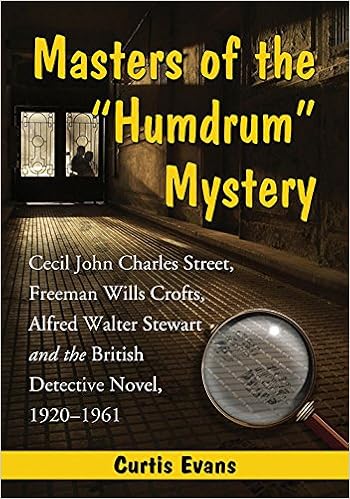
Then there’s the essay written by Curtis Evans, Masters of the Humdrum Mystery. Published in 2012, the essay analyzes the works of three great GAD novelists: Cecil John Charles Street (aka John Rhode / Miles Burton), Freeman Will Crofts and Alfred Walter Stewart (J.J. Connington) and in general the British Detective Novel from 1920 to 1961. Very very interesting, also and above all for the analysis of the three authors to whom no one or almost no one had before Curt, paid attention: each of the three authors is reserved a part, but among them the preponderant one is the first, the one dedicated in Rhode, also and above all for the immense production of the same, which is analyzed succinctly but also with rare acuity, in almost 100 pages. Three appendices follow with the three complete productions of the three writers, plus an insert dedicated to Crofts' contribution to The Floting Admiral, 1931; and Double Death, 1939.
Another very accurate essay study, written as a tribute to an illustrious compatriot, is that of Joanne Drayton on Ngaio Marsh: Ngaio Marsh. Her Life in Crime, released in 2008.
Finally, we cannot fail to mention the two essays by Jeffrey Marks:
the first dedicated to Craig Rice (2001), Who Was That Lady? Craig Rice: Queen of the Screwball Mystery, and second to Anthony Boucher (2008): Anthony Boucher: A Biobibliography.

Two essays, very acute: the first nominated for Edgars, Macavity etc .. is an experimental study on one of the queens of black comedy, halfway between Mystery and Hard Boiled, while the second is a study of the character Boucher through 4 different perspectives: staff, author, editor and critic.
A very specialized study of poisons used as a murder weapon in Agatha Christie's novels is A is for arsenic. The poisons of Agatha Christie (2015) by Kathryn Harkup. It is a very meticulous and technical essay, which informs in a very specific way about poisons and their action, listing them in relation to their placement in Christie's novels and short stories: eg. hexerine is said to be used in Crooked House and Curtain only and then we move on to the explanation of what the poisonous substance is used and what effects it causes.

Then there are collections of
short essays in the form of paragraphs to form treatises regarding Crime
fiction. One of them that comes to mind is for example A Companion to Crime
Fiction (2010), edited from Charles J. Rzepka & Lee Horsley

On the Italian front, we mention only one, but very interesting, out of print for many years, published by Mondadori in 1990, by Giuseppe Fiori & Luigi Calcerano: Guida alla lettura di Agatha Christie (=A guide to reading by Agatha Christie). This is an extraordinarily interesting essay, among other things written very well, very learned, with precise observations and precise comparisons that outline an extremely in-depth work carried out on the sources not only referring to Christie but also to the detective genre in general, detectable in the Note. The result is an all-round, accomplished and fascinating perspective of Agatha Christie.
Among the essays concerning the history of the genre, I emphasize:
first of all the dated but very important, Bloody Murder - From the Detective Story to the Crime Novel: A History (1972) (US title: Mortal Consequences), a second revised edition of which came out in 1985, a third revised edition in 1992, and a fourth in 1994, by Julian Symmons. Its importance as a history of the genre from the mid-nineteenth century to the end of the twentieth century, goes hand in hand with the fluidity of the discourse and acting as an accredited source both to the neophyte, who knows little or nothing about the works and their authors, and to the enthusiast, and finally to the critic and collector, also citing neglected works, but which nevertheless, according to the author's judgment, have a certain importance. The essay earned a 1973 Special Edgar Award.

Then there is a curious but very interesting essay by Ernest Mandel, the most important Marxist and Trotskyist theorist of the second half of the twentieth century, which analyzes the History of the Detective Genre, from a Marxist and social perspective: Delightful Murder: A Social History of the Crime Story. Published in 1984, the essay examines much of the production. Not being an expert on the detective genre, he is not so much suitable for people who love the genre, as for those who, through reading genre literature, want to rise to ideas and concepts concerning the class struggle, the bourgeoisie and capitalism, in the novel. detective.

Very interesting is a critical essay by Bill Pronzini, a great novelist, versed (like Martin Edwards) in the criticism of the genre: Son of Gun in Cheek: An Affectionate Guide to More of the "Worst" in Mystery Fiction, is a series of novels ugly, unlikely, highly original, by established authors such as Henry S. Keeler or Ed McBain or Joseph Wambaugh and many others, whose unsuccessful works are examined, gutted and even cut short. Pronzini's style is always very enjoyable, and therefore the reading is very stimulating. For example, I found among the horrors of him, a very funny novel for its bizarre plot, which I reviewed years ago, Murder of a Mystery Writer by Eric Heath (1955).
The essay is the evolution of a previous essay, from 1982, entitled Gun in Cheek, in which Pronzini analyzed plots bordering on the impossible, unlikely characterizations and the most futile he had read. In Son of Gun in Cheek: An Affectionate Guide to More of the "Worst" in Mystery Fiction there are not only mentioned novels and short stories, but also B and C series films, Pulp magazines and everything that was ugly in the eyes of Pronzini to the highest degree or unlikely and therefore likely to be cited. He won the Macavity Prize in 1988. There is another essay, which more than essay, is a Guide to 1001 between summaries of plots, reviews, and biographies of authors of detective and espionage novels: 1001 Midnights: The Aficionado's Guide to Mystery and Detective Fiction by Bill Pronzini & Marcia Muller, published in 1986.
There is a bit of everything, but seasoned with the humor and irreverent vein of Pronzini and his wife Marcia Muller, who do not necessarily consecrate established works, but affirm the opposite. A guide therefore in some ways unpredictable. This won the Macavity award in 1987.

On genres, one cannot fail to mention the bible of Locked Rooms and Impossible Crimes, by Robert Adey. Released in 1992 and soon sold out, Locked Room Murders and Other Impossible Crimes: A Comprehensive Bibliography was a landmark work of its kind as it listed most of the novels and short stories that over time had been centered around the Locked Room and Impossible Crimes genre. providing each title "the specialty contemplated".
After Adey's death, in 2018, John Pugmire with the collaboration of Adey's wife, published a second edition, revised and corrected, in which he added a series of works that had escaped the first original edition, including graphic novels. , films, TV series. Nonetheless, headlines have escaped. For example, I have identified one (and reported to Pugmire) by J.J. Connington (In Whose Dim Shadow, 1935), a small masterpiece unknown to most, which has escaped its reissue.
A supplement to the second revised edition of Bob Adey's work was also published in December 2019, this time edited not by John Pugmire but by Brian Skupin.
On this same shore, are also some studies by Roland Lacourbe

First of all 99 Chambres closes: guide de lecture du crime impossible, published in 1991 with the collaboration of Robert Adey, which proposes a selection of 99 novels of Locked Rooms and Impossible Crimes for him, with 99 solutions and also very meritorious anthologies of short stories , entrusted to masters of the genre, and the two points of view of Adey and Lacourbe on the genre. It is very interesting above all because it proposes the Francophone point of view compared to Adey's Anglo-Saxon one, and cites a series of novels otherwise unknown to most, but published in France and Belgium.

And finally 1001 Chambres Closes by Roland Lacourbe, Vincent Bourgeois, Philippe Fooz, Michel Soupart: guide de lecture du crime impossible, published in 2013. The guide lists more than 1100 works (660 novels and 500 short stories) written by hundreds of language authors Anglo-Saxon, French-speaking, Italian and Japanese. It represents a sort of very broad response to Adey's work by the only one capable of standing beside him, and perhaps even surpassing him, also and above all for having published almost all of Carr in French, including Grand Guignol, the long story that is the base for It Walks By Night, which Doug is now about to republish in English. This huge anthology was followed by a second part that analyzed cartoons, films and TV series: 1001 Chambres Closes - Annexes, published in 2014.
Still in the Francophone language, among the most important critical contributions, we include first of all those of Thomas Narcejac (who together with Pierre Boileau, constituted one of the most famous associations of detective fiction of the second half of the twentieth century):
Esthétique du roman policier, 1947: Narcejac analyzes detective literature above all by analyzing that specific to Pierre Boileau. It was precisely this study that fostered knowledge of the counterpart and favored the establishment of the Boilaeu-Narcejac partnership.

La Fin d'un Bluff. Essai sur le Roman policier noir américain 1949: it is a pamphlet of criticism, also quite determined to the genre. It earned him a controversy with the director of the Série Noir, Marcel Duhamel.
Le Roman Policier, 1964: one of the best contributions to the genre. It is not so much a descriptive book, but rather it is a critical one. Not at home the pair of authors identifies the mechanism of Suspence through the one-to-one relationship Reader - Victim - Murderer, with all its various facets.
Une machine a lire: le roman policier, 1975: Narcejac, examines the detective genre from its origins and comparing it with field numbers (Religion, Economics, Politics, Literature) demonstrates how it has become such an important representation of our daily life.
Furthermore, in addition to La double mort de Frédéric Belot, a formidable deductive novel by Claude Aveline, a Double note sur le roman policier, written by a leading intellectual like Aveline, was published by the same, a leading French intellectual of the French left. , with the aim of clearing the police literature considered a literary sub-genre in France (but also in Italy), hit the mark and made the Aveine novels become literary cases: ... "Il n'y pas de romans nobles belonging aux Belles- Lettres (qui en décide?) Et de romans moins nobles parmi lesquels on range selon the arbitrator habituel romans populaires, d'aventure, romans policiers ”.
Another story of crime fiction in France is that of David Platten, The Pleasures of Crime. Reading Modern French Crime Fiction (2011). However, it is a patchy examination. Treats the major contemporary authors (Vargas etc.) and some of the past (Simenon, Very ..) but forgets many others (Vindry, Boca, Meirs, etcc).
Pietro De Palma


