Friday, May 9, 2014

Mignon Eberhart: The Mystery of Hunting 's End, 1930


SPOILER


Mignon Eberhart , was a popular American writer . He invented the female nurse Sarah Keate , and inserted it into a his vein, distinguished from plots where there was usually a woman in danger, and in which the mysterious element fasten the romantic sentimental, a bit as the Nancy Drew mystery, novels " for ladies" , written by Carolyn Keene ( pseudonym under which lurked several authors of the Stratemeyer Syndicate, the most famous of which was Mildred Augustine Wirt Benson ) . Unlike these novels, which are dominated by the suspense , because direct more than anything else to a young audience , that relate to  events in which they move crooks and thieves, but not assassinations, and that therefore the violent element is very watered down , those by Mignon Eberhart , who began to write taking as  her mode  Mary Roberts Rinehart, marked by strong atmosphere and a thriller spasmodic , contain  murders ! Although the story is often intertwined with romantic ashes .
Mignon Eberhart wrote The novel  The Mystery of Hunting 's End, s her third novel (with Character Sarah Keate), after Patient in Room 18 (1929) and While the Patient Slept (1930).
Here nurse Sarah Keate , called into question by Detective Lance O ' Leary, his friend , is involved in an affair in which dominates the suspense but also the mystery .
Mary Kingery , daughter of financier Hubert Kingery , after five years from the death of his father ,  occurred in circumstances not fully clarified, decides he wants to know the whole truth , and for this, at the residence of his father, near Barrington, summon all  people who were present at the death of his father, who also accepted , to dispel the suspicion that there may have been involved  : Julian Barre, Jasper Fraley , Nicholas Morse , Charles Killian , they are all friends and partners , and in any case characters related to financial founded by Hubert Kingery ; Jose Paggi is a tenor and his wife Helen Paggi ; Blanche Von Turcum is a baroness ; Lucy Kingery , is the sister of Hubert and Aunt of Mary ; Brunker , is the domestic and Anne , the cook . All were five years ago. The last two continue to serve at home, and like the others, would have had valid grievances , and therefore a valid motive for desiring the death of Hubert.
Apparently , Hubert died of a heart attack, but something is not clear , and the same is not persuaded Mary that her father has died in this way : he was found in his pajamas, on the ground, without slippers , prepared to sleep in the bed and the bedside the light turned on. Inside a closed room from the inside. This circumstance authorized to think that the death had occurred due to natural causes. Later O’Leary will know from Lucy Klinger there was the work of concealment and corruption against the doctor who signed the death certificate , because he was silent on the true cause: Hubert died for a gunshot at point-blank that had caught him in the chest. She who "apparently" was seized with paralysis at the time of his brother's death , bur isn’t seized with paralysys instead, in fact it seems she had opposed in all its forms , for financial games too open-minded  of her brother, faces to enrich himself at the expense of the people around him , not caring about their lost savings : all or most of those who Mary want to spend their days in La Vedette , the lonely place in the sand .
Mary would like to avoid marrying someone who might have murdered the father, also: among her guests there is also her fiancé.
She assigns the rooms on the ground floor in a hunting lodge. Very few go to sleep on the first floor where the gallery is located directly in front of the room where he died Hubert. Among assigned rooms that not assigned also is Hubert’s room, in which three among guests (Julian Barre, Jasper Frale and Charles Killian) offer to sleep there: Jasper Fraley will end among three to sleep there. Jasper is the boyfriend of Mary . At night, while Jose Paggi and Nurse Keate detectives are talking in front of the fireplace, and can be found randomly in front of the door of the Fraley’s room, they feel before a rustle , as if someone passed on tiptoe above them, in the balcony, then they hear a knock coming from the room: Jasper is died , hit by a bullet to the heart, while wearing pajamas , barefoot and attired bed for the night. The door is open , but they were there out the door , though not in the front but the side, perjury and swear that no one came out the rooms, even if, before passing in front of the Fraley’s door bedroom , Sarah had heard two voices coming from the inside. Moreover, the windows are closed and the door that connects the room with the Barre’s room is closed by a bar . And it was not suicide , because you should find the weapon, and this is not there. So ...
But what’s the murderer ? A ghost ?
Some of the guests are emotional , because the old dog of Hubert , Jericho, whining all the time that passes in front of the door of the former owner and behaves as if there was a supernatural presence among them.
The search for the killer which seem difficult. Yet he is there, among them : he can not be escaped , because it's snowing outside , it's snowing , it's snowing incessantly : the villa where everyone came together , is completely isolated . But if the murderer  can not escape, also the other people can not escape,  in case he wanted killer some other . Yeah, because Jasper before he was killed , during dinner , he had alluded to some papers that he was in possession of the hide , which were like a pass, and which contained evidence of fraudulent financial by Kingery . Precisely for this reason , Hubert had forced her daughter to get engaged to Jasper was the price of blackmail. Now everyone is looking for these cards .
Before a sheet disappears from Keate found in the room of the dead, containing a sequence of numbers addressed to Morse ; the dead man's toupee then disappears , then reappears ( Sarah finds him ) and then disappears to reappear again and again ; then disappears even the dead, while there is the Baroness  who swear s had not entered anyone in the room.
Reticence, half-truths , lies, all conspire to undermine the investigation of the couple Keate - Leary . Even the wishes of some of the guests, before the corpse disappeared , make it disappear , because if the body is not there and so there is no evidence of a crime , there can not be (in theory ) a survey.
The present situation becomes absurd , the groceries are becoming scarce , because their estate is completely isolated in the snowstorm. Meanwhile, the murderer kills.
Before he tries  to poison the dog with strychnine . Then , when the snow ceases to fall, and Morse would like to go away to seek relief, he ries to kill O ' Leary, hitting him in the head with a poker night, while the detective is collapsed in one of the chairs in the room. Finally the muredere kills Morse , shoving a knitting needle , lost by the nurse, into the heart.
Then he hides the corpse.
With this novel , Mignon Eberhart won in 1931, the Scotland Yard Prize. Why ?
Undoubtedly we are dealing with a good novel that has some very specific characteristics :
an oppressive and claustrophobic atmosphere , which is a bit the feature of all those novels in which the house is in the middle of something from which the occupants can not escape : a cyclone ( Murder at 28. 10 , of Newton Gayle ), the sea ​​( Ten Little Niggers by Agatha Christie ), electrified doors ( The Invisible Host by Bristow & Manning ), a fire in the woods (The Siamese Twin Mystery, by Ellery Queen) ; the presence of climatic conditions and extreme weather ( something that also appears in other novels of Eberhart ); a woman in danger ( here's the nurse , but also Mary Kingery); a love story (between Killian and Mary ) ; a survey that moves more for isolated events which for a concatenation of tiles put into place ; a history  more than detective , romance , but not too much ; and especially a solution that , while providing convincing , gives way to some bugs here and there . However, because of the strangeness of the survey, which differs a lot from the more classical , typical of the Mystery , the Eberhart who rightly or wrongly (from this first novel , I'd say more , " wrong " ) was defined as the Agatha Christie of America, she’s  more akin to the kind Suspence or Thriller , since the solution does not come as the logical conclusion of a speech, but as the successful attempt by the detective , who is suspected but has no proof that ( he says) , to compel one who he thinks is the murderer to be discovered, forcing him along with other people that make up the decoy , to avoid being shot by the device that he, the murderer, prepared earlier. In essence, the reader is just waiting to see if the murderer will be found or not, because he did not know who might be right ( I had it figured out but for another reason, which is inherent in the allocation of Rooms: why does Jasper die? And this not because the reader is stupid , but because the author does not provide the clues clearly , but then explain its meaning after: " Hidden Harmonies !") so that he can understand it.
The thinking  I do is this : given that the assignment was made by Mary , and that she can not be the murderer because otherwise she would never have called this meeting to find out the murderer of her father, it goes without saying that it should be another. If the murderess was by flesh and bones, could be anyone , but it is obvious that the strangeness of the discovery of the body suggest something exceptional : no one would be able to approach from the other far rooms , so it's someone close to Jasper’s room . Despite this, the novel is good : merit of Eberhart that packs all in all a good novel .
It 'obvious that
The Mystery of Hunting’s End is a classic locked room , while not seeming that at first sight: in this case the sums It Walks By Night by Carr ( The door was not locked, but was supervised from trusty people  ) , and the novels in which the murderer although physically it may seem he was , he was not ( essentially returns the case described in The Greene Murder Case by S.S.Van Dine, in which a gun is operated with a device specially prepared : I note that the novel by Van Dine, American , precedes this by Eberhart two years); and of course, as we said before , it could be called a Locked enlarged  Room , being the house itself a locked  large room , from which, for the blizzard in place, the murderer can not be escaped .
The fact that some important foreign critics have expressed warm appreciation in respect of this novel, is likely to be related to the nature of the Locked Room .
It 'obvious that it can not have happened that the murderer has staged a few pantomime in order to distract the viewer, go in and kill the victim into believing that he was already dead (as in The Wrong Shape of Chesterton ) , because in the latter case , there would be the guilty competition and therefore an action spectacular directed to stage anything ; and then it would explain the lack of credit by specialized critics . I’s obvious that we fall in other cases .
That that sees the crime mature in the absence of the murderer , for a carefully premeditated plan . In this case the repetition of the murder of Hubert,  in the Jasper’s killing , makes us understand how , having been the home, for Mary’s admission , closed for five years, the murderer can neither having prepared the room nor removed the device that is therefore operating . The strange thing is that just kill the person nominated to be killed, dies : then, the murderer left at the last moment that the mechanism of death did his part. Precisely the absence of the person of the murderer and the reliance on a device, technique that’s in the novels of the period preceding Eberhart ( for example Eden Phillpotts : The Grey Room, 1921) , I believe it has contributed little to the credit of the work. But then, why did other works remain immortal ( The Greene Murder Case , by SS Van Dine, for example, with its mechanism mentioned by Carr , and the same Fatal Descent , by Carter Dickson / John Rhode, who puts into practice a murder carried out in an elevator hermetically closed , by means of a gun calibrated in a certain way ? ) and this novel, less ? I think because Mignon Eberhart does not put the reader in the position to understand , or at least to seek to understand how the murder took place , not revealing a few things : so in a sense, she does not meet the 20 Van Dine rules or those by Knox, ie in practice she cheats  the reader
John Dickson Carr at his Locked-Room Lecture in The Hollow Man, he also refers to this way of killing:

“Most people, I am delighted to say, are fond of the locked room. But--here's the damned rub--even its friends are often dubious. I cheerfully admit that I frequently am. So, for the moment, we'll all side together on this score and see what we can discover… A man escapes from a locked room--well?... It's the escape from the room that bothers me. And, to see if we can't get a lead, I am going to outline roughly some of the various means of committing murders in locked rooms, under separate classifications…..
"3. It is murder, by a mechanical device already planted in the room, and hidden undetectably in some innocent-looking piece of furniture. ..
For a more large extract, see my article in this blog:


If you wish to see other killing manners described by Carr, let see the article by a friend of mine, John Pugmire in his website “Locked Room International”:


Perhaps it is for this reason, also, the novel is not overly loved.

Pietro De Palma

Sunday, May 4, 2014

Joel Townsley Rogers : The Hanging Rope, 1946


Joel Townsley Rogers

Joel Townsley Rogers is best known for The Red Right Hand, work which combines in itself the mystery , horror , fantasy and an evident streak of eccentricity . And this definitely deserves the benefit of the public and of the critics. Nevertheless Rogers, not only wrote the thing , but .. a lot more. Indeed, The Red Right Hand , is just one of many works he wrote . Rogers was not so much an author of novels, short or long , but of short stories : he wrote hundreds.
And so The Red Right Hand was an expansion of a story written and published in the same magazine which was published on The Hanging Rope: in fact, the first short story from which was made the famous novel , was published in March 1945 on New Detective Magazine, unlike The Hanging Rope was released in September 1946. 
This sort of long story (but I would opt more for the meaning of " short novel " because of a little, but always substantially , the work exceeds the threshold of 100 pages that is accepted as a limit because we can start talking about the novel ) , The Hanging Rope , was forgotten for a long time and only in 1990 was rediscovered by Robert Adey ( author of the Bible of  Locked Rooms , Locked Room Murders and Other Impossible Crimes: A Comprehensive Bibliography ) and Jack Adrian, who together  created an anthology  I would say historical, The Art of the Impossible , containing short stories and tales of absolute value , where next to the most famous works (but not much) there are some almost unknown works . It 's the case of this work of Rogers.
Daniel McCue lives on the fourth floor of a large luxurious palace , in a large luxury apartment: he is a wealthy businessman who is also a politician .
Every evening,  go to visit him two of his friends: his lawyer Paul Bean, who is also a friend of his (who after leaving it , in the street is the object of a joke on the part of boys : he falls , peels one knee and palms of the hands, and bleeding back to his house, without  no one saw in that street him neither  helped him) and Father Finley, a priest devoted to the cause of abandoned cats, mild and quirky . Both , however , left the building before the murder of the old McCue , and the witness who confirms it is Boaz , the elevator man . The murder of the old man was accomplished with the aid of a bottle of champagne( brought by his friend Paul Bean, who presented it as a gift for his birthday) and then with the poker:  but if Paul Bean returns home with bloody hands , the priest enters a building not far from that where the old McCue is dead, when he knows that there's no one, to find a cat .
However, in that building, half deserted , in a bare apartment, devoid of furnishings that are not almost just a bed, a table and a typewriter, also lives the famous playwright Kerry Ott, deaf, there abiding, in absolute silence , to find the inspiration for his new comedy .
Tuxedo Johnny Blythe, former police lieutenant , coming from Washington  gives the alarm: he came to the apartment of McCue , and found the handle of the door of the house dirty of something that looks blood . Tuxedo which is the former son of McCue having married his daughter , before she remarry Paul Bean and divorce from him. Frightened by the blood, he gets down the stairs and finds that the goalkeeper, such Ignaz Slipsky,  wearing the uniform of the police patrols: Tuxedo doesn’t know  he came out from police . Slipsky confirms to Tuxedo no one came out, and the other says the door of McCue apartment is locked , having he tried to open it using his key since he failed.
Together they decide to go into the house from the outside, from the balconies. The caretaker , Rasmussen, another weirdo , tells them he saw the devil come out from the apartment of the old Dan :he would go to recover the soul of the old possessed man.
When Tuxedo and Slipsky arrive on the fourth-floor balcony by fire escape stairs and break the glass, they  find  the corpse of Dan with his hands cramped in the act of grasping the edges of the Bukkara Persian, near the desk Louis XV, the back of his head smashed by a heavy bottle of Champagne ( brought by Paul ) and by wild strokes of poker. As Johnny goes to see the front door ( to make sure whether it is locked from the inside ) and desn’t realize that behind him is Slipsky , they hear a piercing scream coming from one of the  other rooms. Tuxedo rushes towards it, and a second later Slipsky finds him dazed at the corpse of Kitty Kane , the beautiful Kitty, whose jugular someone has cut: the warm blood is still gushing out from the mortal wound of the neck. None , however, has seen the murderer , who escaped to the two in no time . He could walk out the door , but it is blocked for the inner chain , and from the balcony no one comes out. So what? How did he do? The only possibility is the bathroom window , which faces on a smooth wall .
The only possibility would be a window opposite , belonging to another stable : watch the odd case , the window overlooks the apartment by the famous playwright Kerry Ott, who lives in a world devoid of its sounds : Ott in fact is deaf . Possible that was just Ott ? Or to kill McCue and Kane were Father Finley ( who just moments before was seen by Slipsky and Boaz , the man of the elevator, go away ; or Paul Bean, went away again before Finley, from McCue home ? The fact is that the two men would have an airtight alibi which is given by  Slipsky ; yet the first , who lives in the same building of Ott, and on his own landing, among a myriad of cats , has been seen with wearing gloves covered by blood (but he says it was the meat that he gives her cats ) and one he lost at Ott’s home , where he came in ignoring in that place lived the playwright , from a few days . Instead Bean was attacked in the street by the terrible sons by Kitty Kane , hurting and being robbed of purse , which was found at the Ott home : were they to lose it or was Ott, penetrated through the window ? The fact is that to put in communication the two windows would serve a scale or a board like those used by painters to paint the walls of the rooms. In fact, one of these is found in the apartment occupied by Ott.
To take care of the investigation is "Big " Bat O'Brien, Homicide Inspector , who will turn ,  and will be misled in the investigation until Kerry Ott, with the involuntary complicity of a spider, argiope , will demonstrate that the window could never be used , also for a spider web that covered it completely . He will indicate to Inspector who could kill at an absolutely extraordinary manner .
Work of absolute importance, it is a real masterpiece . It has a tension that takes the reader to the end, since after the same identification of the murderer, because the end is built like a thriller : the murderer be able to get away or not? Will he be able to escape using the escape way that he has developed , a hanging rope , to avoid being caught?
In the final,  are found other things that give a glimpse of an absolutely diabolical plan .
The novel has also the features that make it if not unique, at least rare: the plot has a very strong atmosphere , which almost turns the detective story in a horror story by the oddity of the situation and by the components that Rogers glimpses , taking care to give each character a benevolent air that strides and contrasts with a more hidden : in this , and in the end at nothing granted, could remember Fredric Brown . A more direct  feature exclusively attributable to him , differentiating him from all other writers is his literary style , which uses a language sometimes obsolete , with exclusive words . The construction of the same period , uses a syntax strongly sought, almost before writing the sentence , he weighed the impact on the reader. These phrases Sometimes  may be too grotesque if not surreal .
A such perspective would suggest a slow writing, but obviously at Rogers was an innate characteristic  to want and to know write in such way , if we think to the hundreds of stories that he wrote. From a certain point of view , the bizarre and horror  remind me the stories by Stanley Ellin .
The Hanging Rope , from another point of view is a kind of synthesis of Mystery (the two impossible crimes) and Hard Boiled . From this second kind , it takes the claustrophobic atmosphere , made almost exclusively indoors , and the topics covered: the playwright could remind for example a reporter , the politician is disliked ( Dan McCue ), there’s femme fatale (Kitty Kane) , there is the sad murderer.
However, outside of the Baroque and refined style (an example is the description of the spider web: "It is not the sloppy and messy canvas , woven haphazardly in a quarter of hour by a teridio , but the patient work of an argiope , an octagonal  canvas, geometric , flawless, with four rays of silk. A job that takes time" ) , surprises the reader.
It reminded me - certainly daring comparison - how Marcel Proust set the writing of À la recherche du temps perdu, with a semantics tortuosity that goes round and round on a certain fact to reveal the hidden aspects as well as the visible ones . This continuous spin of situations , means that the suspicions are cast  out for things that appear the most obvious, on all the characters that appear in the plot: for example, Paul Bean , who falls across the street, mocked by the terrible sons by Kitty Kane, woman loved in the past by some characters of the story, that gives herself to the old Dan.  There would be nothing strange if falling, Bean had scraped knees and the palms of his hands were scratched and then he bled ; but .. the suspect that knocks him Townsley Rogers is that the blood can belong to old Dan ( then Paul would return later , in the Dan’s apartment) .
The references to the great tradition are countless and the same murderer who in some respects may call some other great previous novels as The Big Bow Mystery by I. Zangwill and The Peacock Feather Murders by Carter Dickson, in fact in my opinion it's much closer to Le mystère de la chambre jaune by Gaston Leroux.
The last thing I want to emphasize is that the brilliant idea by Ott on the spider's web , which essentially concludes the novel “ante litteram” , makes already know who is the murderer without reaching the final , because the final idoes not have to reveal the killer’s name, but to ensure that he comes out of the scene in spectacular fashion.
Notice how the novel gaits about the subject of blood: on the door handle , on bathroom tiles , the blood that flows from the neck of Kitty, that flows from the murderer, is perhaps the most obvious feature of a baroque horror , which is in the same time very spectacular and cinematographic  : each of the  sequences is as if it was conceived as a pose distinct from the next. The repetition of the scenes of blood permeates the plot also has a golden unhealthy , by grand guignol . The insistence on the gurgle of blood that comes gushing from the throat of Kitty, terrible because the blood is associated with the life  ( it is as if we were witnessing her death) , brings to my mind the verses of A.E. Housman : Some can gaze and not be sick , But I could never learn the trick . There 's this to say for blood and breath , They give a man a taste for death , which are mentioned by P.D.James before the beginning of her novel, A Taste for Death .
However, it is interesting to note the detail of the web of Argiope because I think it is the direct source of inspiration for other web that in another novel , more contemporary for us , covers the frame of a window, like a glass : I'm talking about La toile de Pénélopeby Paul Halter , although Paul interviewed by me long time ago while admitted to have in his library the novel by Rogers, he did not remember that particular in a book that he admitted he had read in the 80s.
 (  http://deathcanread.blogspot.it/2013/08/entretien-avec-paul-halter-interview.html  ).
I think the reference was , however, settled in him , unconsciously , and then it produced the idea of a spider's web that deals with the window frame (let look the note No.4 of interview).
However , the two novels differ in the solution that is diametrically opposite : in Rogers , the presence of the web prevents the window may have been used as the entry of the elusive murderer ; in Halter, the presence of the spider's web is not in itself a fact that prevents the action, because he , overcoming the obstacle,explains  by Twist how that window could have been used .
In Halter, basically, there is the overcoming of the idea base , creating the “plus ultra” than the other, bearing in mind , however, that in Rogers, to legitimize the web is also the fact that the window was locked and nailed anyway .
In short , the idea of ​​a spider's web is the same, but everything changes.

Pietro De Palma

Saturday, April 5, 2014

Peter Lovesey – Bloodhounds, 1996


In the contemporary scene of the writers of detective novels , specializing in the classical genre , Peter Lovesey has a prominent place. Born in Whitton , in 1936 , Lovesey has spent many vicissitudes in 1944 his house was destroyed during a German bombing ; had a passion for sports and dabbled in athletics , but soon realized it was not his way ; attended the University where he met his current wife ; he devoted himself to teaching but then you chose the career of full-time writer . He lives near Chichester. He signed with his real name all his novels except three , signed instead with the name of Lear Petert . His son Phil writes detective novels .

His series are centered on characters such as Sergeant Cribb , the agent Thackeray , Bertie (ie Albert, Prince of Wales ) and Peter Diamond. His novels  earned many awards : in 1976 with Swing, Swing Together

He  won the Grand Prix de Litérature policière ; in 1978 he won the Silver Dagger Award for her novel Waxwork ( repeated in 1995 with The Summon , and in 1996 with Bloodhounds ) ; four years later he won the coveted Gold Dagger Award for her novel The False Inspector Dew . She also won the Prix du Roman d' Aventures with the novel  A Case of Spirits, the Macavity Award with Bloodhounds ( repeated in 2004 with The House Sitter ) and with the same novel also the Barry Award . He also won the Cartier Diamond Dagger Award in 2004, and the Agatha Award for Lifetime Achievement in 2008. In 1988 , his Rough Cider has been selected in the final five of ' MWA Edgar Award , and again in 1996, The Summons .


Bloodhounds , translated and published in Italy as Il Signore dell'Enigma ("The Lord of the Enigma ") , is dedicated to John Dickson Carr. [1] 


A group of loyal readers of thrillers , known as the The Hounds , come together in an underground chapel of the Church of SS. Michael and Paul, at Bath . They are : Milo Motion , Hilda Childmark , Jessica Shaw, Polly Wycherley , Rupert Darby, Sid Towers. At one day also ,  Shirley -Ann Miller joins to these. She made himself known for her versatility in the kind of knowledge and for her kindness . The Hounds occupe themselves principally about  Mystery , while somehow they abhor the rest .

Inside, Shirley -Ann recognizes dynamics certainly not idyllic , that make well understand how , beyond the similar knowledges, the affiliates to the group are not all united by feelings of close friendship : she already sees the day when Rupert ports downstairs her dog , provoking the ires of someone, especially Hilda Chilmark, an old heir of an illustrious family fallen into disrepair, who  not mindful about this, treats others as if they were a notch below her . The attitude of rejection towards Rupert and his dog , is accentuated at another occasion , during which both Sid Towers and Milo Motion ( both Carr fans) would have to bring along a copy of The Hollow Man , to discuss it into the group , and also read the Conference by Dr. Fell. 

At this occasion, just the lady Chilmark has an attack of hyperventilation , and then recovers by the intervention of Jessica Show that after she eliminated a paper bag where Motion kept his copy of the Carr, she provides to Chilmark to restore her proper breathing. The fact is that the incident provides an opportunity to introduce into the copy of the novel by Carr , owned by Syd Tower, a rare stamp from 1 penny black , stolen a few days earlier from a city museum , theft which had been announced in advance by a message in the form of quatrain , and that he had alerted the city police : the same Peter Diamond , superintendent of police of Bath, and head of the homicide departments , had provided some of his men to Inspector Wigfull, including Inspector Julia Hargreves, to find the stolen stamp.

At the moment in which the stamp reappears, at the meeting of The Hounds, and after the attack of hyperventilation of Hilda Chilmark, the suspect (also in the reader ) that one of the hounds may have been the thief of the stamp, creeps.

Syd , after a confrontation with the other hounds , he decides to go to the Police Station and report the discovery in his book, which he swears he never left from the time when he took on board his boat  where he lives . The fact is that Syd , after denouncing it in most interviews, and be able to demonstrate that he was not the theft of pennies, returns to the boat owned by him in the company of John Wigfull , and , after opening the lock with which he holds closed the cabin , he finds dead Milo Motion: the lock is of a special type , German, with only two keys that can open it , and one key of both fell  in the water where the boat is anchored more a year before ; The cabin has no other openings , if not another door that is bolted from the inside , however, by a number of bolts ; Syd swears that the only key to open the lock was always in his hands , and at the same time professes her innocence . Further investigation will show that he is not the killer . How did Milo Motion to enter into the booth and why? How did someone kill him and be able not only to open a padlock Syd swears that it has closed , but also to close it, for the physical impossibility that the lock may have other key to open it? And above all, why was he killed ?

The most incredible thing is that the impossible murder appears to have been previously announced by another quatrain , whose meaning is incomprehensible before subsequently put in  report to the novel by Carr. It ‘s clear at this point that if someone had previously suggested that the thief could be one of the Hounds, now there must be between them even a murderer , if the murderer is not also the thief.

Various hypotheses will make their way on the identity of the thief, also able to explain the murder , but the resolution will come only at the end of the novel, after we will admire two hypotheses about the solution of the Locked Room (at the second , Diamond will destroy the first by Wigfull , after the discovery by police divers of the first key of the padlock ) for brilliance and flair , after a second murder will throw more sand in the eyes of the investigators ( Rupert Darby will be killed , awkward and unpopular man to most people) ; and after that someone will begin to suspect a blackmail for the detriment of another member of the Hounds, uncomfortable for a pregnancy and the birth of a secret son , always gravitating in the group of The Hounds .

The novel has not a granted end, because two tight end are taking place: the first , with two culprits almost sure but announced too , and another , the true final, with a guilty not granted , not far from the action and at the same time never kept in mind of the investigation, and brought under the spotlight , only after the final reflection by Diamond.

Spectacular and beautiful novel , it presents an incredible variety of characters (and thus driving ) , even within a narrative structure , already consolidated and addressed in other novels by other writers: in fact, the so-called association of The Hounds , formed by readers and passionate lovers of thrillers , is only the last in order of time , among the many that have preceded it : suffice it to say that Blacks Widowers by Isaac Asimov , or The Seven Solvers in Invisible Green by John Sladek , or even the three friends mystery fans , who will face off in Gammal Ost by Ulf Durling .
It is necessary to recall that Lovesey , in the novel also introduces a vein decidedly humorous , and ironic ( just remember that The Hounds meet themselves in an underground chapel of a church , nor they were the followers of a sect , within collide rivalries , hatreds , and are committed thefts , blackmails and murders : a satanic cult , almost) : it is as if the author himself ironized about who takes terribly seriously the Mystery Genre.

Lovesey , however, impresses in this novel,  his recognizable trademark : a tribute to John Dickson Carr, recalled from beginning to end , through allusions , quotations and conferences , which have as a reference, the most novel reminded by Carr : The Hollow Man (The Three Coffins). This giveaway is not only formal but also substantial because is processed a double Locked Room enigma : a murder in a cabin of a boat, hermetically sealed from the outside by  a padlock thief-proof , and from the inside by another door closed by  a bolt ; the appearance of a rare stamp , stolen from a museum, in a book that the owner swears he never deposited elsewhere ( and he is not the murderer ! ) .

Added to this is the mood light which permeates the novel, the humor always present , the tumult of the suspects , the true and false tracks , the crackling inventions that are never final , but always leave a second chance to reasoning.

Unlike by other authors who keep up rytm with the  action , Lovesey fails to attract the reader's attention (which doesn’t fool till the end ) only with the his ideas. Indeed , the fact that in twenty pages from the end, Lovesey indicates a possible suspect , it is not for me to be put in relation with the tendency of some writers of the old school to use the last few pages , as a kind of summary that explains the facts earlier; for me, instead, the author is launching another false bait, so that the ultimate truth is found elsewhere : it is the old assumption by Agatha Christie , whereby because the picture of the situation can be said to be solved at all, it is necessary that all pieces of the puzzle fall into place , not in any way forcing their inclusion.

The only thing that leaves here and there dumbfounded is the hidden explanation of a particular event,  not communicated to the reader immediately and instead only revealed at a later time (the  splashes of white paint not only on the basque by Rupert but also on the coat of fur of his dog, which had not been brought by him to the inauguration of the painting exhibition ), even if you immediately understand its scope : it holds high the reader's attention on the contextual  assumption, until it is revealed the hidden detail , which it leads to a solution diametrically different, though not definitive as regards the discovery of the killer.

Lovesey 's attention about the personalities of the actors in the drama , most importantly , is not at all related , and this is demonstrated by the influence that all the characters have in the course of the narrative : even what would seem to be the only person not to can be inserted into the group of be suspected , because the only  joined the group of The Hounds after, will play a very important function albeit indirect , and this person will enter by force in the final solution , although not personally .
So in the novel , the trend of action will see the beginning coincident with the end and vice versa.

Pietro De Palma 


[1] As Carr lost his home in World War II in an air raid, also Lovesey lost his home in 1944, destroyed by a V1 Flying Bomb.

Friday, February 14, 2014

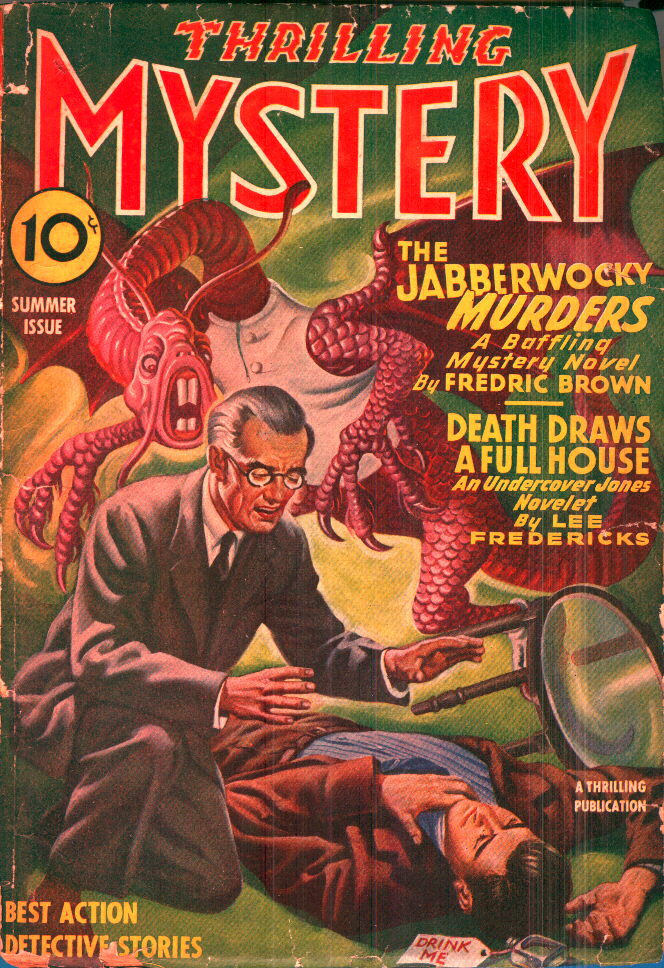
Fredric Brown : Night of the Jabberwock, 1951


Fredric Brown is famous for original and bizarre plots and unusual ends in his novels.
Now, it is clear that his plots are not conventional , even very original , reading his works : I would say that it was a normal thing too , since the author was a famous science fiction author , and therefore the fantastic futuristic was for him a way of looking at everyday things in a different light. However, beyond that he was or was not , essentially an author of science fiction borrowed to crime fiction or an author of crime fiction borrowed to the sci-fi or both together, Brown was always trying. Sometimes the surprise is related to the use of instruments or strange events that follow the science fiction (i.e. The case of a strange customer , the novel that we reviewed recently ), sometimes in very strange situations .
Night of the Jabberwock , is a novel of 1951.
It 's the story of a small publisher , who resides in a small town in Illinois , Carmel City, where nothing ever happens . This forces him to rage over what could have been if he had lived elsewhere, and unfortunately procure the strangest news in the ranks of those cheesy , that can happen in a country where nothing ever happens. So, just to say something, even he managed to stand against the local police, whose the sheriff did not forgive the attacks against him. In fact, Doc Stoeger would like a nice crime, not for the purposes for which Gervase Fen by Crispin wanted it, i.e. an intellectual challenge , but to have material for a nice article . In fact, the thing he would like to do , would be a last great number, in which he could write everything he ever wanted, and then close the magazine at least in beauty.
But nothing ever happens at Carmel City .
Doc has two real friends : Carl Trenholm , a lawyer , and the bartender Smiley Wheeler, and with them he spends most of his time with the first reflecting, with the second drink (which is alcoholic). A third is his acquaintance Al Grainger, a young man whose the revenues nobody knows which they are, but that in himself leads a carefree life , and that engages Doc in endless games of chess.
One day, it happens all that did not happen in too many years: a series of facts so out of the ordinary ( always with reference to the routine of life of Carmel City ) that even only one would have been enough to cover the hole in the layout of the first page.
In essence, he assists in what would seem a bank robbery , but penetrated through a window ( it is a provincial bank , in 1951 , not a modern bank, where if you also have a key on you, the metal detector at the entrance does not let you pass! ) stretches the bumbling thief , only to realize he is the teenage son of an acquaintance of his , the banker and master of bank, Clyde Andrews ; learns that the husband of her maid , had an accident in the Department of Roman Candles , a fireworks factory , burning one hand;  he realizes that at his small town turn the bad guys , two gangsters , one of which is wanted , famous for their ferocity , who almost did not swell with fists, just because he would not say which city was the one in which they had arrived by car, gangsters whom he subsequently will find by Smiley : Smiley also recognized them , and they will be saved from certain death just because Smiley will take advantage of a moment uncertainty of the two gangsters, shooting them with the gun whom Doc has in his pocket; a lunatic escapes from the asylum , and the police organizes roadblocks to catch him ; Ralph Bonney , rich industrial fireworks factory owner , and Miles Harrison , deputy sheriff , who is escorting him because of the wages of workers, from one bank to another city , they vanish into thin air; and finally one last amazing event happens before the eyes of the unbeliever Doc: he be gone before our eyes, after a little time . But the thing that most he can not believe is that , about any of these extraordinary things, he can write a piece , because for one reason or another, the people involved therein accepts that he write a piece about the fact or about themselves .
However, are all things that Doc did not properly lived , except the adventure along with Smiley against the two gangsters.
What it happens to him now rather it’s incredible.
In an interval between one thing and another, not his friend Grainger who entertains him with challenges chess but a strange little man  who shows up on his doorstepwith, who qualifies himself as Yehudi Smith: he entertains him about his knowledge of Lewis Carroll and Alice in Wonderland: few people know that years before Doc wrote his own practice about this visionary and that is quite a scholar . Soon Doc focuses on the strange guy that is fascinating for him, as is evident , because of his knowledge of the work of Carroll, also of essays by Carroll, very little known about the math: so the two become comfortable and Doc  by Yehudi is invited to a meeting in an abandoned and haunted house, where there will be a true rite about the existence of the fantasy world of Alice, in another dimension.
They go together, enter into an attic , they find a little table with a small key and a small bottle with a label that says DRINK ME (as into Alice in Wonderland): Yehudi drinking from the bottle and he slumps ... poisoned and stiff .

Doc runs away from home , he goes to the police station where he denounces all to the sheriff who does not believe him , but sends his second deputy to the house , where there is nothing; but from the trunk of Doc’s car blood is dripping: with the Doc Yale key that he found on the little table in the attic, they open the trunk of the car and they find the industrialist and the deputy sheriff vanished, dead.
Doc must have been ! It’s clear: he is mad! All because of all the liquor that he gobbles up !
The sheriff Kates who hates him , is about to kill him when Doc manages to escape and hide in the bar of Smiley: in the fumes of alcohol, he seesYehudi sitting at a table and talking to him and answering his questions. There is nothing supernatural : Doc putts into the mouth of his extension of his subconscious the answers he seeks, and finally he understands how the whole thing could have happened , who might have done to organize the conspiracy against him, and why he killed three people. And with the information had from Smiley , about the phobia of which would suffer the alleged murderer , the pirofobia (fear of fire) , he manages to force him to make a full confession .
It happens more in this novel and the ending is whimsical , though without upheavals of the last line .First, the novel , like many others in the production of Brown, is a hybrid: it melees environments and situations hardboiled , with a deductive enigma . We could say that it is very close to the atmosphere of Jonathan Latimer and Craig Rice : gangster and punches , alcohol and guns , but also fantastic Carroll atmospheres, a poisoning , a corpse that disappears , and two corpses that appear in the trunk of the car, a key that would open a small door and instead opens a trunk, and a bizarre plan to accuse an innocent and at the same time inherit a fortune.
In essence we are dealing with a Pout -pourri , a soup of hilarious and ironic situations, bizarre and rambling , but also dramatic and tense and especially a series of circumstances absolutely paradoxical : a paradoxical situation , a paradoxical subject , paradoxical ambiance , a paradoxical poisoning , disappearance and reappearance of a paradoxical , and above all, a paradoxical murderer and a paradoxical motive . Almost we could say that if  Brown didn’t write the novel and he did not pack in such a way, falsely arranged but stylistically very popular , we could attribute it to the deranged fantasies of an alcoholic writer .
The fact is that motive and murderer , sticking out like a cabbage to snack: why just that person should be the murderer and why Doc can figure out what could be the motive? If anything, he imagines what could be , but ... without a shred of proof .
It almost seems that the drinks, cocktails , calls into motion his nerve cells. Doc is an alcoholic and like all alcoholics need to drink to be able to get better:  in our case he uses the drink to be able to understand how it was hatched the plan , why and by whom. And the delirium tremens gives him the solution by splitting his identity in two : he and Yehudi . Yehudi , now dead, appears as an alter ego of Doc, his subconscious . This interview absurd , dreamlike and unreal between the conscious part of Doc ( Doc himself) and his subconscious ( Yehudi ) does not embody nothing more than the pursuit of truth in himself, the Socratic dialogue: if Socrates found the truth through the dialogue (Method of philosophical inquiry otherwise known as “Socratic method” ), Doc , through dialogue with a part of himself that asks questions, takes the connection . In other words , Γν
ῶθι σεαυτόν .
The nice thing is that all this is embodied in Doc , a man who needs to drink to think.
But the "drink" in addition to being the spring to learn , makes Doc arrives at the truth in a very strange way : i.e. assuming , without evidence , on the basis of a theorem absurd, so if everything that happened in that night is absurd , also the truth must be.
Did Brown mean that the truth not ever can be reached with absolutely rational methods and that sometimes even the chance and luck are important in human affairs ? Or they may find “the truth” without evidence , basing on absurd mental constructs ?
Here then is the final by Brown, for me is the real punch in the stomach : on what evidence or even better, on the basis of what evidence, does Doc nail his enemy, the murderess ? Nothing .
The revelation occurs through the torture:  by placing before the threat of being burned, the murderer reveals everything Doc has already thought It could not have happened that the murderer was not the real one and that he admitted to be him only because victim of psychological torture (for him also real ) ?
Why don’t we think that Doc to save himself, invented an ending of convenience, creating an ideal culprit , which in turn be able to absolve himself?
Why don’t we think the ending by Brown accounted in his case  a “Je t'accuse” about the torture?
Therefore, for me, because it is a fascinating tribute to Alice in Wonderland ( each chapter is introduced by a verse of Carroll's book ), and for his hiddeen meanings, this is one of the best works, perhaps, by Fredric Brown.

Pietro De Palma