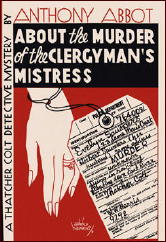
About the Murder of the Clergyman’s Mistress is Anthony Abbot's second novel.
It was written a year after his first, About the Murder of Geraldine Foster, and as we will see, it repeats and expands on some of the characteristics noted in the first, while highlighting others.
Like the first, we find ourselves in the antechamber of hell.
WARNING: SPOILERS !!!
At the beginning of a sultry summer, a boat is found adrift: it contains two bodies. A woman killed with a gunshot to the heart, but then almost decapitated; and a man, with a meek face, whose clothing indicates he is the wealthy pastor of an Episcopal church, with a bullet hole in his forehead, from which blood has dripped, matted his brown hair. In the boat, which still smells of brand-new paint, there is also a crumpled piece of paper: a letter, clearly sent from a man to a woman, about love. Could it have been written by the man and addressed to the woman, both of whom were killed? And there's also a cat, a witness to the killing, since its paws are covered in blood. It must have stepped on a lot, if it got them dirty. But, strangely, there's no blood in the boat.
Evidently they weren't killed there, but elsewhere, and then transported dead to the boat, evidently to be dismembered and then sunk in the water. Where is the place of the killing and whose bodies are the bodies? They are quickly identified: Pastor Timothy Beazeley and his secretary, Evelyn Saunders. The pastor comes from the Parish of "St. Michael and All Angels." But where was he killed? Evidently it must have been somewhere near the river, otherwise he would have been seen, and the boat would have been discovered immediately, which no one knows about. No one would know how to do it, but Colt Thatcher, Commissioner of the New York Metropolitan Police, knows: possessing an encyclopedic knowledge, he even knows all the varieties of leaves on New York's trees, and the leaf found on the boat, according to him, comes from a sumac tree. How many sumac trees are there in New York? But William Lederer, Director General of the Tree Division, whom he consulted, contradicts him: it is a leaf from a Tree of Heaven. They manage to trace the property, and they also know that a cat resembling the one found on the boat belongs to Mrs. Warthon, an elderly woman who has an apartment that no one uses. Having entered the house, thanks to the caretaker Kraus, they find strange edible algae, paint stains in a large living room with enormous windows overlooking the internal garden, an earring under a sofa, similar to the one missing from the dead woman's ears, strange fingerprints inside a built-in closet, and a very sharp, clean knife hanging from a hook.
Meanwhile, Timothy's husband is identified: the very wealthy Elizabeth Beazeley, formerly of Curtainwood. Her two brothers, Paddington and Gerard, live with her; the latter is a mentally handicapped man who enjoyed dissecting animals with razor-sharp knives.
From the very first moment of the investigation, after the bodies of the two lovers, along with the boat, were sent to the morgue for an autopsy, it becomes clear that many unanswered questions surround the Beazeleys' home: everyone seems highly suspicious and, above all, very reticent. Furthermore, by chance, it is learned that a package containing a piece of clothing has been sent to distant relatives to be washed and cleaned of any stains. Through a complex procedure (the air police, credited with inventing it to Thatcher Colt himself), they manage to obtain possession of the item, which turns out to be a fur-trimmed overcoat belonging to Elizabeth, stained with blood.
Is it all over? Did they find the killer? Did they find the accomplices ? No. Because other characters enter the picture: the churchwarden Chadwick and the Powell family lawyer, both in love with the widow, who would have had more than one motive for killing the Pastor (to inherit his position, and his money). And then there are the Pastor's two other secretaries, one of whom was a former one: Bessie Struber and Emma Hicks. Both seem to support the theory that the Pastor was anything but a serious man, vying to become a Bishop (of the Episcopal Church), but instead a vain flirt, who fell in love with anyone who made his skirts dance before his eyes. In short, they both had motives too: envy, jealousy, resentment towards Evelyn this time; but...the Pastor? Would they have killed him? It must be said that there are many suspicions. Of course, there's also Evelyn's husband, William Saunders, a night watchman, who indignantly rejects the suggestion that his wife might have cheated on him with the pastor, but then demonstrates with his actions that he repeatedly suspected her of cheating on him. Furthermore, there's a mysterious blackmailer who threatened Evelyn with death, and who even sent a telegram to have the watchman of the villas removed, including the one where the double homicide took place. The interesting thing is that this person is identified as the same person who had purchased cedar planking and carpentry tools (the latter found in the river along with a large roll of linoleum and the gun) so he could build the boat himself. So the crime was carefully premeditated. Especially since they were found in the mysterious villa, which later turns out to have been secretly purchased through intermediaries by a mysterious owner, unknown to anyone. These dumbbells suggest that the killer, after dismembering the victim, intended to weight down the remains in the river.
After figuring out who the blackmailer might have been, as well as the buyer of the raft who secretly built the boat, Colt will figure out who the killer, or... killers, might have been.
THE END OF SPOILERS
Abbot's second novel lives up to expectations, remaining in the vein of the first; if anything, it deepens it. It is therefore still, in case you hadn't understood, a Van Dine novel, maintaining all the valid connections with the archetype: the detective and his institutional sidekick (here is the prosecutor Dougherty, as in Van Dine there is Markha while the detective here is a Police Commissioner), the detective and his mentor (as Van Dine is to Vance, so here Abbot is to Colt) who is also identified with the writer himself, a way like any other to accredit the truthfulness of the concocted stories. Here too, the characteristics of the Van Dine detective are intact: super deduction, super culture (Colt here is even said to know every species of tree in New York: although later, he too... gets it wrong), super versatility in all sciences.
But at the same time, some differences are explored: the novels are true procedurals ante litteram; the crimes do not only occur in the upper classes of New York and the victims are not only high-class; there is a much higher level of violence here, in Abbot, than in Van Dine's stories; finally, also as a result of this, at times Abbot's stories can almost be defined as Horror-Splatter stories: in the first novel there is a corpse immersed in tannic acid to slow decomposition and blood everywhere, here there is a killer who was unable to dismember his victim because he was interrupted by something. Furthermore, this superabundance of blood contrasts with the anemia of Van Dine's murders: in some ways, the only novel by a Van Dine follower that in any way comes close to this one by Abbot is The Egyptian Cross Mystery by Ellery Queen, with a strong splatter component. Another difference, which tends to channel Abbot's Vandinism into a Vandinism that isn't slavish but seeks its own path, is the tendency not to favor the static action of the detective investigation: Philo Vance always operates in static environments, in villas, palaces, houses, pavilions, never leaving except to go home; Nero Wolfe is like this, never leaving his home; and so is Ellery Queen, who intervenes in the crime that occurred in a specific place, never moving his investigative action elsewhere, if anything returning to his own home. However, fueling the headwinds is the way of Archie Goodwin, the detective's factotum and sidekick, who nevertheless represents the detective's legs: with him, Rex Stout's detective story loses its immovability in the detective's crime scenes (also because Goodwin himself is a detective). However, if what happens in Nero Wolfe's novels is true, it should also be said that the first novels in which there is a certain shift in direction and a loss of investigative immovability are precisely Abbot's novels: a certain shift in action had already been seen in About the Murder of Geraldine Foster, but it is precisely in this second novel that the Van Dine novel as it was conceived by Van Dine (a crime in a high-class environment, with all high-class subjects or in any case connected to high finance and an investigation limited to the crime scene) loses its static nature (even if sporadically in some classic Van Dine novels there is sometimes a shift in location: for example in The Canary Murder Case, the Canary's lover is found in her hideout, where he was killed from the Canary's murderer whom he attempted to blackmail). After all, About the Murder of the Clergyman's Mistress is from 1931, while Fer-de-Lance is from 1934. However, he is not the only Van Dine Author who varies the action of the novel, not expressly static, because another free-spirited author, with absolutely unconventional crime scenes, is Rufus King.

The genre remains that of the classic Whodunnit (even if echoes of the Hard-Boiled can sometimes be heard in Abbot's stories), with an investigative action that begins with clues, yet sublimates into a purely psychological one, in which the ending has a very important cathartic conclusion: in the case of this second novel, however, we find a certain variation in narrative technique. If in fact, in Van Dine novels par excellence there is a scheme of this kind: Prologue (which coincides with the Introduction)—- Crime—- Investigation—- Finale (and sometimes an Apologue), here, keeping the internal scheme Introduction—- Crime —- Investigation —- Finale unchanged, Epilogue and Prologue are identified, changing the action of the novel from one characterised by becoming and therefore the succession of events one from the other, to one in which there is a cyclical nature of the action: in the Prologue what will be understood only in the Epilogue is announced, that is, why the case contemplated in this second novel, for which no one was arrested and therefore the electric chair remained inoperative, had been archived.
The particular quality of the whodunnit in Abbot lies in the non-univocal interpretation of the clues: if in Conan Doyle, Sherlock Holmes' analysis of a clue led to a certain consequence, in Abbot, more than in Van Dine, a clue can be interpreted in different ways. This different perspective here is entrusted not only to Colt Thatcher's abduction but also to that of Attorney Powell: the presence of a certain watch, missing from the dead man's, in a certain piece of furniture in the Blazeney house, would have led one to think that after the Pastor's death, if the murderer had been someone in his family or perhaps even his wife, that someone would have stolen and hidden it; but as Powell observes, that watch found is a completely new one, which could never have been on anyone's wrist, and which was a gift from the wife to her husband for his yet-to-be-completed birthday; Just as Colt himself will demonstrate that the presence of blood on a garment is no indication of absolute certainty of participation in a criminal act.
The absolutely spectacular ending overturns all verbal logic, framing a criminal act in which the demonic soul is underlined without preamble: the murderer is a great adversary of the detective (here on a purely virtual level), highly intelligent, and a ruthless being who kills because he has evil within him, when he kills only out of calculation.
Pietro De Palma

No comments:
Post a Comment