Monday, July 17, 2023

John Rhode : Poison for One, 1934


John Rhode alias Miles Burton were the two pseudonyms used by Cecil John Charles Street (Gibraltar, 1884-Eastbourne, 1964), to write Mystery: the first being used for the series with Sir Lancelot Priestley, retired scientist, the second for the one with Desmond Marrion, former Naval Officer.

Before dedicating himself to writing he was first an artillery officer and then an officer in MI7, the Counterintelligence of the time. He wrote many novels, and this penalized him because he could not always maintain a certain narrative and inventive quality. However, a good number of novels brought him to general attention, so as to earn him the consideration of John Dickson Carr, with whom he wrote a brilliant novel, Fatal Descent.

The consideration of critics, as well as that of the public, was not always unanimous.

If in fact Willard Huntington Wright better known as S.S. Van Dine, in 1927, in his essay The Great Detective Stories, stated: “Better written, conceived with greater moderation, and clinging more closely to human probabilities, are John Rhode's novels dealing with Dr. Priestley's adventures-Dr. Priestley's Quest, The Paddington Mystery, and The Ellerby Case. Dr.-or, as he is generally referred to in Mr. Rhode's text, Professor-Priestley has many characteristics in common with Dr. Thorndyke. He is a schoolman, fairly well along in years, without a sense of humour, and inclined to dryness; but he is more of the intellectual scientist, or scientific thinker, than Dr. Freeman's hero. ("Priestley, Willard Huntington Wright cursed with a restless brain and an almost immoral passion for the highest branches of mathematics, occupied himself in skirmishing round the portals of the universities, occasionally flinging a bomb in the shape of a highly controversial thesis in some ultra -scientific journal.") His detective cases to date have been few, and he suffers by comparison with the superior Dr. Thorndyke”; and Julian Symmons in Bloody Murder (Penguin, 1974), designated him as belonging to the Humdrums genre, considering him a pretentious author : " as a prominent member of the "Humdrum" school of detective fiction. "Most of them came late to writing fiction, and few had much talent for it. They had some skill in constructing puzzles, nothing more, and ironically they fulfilled much better than S. S. Van Dine his dictum that the detective story properly belonged in the category of riddles or crossword puzzles. Most of the Humdrums were British, and among the best known of them were Major John Street ..,” other critics have extolled this more recently, notably Curtis Evans in his Masters of the "Humdrum" Mystery: Cecil John Charles Street, Freeman Wills Crofts, Alfred Walter Stewart and the British Detective Novel, 1920–1961 (McFarland Press, 2012) : “.. long overdue reappraisal of these purportedly "humdrum" detection writers as accomplished literary artists. Not only did they produce a goodly number of fine fair play puzzles, but their clever tales have more intrinsic interest as social documents and even sometimes as literary novels than they have been credited with having”.

WARNING : SPOILERS !

The novel discussed here is a locked room, rather unusual. In fact the crime perpetrated is the murder of Sir Gerard Uppingham in his mansion by prussic acid poisoning. Why am I talking about an unusual case? Because usually when we talk about locked rooms, cases of disappearances, murders, thefts perpetrated in a strictly defined and closed space are mentioned, and because all these crimes can be worth being considered in this genre, it is it is necessary that the criminal action has been carried out personally in the closed space, and then the murderer has managed to escape, maintaining the limit situation, i.e. the effective closure of doors and windows; poisoning, on the other hand, does not necessarily presuppose a direct action by the murderer in the closed room, i.e. his presence at the time of the victim's death, because poisoning can be prepared first, and then let the victim, drinking or eating something , dies, like a rat in a trap. Normally. But here the poisoning is served up in an absolutely ingenious way, which does not exclude the presence of the murderer.

This is one of the two cornerstones on which the novel rests. The other is being a classic whodunnit, where motive and killer must be reasonably identified and proven.

Sir Gerard Uppingham is an industrialist who made his fortune mining albanite, a mineral used to generate light in lamps. Although he is rich and respected, however, he is not loved. He is not loved by his partners Somerton-Jackson and Tibbott, but not even by his fiancée to whom Muriel Featherleigh is promised, and especially by his future brother-in-law Rupert; even her sister Elvira doesn't show much attachment; and also his secretary Percy Richards has an ambiguous attitude towards him. But everyone, and especially Lord Cossington and his sons Muriel and Rupert, should be far from having a grudge against him because Cossington's family is on the verge of ruin and therefore only Muriel's marriage to Sir Henry could restore sixth the family; yet only the old Lord shows himself not averse to his future son-in-law. The fact is that in such an environment, one evening when everyone or almost everyone was invited to dinner, and there was also a moment when the wife of one of the envoys played Beethoven on the piano, he was found locked in his study , Sir Gerard Uppingham, died of prussic acid poisoning. Doors (3) and French windows, closed, except for the one forced by Somerton-Jackson, Tibbott and Percy Richards, the secretary of Uppingham.

The three immediately call the family doctor, Doctor Emery, who had also been to the evening at first, leaving immediately afterwards. He diagnoses Uppingham's death and suggests calling the police, as he believes death is not natural. It appears that the vehicle is a bottle of cough syrup, to which a generous amount of hydrogen cyanide has been added to kill in seconds. And therefore its content was poured by the murderer or by the victim himself into the glass, but there is no trace of saliva on the rim of the glass which therefore would not appear to have been used for poisoning. Then how?

Another strange thing are the glasses of port, wine and whiskey that the landlord had asked his butler to have found in the study and which lead the investigators, Sir Lancelot Priestley and Superintendent Hanslet, to doubt whether Uppingham should have hosted for discuss not only Somerton-Jackson and Tibbott, but a fourth character as well. By any chance a certain John Woodville, who seems to have arrived in the village but no one knows where he went?

To identify the culprit, it is necessary to establish the Cui Prodest, i.e. the motive. Apparently no one would have one. But the strange thing is that at the time of the industrialist's death, very few, practically only Lord Cossington, are saddened by his death and indeed are relieved by it.

Hanslet soon discovers  the victim had not only impregnated a village girl while he was engaged to Muriel, but had also attempted to have sex with Somerton-Jackson's wife while he was busy at the factory. Therefore, Somerton-Jackson himself would have a motive, but also Rupert and perhaps even Muriel. Only Lord Cossington seems to be sad, because it seems that with the marriage he would have become director of a company, he who had squandered his and his wife's assets in horse bets, and would have revived the family finances, by virtue of a new will that Uppingham he would sign on the day of the wedding. He would have gained new liquidity, the other his noble title. But the sudden death made the second will invalid, so with the first, Uppingham's sister, Elvira, who inherits everything, gained everything. And then you add her to the others for motive. Moreover, hers is double: to inherit the fortune and to prevent another person from inheriting it. Uppingham is linked to Percy Richards, and this must be evaluated because he is the one who says he brought a bottle of syrup even though she was stolen from him (he says so). Furthermore, the issue of telephone calls is linked to Richards: he says that a telephone call was received at 10.15 pm of which no one knows anything, while he claims that he has not heard any telephone calls ringing, while from the telephone company it is learned that this call was arrived at 10.43pm. And in those moments, the doctor said that Sir Gerard presumably died.

The investigation goes on. Someone, the phantom John Woodville, sent a crate to the factory containing raw albanite. Hanslet learns here that Somerton-Jackson took potassium cyanide a few days before Sir Gerard's death (cyanide is produced from cyanide gas produced by processing albanite), and is about to issue a warrant for Somerton-Jackson's arrest , when Dr. Priesley intervenes and upsets everything: no syrup was found in the victim's stomach, yet it was in the syrup that a small amount of concentrated prussic acid was dissolved. Furthermore, the victim could not bear the smell of bitter almonds and therefore would never have drunk a syrup that had that smell. So it follows that the syrup was put to mislead, it's a red herring. The victim was killed by hydrogen cyanide and that's for sure, but how? Slowly one begins to think that it was inhaled in the form of anhydrous gas, but this leads to the possibility that someone made him inhale it (so how would it have come out?) and then the Locked Room problem reappears, or that it is a deadly mechanism has been set up. Somerton is still among the suspects, because hydrogen cyanide can also be obtained by the reverse process from potassium cyanide. But..

Here's a twist! Her wife, with whom Uppingham wanted to have sex with, accuses herself of the murder, without however providing evidence of her action, and therefore making her suspect that she wants to cover for someone, perhaps her husband. But the husband also adopts a similar or almost similar tactic: isn't he in turn suspicious of his wife?

However beyond these true or false confessions, the investigations go on and lead to the discovery of…a cork in Uppingham's studio. Together with the testimony of the person behind the pseudonym of John Woodville, that is Lemaitre, the president of the French national company competing with the British one of Uppingham in the exploitation of albanite, according to which he was the fourth person waiting for Uppingham that evening been killed, will provide the clues that will lead Dr. Lancelot Priestley (and Superintendent Hanslet of Scotland Yard), to detect the killer.

FINISHED SPOILERS


Beyond a certain tortuosity in the first part of the novel (to arrive at the decision that it was certainly a matter of murder, one would expect almost 100 pages), this one by Rhode is a good novel! Even if the undersigned to the murderer and the accomplice got there 50 pages earlier, even before the cork was found. Call it sixth sense? I don't know. However, the memory of another novel made me think, if I'm not mistaken later (I don't remember which one it was: ah the memory !) in which the culprit was the same, and for the same thing, he hadn't initially been considered among the suspects. And furthermore he is a character who later becomes known, he frequented Govery Manor, the residence of Lord Cossington.

The absolutely ingenious weapon, and I would never have thought that such an object could be used to kill, but if anything.. to pass the fever! And the cork goes well with the rest. After all, it is a characteristic of Rhode, that of inventing mechanisms capable of killing, which can be derived from the fact that he had been an officer in the English army. A direct consequence of Rhode's origin, it is an object the killer uses to get himself invited to Uppingham's house. Using hydrogen cyanide gas as a weapon, on the other hand, is nothing new: in fact it had already been used six years earlier, in what some consider Rhode's masterpiece (but was it really?): The Murders in Praed Street. If anything, the medium changes: there a light bulb, here…

The Locked Room is only apparent, because the door through which the assassin enters and exits is provided with a snap lock, however how we arrive at conjecturing his presence and how he managed to get himself invited and how he killed, is a nice to say. The clues are there, and the culprit doesn't just fall from the sky, because he is present throughout the story, several times; if anything, his motive does not spring directly from the facts, which is, for once, not greed, hatred, revenge, but… love. And we get there, only per absurdum.

But then it is said that by reasoning in this way, one cannot catch the culprit.

Pietro De Palma


Sunday, July 16, 2023

Margaret Erskine: The Voice of Murder, 1956


Margaret Erksine (aka Margaret Doris Wetherby Williams), wrote 21 detective stories featuring Inspector Septimus Finch, between 1938 and 1977. She was born on May 2, 1901 in the city of Kingston, Ontario, Canada but grew up in Devon, England. She died on July 9, 1984.
One might think that she was of Canadian origins, but this is not the case: her parents were temporarily in Canada and therefore she was born there, but in reality they were English: her father was Thomas Wetherby Williams and her mother Elizabeth Erskine. On her father's side he was descended from Thomas Williams (1737-1802), the great copper baron of Llanidan on the Isle of Anglesey in Wales, while on her mother's side from the Erskines, a noble Scottish family, related to the Stuarts. Indeed, it is very probable that she herself descended from that Margaret Erskine who was the lover of James V of Scotland, father of Maria Stuarda.
Why did Margaret Erskine, then 30, start writing detective novels in 1937? Mysteries scholar Ellen Nehr said in 1984 that she Margaret Erskine had once said she did it as a form of revolt against her family by her name.
Margaret Erskine later became a member of the Crime Writers Association, and she died in a nursing home in 1984 (news learned on Curtis Evans' The Passing Tramp blog).
Voice of Murder is a 1956 novel and is the ninth in the series.

WARNING: SPOILERS
 
Alice Carne is 48 years old and still a beautiful woman. She writes a letter in the evening. The next morning they find her dead. His doctor Stephen Leighton is forced to report his suspicions to the police: namely that Alice was murdered, by poisoning with an opiate, which later turns out to be morphine: someone had taken the pills of the late Miss Page (the housekeeper) , forcing the cabinet where they were placed. Augusta Parrish, Miss Alice's niece on her mother's side, witnessed part of Alice's speech the night before, before writing the letter (which has since disappeared), to an individual she identified as Dominick Potter, former fellow soldier and friend of Charles Forrest, cousin of Augusta, rescued by Dominick during the conflict, although he died anyway. Alice would have been scandalized because she thought that he and Barbara, the woman she lives with, were married and instead they are not, since she is even married to another man.
Inspector Septimus Finch is called to investigate, the seventh of seven brothers, son of lawyers, but who had made his entire career as a simple agent earning the esteem of his superiors and ending up working in the CID. Finch, together with Sergeant Gilroy, will unravel the skein and catch a diabolical assassin, but not before he has killed two more times, removing dangerous witnesses, and who are also attempting on Augusta's life, in a pyrotechnic finale, in which one time the other possible suspects will be set aside.
The story will end with a pink ending.
Very fine and elegant writer, Margaret Erskine wrote stories that often concern family mysteries, with dark secrets that peep out: here there are extramarital affairs that intertwine.
Very skilled in plotting, and in the psychology of the characters, she mixes mystery and thriller in an irresistible amalgam. In Anglo-Saxon countries, her novels have been defined as gothic, not really being so, because they are real detective stories, despite the trappings sometimes enriching them with gothic elements (sleepwalkers walking in their dressing gowns in the moonlight, for example). Even if "gothic" is an adjective not exactly fitting. Of course, in the sixties and seventies, when Margaret Erskine's books were successful again, there was a fashion for books and films that sometimes even bordered on the pseudo-erotic-horror genre. And therefore, they defined her series with Finch, gothic. In reality, the gothic atmospheres of her novels do not arise as they refer to this neo-gothic vein, even cinematographic, but much earlier: since the end of the 30s and in the 40s and 50s, when Margaret wants to instill fear and tension always describes nocturnal landscapes, with the sounds and colors of the night; and this tendency to recover this type of fear of the dark is in her an effect of having read about her in her youth, the many books about her that her father's enormous library had made available to her.
We do not know if she had read the ghost stories of Henry James, of Montague Rhode and those of vampires and doppelgangers of Joseph Le Fanu; it is certain that Margaret Erskine, she had appropriated that way of writing, of evoking dark and nocturnal atmospheres, which only in this way already instilled fear in her pages.
We don't know if she had read John Dickson Carr or J.J. Connington, but it is certain that, like them, he knew how to nonchalantly master the tremors, sighs and gasps, and not only the song of hoopoes and owls, but also of other birds, if done at night, becomes an omen of misfortune: it is no coincidence that , Aunt Alice's death, happens when? Late at night. And when she sees a barred, swollen face that she tries to peer at it from outside the kitchen window? Late at night. When it's dark. And when she distinctly feels that there is someone behind her watching her, while she is writing the letters with which she offers herself to the police as a witness, and when she comes out onto the landing, what do she see? The darkness that swallows her. And she is afraid. Because she suspects that there is someone watching her in her shadow. And she's not wrong, because a few minutes later when she comes back, her letter has disappeared from the desk.
Psychological depth is another of the strengths of her novels and in this she is immediately noticeable: everything is the opposite of everything. No one can be said to be innocent until Finch puts him aside. Each subject is what he says he is, but also what he doesn't say he is: Alice hates Timothy in words, and Timothy hates Alice in words, because she cheated on him by putting herself with another. But.. then they get married, secretly. And someone kills them. But not for the money motive. The motive of money, even if it is waved wide, is not the right one. Here the one of the Deep South stirs, of the shame of a secret union, of the amorality of a union more uxosio which is not matrimonial. Of course everyone would give a damn about the bigoted morals of the not even fifty-year-old Alice, if they didn't all depend on her, for her money: Gordon and her wife, to open a bigger school for handicapped children; Dominick Potter for the bequest of five thousand pounds; Pauline Forrest, to continue spending on hats, perfume, purses, shoes and dresses; Augusta and her mother for the bequest of twenty thousand pounds.
It won't be Augusta, the fourth failed victim, who remembers the words that the killer thinks he heard and instead didn't hear because he was already shocked by the revelation of his aunt, that his father had killed himself out of shame for an extramarital affair revealed by anonymous letters, she fled to the first floor and locked herself up in her room. But Barbara, Potter's shameless companion who, having followed her companion to Alice, will reveal the last words of the assassin nailing him to her responsibilities. 
Furthermore, the reading and the sentimental ending with Augusta leaving, together with a gloating Septimus Finch, brought back to mind the plot of another novel, from twenty years earlier: Artists in Crime, by Ngaio Marsh. In truth, not only does Margaret Erskine describe situations, places and subjects in Marsh's way, but it seems to me that she also takes from Marsh the love between a CID Inspector and the heroine of the moment: there Roger Alleyn and Agatha Troy, here Septimus Finch and Augusta, an event certainly not usual in detective literature.
Historical courses and appeals.
 
Pietro De Palma 
 
P.S.
Lots of news, about Margaret Erskine, on Curtis Evans' blog, The Passing Tramp

Friday, March 24, 2023

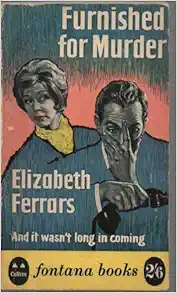
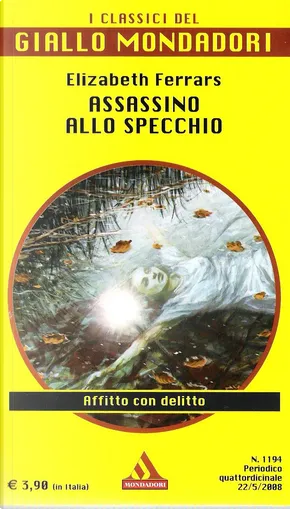
Elizabeth Ferrars: Furnished for Murder, 1957


Morna Doris MacTaggart (1907-1995), was born in Rangoon, Burma to a Scottish father and a German-Irish mother. After other books, she wrote her first mystery in 1940 with Give a Corpse a Bad Name, which was published, like all that followed, under the pseudonym Elizabeth Ferrars (using her mother's maiden name). She was married secondly to Robert Brown, a university professor of botany, in 1951 she followed her husband around the university, moving to New York, then London and finally Edinburgh. An extremely prolific author, Ferrars wrote 71 novels and remained in business until her death in 1995. In 1953 she was a founder of the Crime Writers' Association (which she chaired in 1977) and in 1958 she joined the Detection Club.

She published three series with a fixed character and many novels without:

Toby Dyke series (1940 to 1942: 5 novels)

Virginia and Felix Freer series (1978 to 1992: 8 novels)

Andrew Basnett series (1983 to 1995: 8 novels)

Without fixed character (from 1945 to 1995 : 53 novels)

In the flood of novels, Ferrars perhaps the only rival by number of Christie (she should have surpassed her by one novel), and underestimated for many years, is in constant revaluation: despite the enormous number and therefore understandably the presence of unsuccessful novels, compared to other of her colleagues (for Christie the reference is a must), a much more open attitude to the new, and towards certain "new" aspects: rock music, sex, the beat generation. Even her works, up to the end, maintain a good background, despite their age: something that does not happen in the case of Agatha Christie, whose works of the last few years show clear signs of fatigue and lack of lucidity. For Ferrars, the constant level of her works, even in her old age, was the result of a very rigorous way of life, on which even her origins, partly German, had evident influences. Her best works, according to many, are roughly those from the mid-1950s to the mid-1980s. Nonetheless, her first 5 novels, those by Toby Dyke, a contract journalist, & her friend George, an ex-criminal, are very good. She echoes, only in the unusual pairing, Chesterton's Father Brown & Flambeau. Toby is the classic amateur detective, of Van Dine's memory, but who is decisive for solving the cases is George: a kind of revenge of the proletariat (and of the "sidekick").

The novel, as one would expect from a British author, should have begun with an introduction, as usual in Christie's novels, in which the various characters are introduced, before the crime occurs: this practice, even if it is not present in all the Christian work, however, has a very marked evidence. Instead, in this novel by Ferrars, a novel which, as we have said, belongs to the 1950s, i.e. one of the most fruitful and inspiring periods, none of this happens. First of all, the crime takes place at least 100 pages from the beginning of the story, and in these 100 pages, the characters appear one after the other without a precise role; they are elusive characters, whose classification in the tragic plot is not well understood for a long time.

WARNING: SPOILERS !!!

Meg and Marcus are a couple who live in a house that is too big for them, as they are childless: he is a writer, but he doesn't earn much and therefore she rents an apartment in the cottage to a guy who arrives by Jaguar and whose name is Gerald Chilby . This fellow soon begins to ask strange questions about the Priory, a house that was originally a convent then destroyed during the Reformation, and about who lives there.

To inherit it should have been Kate Hawthorne, a young woman who had been adopted by Miss Velden, mistress of the Priory and other properties. Except that her old woman dying, she had changed the will and named her nephew Richard as her heir, excluding the young woman from her inheritance. The reason? The love between Kate and Roger Cronan. Roger was married to Daphne who had left him for someone, and so he had found love in Kate's arms. But then Daphne had returned, and realizing that her husband had decided to divorce her, he had threatened to kill himself. Roger had kept Daphne, and Kate had left. But her aunt had died before her, and the will had been changed. Now this Gerald Chilby goes around asking for information on the Priory: why? And these questions are certainly not without purpose, if it is true that he himself – before he is attributed a role in the story, when one thinks he is just a shady or in any case ambiguous type – insinuates that Miss Velden's death was not bronchitis as everyone accepted to have been and is surprised that there hasn't been an investigation: "..An old lady, a country doctor, and everyone is fully satisfied" (chapter 6, pages 66-67), when no one has yet thought of exhuming his body. Who is he, and why is he asking these questions?


Moreover, the story is already ambiguous in itself, it becomes more so when it becomes known that someone has spread that Richard Velden, that is the one who inherited the priory with the annexed properties, is an imposter. The fact is that Richard left when he was a boy, and came back already a man. But he proposes a settlement on the property to Kate who doesn't expect it, and he always answers interested questions with precise memories that intersect with those of Kate and which answer the truth. So is it him or isn't it him? Doubt creeps into the reader, and involves another of whom nothing is known, Chilby: isn't it him? Chilby shouldn't know Richard, but then, from conjectures made and which we see later answer the truth, he ascertains that it was a phone call from Chilby to Richard that caused the upheaval, a phone call that was intercepted by Daphne, that no one had invited to the Priory, but who had entered.

Why is Richard deathly pale? What does Chilby know that's so important?

It is following this phone call that the infernal machine moves: while Chilby is out of the house, someone enters it and steals something that is vital to him. Chilby thinks it was Kate, but it was Daphne instead. From the moment this stolen document reaches him, her life is worth nothing and she is killed. Shortly afterwards Chilby will also be killed, with his gun.

Daphne will be found by Richard in the water, and he will notify the police at the home of the widow Thea Arkwright, who is in love with her.

At this point the investigations are entrusted to Inspector Wylie who, with uncommon gifts of sagacity, manages to come out of the quagmire of things said and unsaid, and through increasingly daring hypotheses that affect all the characters in the drama, manages to give a sense of things and to frame a premeditated criminal plan, which had had the end of killing the old lady, and to answer some questions: why had Kate destroyed the will that named her heir, and which lay half-burned on the floor near the fireplace? Who had burned him if it hadn't been Miss Velden as had first been assumed? Who had advised the lawyer of the will to change the will, if the phone call had taken place when the lady had passed away? What was Chilby holding that had cost him and Daphne their lives? To whom was referred a note from Chilby about her appointment at 7.30 with a certain D.V. ? one could hypothesize that it was Richard Valden because (I had assumed it before it was mentioned) in English Dick is diminutive of Richard. But.. accused of the crimes, he knows how to get out thanks to unassailable alibis.

In a park of possible suspects ranging from Roger, the husband who no longer loved his wife, to Kate, the rival in love, to Marcus, who sometimes bordered on moments of madness, to Richard, whose role is not understood, important even if he was far away in all the crimes even of his aunt, to Thea who is in love with Richard and could have killed for him, but that when she arrived in the village, Richard had not yet returned from abroad and therefore did not know him , Wylie will nail the evil killer.


THE END OF SPOILERS


The novel is beautiful, it is fair to say. I would say a small masterpiece.

The descriptions of the characters are all-round, withering. And the relationships between them are not only hinted at, but explored in all their possible characteristics. Yes, it is a deductive novel, but it is above all from a psychological point of view: if until Daphne's death, the 100 pages are themselves an introduction, a very long introduction, from that moment on, everything changes perspective, and they are the same characters, as the story goes on, to define the framework of the situation: while in the classic investigation, the witness is reticent and the detective has to discover, through a whole series of questions, the truth, that it comes to the surface little by little, and it is the main actors of the drama, Roger and Kate and Miss Harbottle, the village spinster who knows everything, who dispel the veil at least in its most hidden truths, which do not frame the murderer, but at least help to make the picture more outlined: the old lady, despite being against the love between Roger and Kate, did not want to disinherit her; the new will did not exist nor had it ever been thought of; Kate had found the sheet of the will half burned and she had burned it completely herself, after the discovery of her aunt's body, because by attributing to her a desire to disinherit her that she had not had, for ethical correctness she had wanted to respect a will of her aunt, which however there hadn't been. So for that alone Richard had been involved while he was overseas. In short, a great mess!

Elizabeth Ferrars turns out to be a writer of race, very underrated, compared to many other authors of her time. Of course, as I said in the introduction, having written more than seventy novels, inevitably some novels may not have turned out well, but, if you have been churning out great novels for thirty years, there must have been some reason! This however is a little gem.

The reason lies, also and not only in itself, as in the basic idea of Ferrars which polarizes all the novels starting from the end of the 40s, that is when abandoning the series of Toby and Dyke, which is directly connected to the age of gold, of the amateur detective, Ferrars evolves the structure of the British detective novel, much more than Christie did: essentially, he sets his dramas in country houses, where the gentry does not act, as in Christie's typical novels (but also by Heyer), but normal people, as Curtis Evans says : “..regular people" (in practice this means white, college educated professional types)". Curtis adds: "One Fifties crime fiction critic referred to these books as "country cottage" mysteries, distinguishing them from the country house mysteries of the Golden Age. Here you tend not to have stuffy gentry and comic servants and great mansions and weekend house parties and stolen jewels and bodies bludgeoned in lib raries, but college-educated, middle-class commuter professionals, modernized cottages and bungalows, and grumbling women from the village who come in once week to clean”. Basically "The mysteries of the country houses" of which the critics of the 50s spoke, opposing them to those of the golden age (which are still present in Christie's 50s novels) in which the class of the ancient landed aristocracy acted, connected to military figures, to the curate of the village, to ladies of good society engaged in charitable actions, are those typical of Ferrars' novels in which a society operates which, if anything, is based on people with degrees, who make their way into society: the small bourgeoisie becoming average, compared to the old very conservative small landed aristocracy. It is essentially the middle class, the one already used by Ellery Queen. It's as if Ferrars, even using the typical means of British thriller (the murder in a country house or cottage, if you prefer, the return of the heir, the past abroad of some characters of whom little is known ) wanted to renew it by drawing on the great tradition of the Yankee.


Pietro De Palma

Tuesday, March 21, 2023

Honda Tetsuya (誉田 哲也,) : Strawberry Night ; Omicidio a Mizumoto Park (ストロベリーナイト, 2006 )


 Murder in Mizumoto Park, is the first in a series of novels by Honda, which focus on the figure of the Tokyo Homicide Inspector, Reiko Himekawa.

The novel takes place in Tokyo, in the month of August: five parts of which the first three, anticipated in substance by a kind of prologue, with which the one who is understood to be the murderer, completes the murder of his parents , addicts and delinquents lost, then burning them together with the house; she then joins a gang; and finally under the name of F, she becomes the killer of an attraction known as Strawberry Night. In these sorts of prologues, at least at first glance, with a very raw and direct type of language, it would seem to be a novel ideally linked to the hardboiled or to contemporary American crime fiction, and instead.. reading the rest of the five parts of which composes the novel, it can undoubtedly be said that it is a precedural, which in its movements is slow as are the very complex and difficult investigations, and then in the last part it suddenly wakes up and picks up pace up to the absolutely original ending, at least not in line with what one would have expected midway through the book.

For the gloom of the narration, and also for the merciless description of contemporary Japanese society, and of the police force itself, it recalls certain American films, such as Robert Aldrich's The Choirboys and Japanese films such as Ryū Murakami's Tokyo Decadence, and also certain Hillary novels Waugh for the kind of very gray almost black, pessimistic procedural.

Reiko Himekawa is a twenty-seven-year-old Tokyo Police inspector, well liked by her boss, Captain Haruo Imaizumi, leader of Unit 10, of the Homicide Squad: she became an inspector only with her will, but in the still patriarchal Japanese society, she is seen with suspect and even condescendingly, even if in his team he enjoys an excellent relationship with his subordinates and with his superiors. Despite this, her everyday life sees her having a very conflicting relationship with her relatives, as her independence is not so much accepted and instead she is repeatedly asked to get married and return to the home. ,. Precisely this lack of symmetry between her conception of personal and social affirmation and that of her family of origin spurs her even more to find ever greater satisfaction in her work in the police.

So then a case that happens to her in August finds her immediately ready to immerse herself in it, all the more so as she avoids having her relatives in the way: a corpse was found at a crossroads near a small lake, in Mizumoto Park, a corpse wrapped in plastic, in an advanced state of decomposition. It will be discovered that it is a certain Taiichi Kanebara, a thirty-one year old from Nakano, whose completely naked body presents an infinite series of more or less serious wounds up to the fatal one in the neck that slain his throat. Furthermore, very strange thing, he has a huge wound in his belly, inflicted post-mortem, which no one can explain, and the most bizarre hypotheses are made about it, even with regard to drugs. Why was he wrapped in plastic, but left in plain sight, when he could have been thrown in the lake?


Many are wondering, including the inspector, who however reasoning arrives at the reason for the injury. In addition, the lake has a sign which strictly prohibits bathing. It is then that Reiko makes a strange instinctive association: she connects the pond with the death a few days before of a certain Yasuyuki Fukazawa, who had drunk without meaning to some water containing a certain amoeba, which then had literally eaten his brain. What if that was the pond in which the amoeba was present? In that case it could also have been hypothesized that Yasuyuki Fukazawa was the one who should have thrown the body into the pond, but he couldn't do it because in the meantime he was dead. The wound would have been a ploy to prevent the putrefactive gases from inflating the abdomen of the corpse, making it re-emerge. And therefore, it would also have been possible that there was something else on the bottom of the lake. And in general disbelief, Reiko manages to convince the high ranks to do research in the pond, which leads to the discovery of another more decomposed corpse, dating back to at least a month earlier. From the dental impressions, it is also possible to give a name to this second body: it is a very brilliant creative mind in the field of advertising, a certain Yukio Namekawa, a successful thirty-eight year old, with a very high number of women with whom he had sex besides having a wife and lover. This guy, however, he had periods in which he was very down, to which he was however counterbalanced by other periods in which he had a superhuman energy which he poured above all into his work. With the continuation of the investigation, Reiko learns that the period of exaltation of Namekawa always began with the second half of the month, the day in which he was untraceable. What happened on that second Sunday of the month? Reiko will discover that everything is connected to an imaginary "Strawberry Night" website, normally untraceable and located in the so-called deep internet, a site that promises those who view it an unforgettable experience: being able to see someone die live, chosen at random in the public. It is obvious that whoever was not chosen and saw someone else die received an enormous adrenaline rush, consisting in the awareness of having escaped it and at the same time in the willingness to give everything in the month that would follow until another appointment with death from I live. Reiko and the partner that her boss has chosen to work with her, Inspector Katsumata, hated by her, will find themselves working together, and after discovering many other corpses, they will know an uncomfortable truth, the only one for which Yazuka, having learned of this shocking spectacle, had pulled out of it. And in an equally unexpected ending, they will be able to stop murderer and accomplices hidden in the shadows.

Honda's novel, despite the fact that at the beginning it had somewhat shaken me with its very direct and unrefined language (which wanted to be unrefined, to outline such a reality), in reality I really liked it later. It follows Western yellow models in which the precedural is used in very long and complex investigations, in which despite having little as clues, with the power of intuition and deduction, it is possible to reconstruct absolutely little proven truths, only relying on a few clues . Hillary Waugh's novels such as Sleep Long My Love, 1959 or A Rag and a Bone, 1954 would come to mind. , of an audience that enjoys death, also satisfying the risk of being chosen instead of the unfortunate person tied to the center of the lights and tortured to death, even films like Eli Roth's Hostel. In other words, it is a procedural but with very black hues, which also borders on horror (slightly, but as much as it takes to outline a shocking truth, connected with the degeneration of Japanese society, dedicated to work and nothing else and devoid of real stimuli).

Beyond this, in a certain sense it is also a social novel, because it takes a look at society, and its traditional models which sometimes clash clearly with what are the demands of the contemporary world: the woman, who according to parameters Westerners, tends to affirm herself more and more, but which cannot escape both those who would like her at home to raise their children, and those who cannot bear that the affirmation of women takes her away from male authority, and therefore makes fun of his work successes.

Inspector Kensaku Katsumata, inspector of the homicide of the metropolitan police, foreman of Unit 5, interprets this macho attitude, but in the extraordinary finale, he will overturn this license of his, with a hidden attitude, much closer to Reiko, than she herself imagined.

To put it this way, the novel would seem like a little thing, and instead it is a powerful novel, which manages to conquer and outline shocking truths, the most shocking of which, can already be guessed before the murder of the policeman Otsuka, a friend of Reiko, but which then, acclaimed and trumpeted, recalls distant novels and one in particular French from the early twentieth century. In other words, that this novel was not born suddenly like a cabbage, but rests on the very solid foundations of the historicized crime novel of Western origin.

And the murderer? He/she too is the victim of this society which is the daughter of the economic miracle, of a society which is also violent, and which ends up creating many dissociated models. And the murderer is also one of these mentally ill subjects, even treated in a psychiatric hospital, who has cured his own self-harm, with the will to hurt and kill others and who draws his own satisfaction from blood from seeing his world gray and dull, shine with the brilliance of blood. But before being an insane subject, he was a normal person, raped and beaten repeatedly in the family. However, this way of approaching the murderer is not an end in itself. In a certain sense, a parallelism can be drawn between the murderer who curiously in his delirium will associate Reiko with Mako, the only person who in his past had shown her friend, and therefore will save the inspector from certain death, and Reiko herself: in fact both, murderer and policewoman, have a past of violence and abuses in common, which however have generated two different futures: that of F, has materialized in evil, in killing and torturing others; Reiko's, in wanting to become a policewoman, to try to prevent what had happened to her from happening to others as well.

Pietro De Palma


Thursday, February 16, 2023

Yokomizo Seishi : 犬神家の一族, Inugamike no Ichizoku, 1950-1951 (Italian Edition: L'ascia , il koto e il crisantemo)


The novel was first serialized in magazines in 1950-1951 and then published later. A famous film by Japanese filmmaker Kon Ichigawa was made from the novel.

The novel is written and set in the period following the end of World War II.

WARNING: SPOILERS

Detective Kosuke Kindaichi is reached by a letter from a certain Wakabayashi Hoichiro who begs him to join him in Nasu (Tochigi Prefecture, Honshu Island), a small town on the lake of the same name, to investigate a hereditary succession which according to the sender could be at the basis of a feud. As soon as he arrives at the hotel, Kosuke discovers that Wakabayashi Hoichiro has been killed (it turns out he was poisoned). The event confirms the fears of the victim. Interrogated by the police, he soon becomes a valuable ally of Commissioner Tachibana who is well aware of the fame of the Japanese investigator. But why was he killed? So no one knows, but a fact is that the victim would have survived and probably would have revealed to Kosuke his fears about

It soon turns out that at the base of everything, is the struggle for the legacy of the Inugami Clan: the old Inugami Sahee died leaving three daughters Matsuko, Takeko and Umeko, whose mothers were not married by the old man, but were l object of his sexual pleasures, in short, his concubines, each housed in a different pavilion of the Western-style building. Matsuko has no husband, while the two sisters do: Takeko's Toranosuke, Umeko's Kokichi. To complicate matters, there are also the grandchildren of the old man: Sukekiyo, son of Matsuko; Suketake and Sayoko, son and daughter of Takeko and Toranosuke; Suketomo, son of Umeko. And as if that weren't enough, it will be known that Aonuma Shizuma son of Aonuma Kikuno also shares the claims, who had been the only woman loved by the old Sahee, much younger than him, forced to hide after giving birth to a child who would have been the natural heir of the old Sahee, industrial tycoon, and therefore disliked by the three aunts. The old man had given her the golden emblems of the family: an axe, a koto and a chrysanthemum. Whoever had them, would have had the right to administer the Clan's assets. But the woman, joined by the old man's three daughters, had been forced to hand over the three objects, to prevent her son from being injured or killed by the three women.


The will of which the notary Furudate is the depositary will increase the hatred and the power struggle existing within the Clan, assigning the task of settling the dispute, establishing who will inherit most of the assets , to the young Tamayo, a woman of great beauty, adopted daughter of Sahee, as granddaughter of Nonomiya Daini, a Shinto priest who had been Sahee's main benefactor when he was young, as well as being his lover. However it will be Nonomiya's successor at the Shinto temple, to learn by reading old documents he found, that she was the daughter of Moriko, daughter in turn born from the extramarital relationship between Sahee and Haruko, wife of Nonomiya Daini, and therefore granddaughter by Sahee. That's why she had had a significant part in her inheritance: essentially whoever married her among her three male grandchildren would inherit the Inugami industrial empire.

Soon the woman is stalked by the children of Takeko and Umeko, who each try for their own part, to make inroads into her heart. Then there is also Sukekiyo, who before the war was the one who had been closest to Tamayo, but since he returned, a rubber mask covered his features horribly disfigured by the explosion of a grenade, and no one nourished the little chance that a woman as beautiful as Tamayo could join a man now horribly disfigured. But if she was able to marry anyone, unless they died and in that case she alone would inherit, she would be succeeded by Aonuma Shizuma, who, however, was not known to have ended up with her.


But crimes disturb the precarious coexistence in the Inugami Clan Palace: first Suketomo is found decapitated: in reality the head is found placed one of the four mannequins in the chrysanthemum garden, representing the 4 characters of the Kabuki Theater, while the body is not found and will be found only later in Lake Nasui; then Sutekake will be found tied to a chair and strangled by a Koto rope; finally Sukekiyo will be found upside down in the frozen lake, with his legs apart to symbolize an axe. The crimes seem to recall the three symbols of the family.

To make Takebana's investigation increasingly convoluted and difficult, there is also a phantom demobilized soldier, who stays in small hotels under a convenient name and wanders around the house, proving to know too many things: who is he? Is it Aonuma Shizuma, the son of Sahee and Aonuma Kikuno, or is it Sukekiyo, the son of Matsuko? Indeed at one point Matsuko presented as his son, the man wearing a rubber mask to cover the horror of a face devastated by war, but no one is really sure it's him. And besides, when he touches something that might keep his fingerprints, he too hastens to erase them. Yet when it's the long-awaited moment to confirm one's identity, to affix his fingerprints so that Furudate can compare them with the fingerprints left by the three nephews before the war, in the end it is confirmed that he is indeed Sukekiyo. So why does that something indefinable associated with his person remain? Is it that mask? Will Tamayo's behavior be so strange when he sees him? Why did someone, after beheading Suketake, bother to go and make his body disappear, risking being seen? Who was it that was hiding in Sahee's first house, along the reed bed, washing and eating in the bathroom, the only room not visible from the outside? Was he the one who, after having saved Tamayo's virginity from the aims of Suketomo - who by dishonoring her would have offered to save her by marrying her - killed him? Why did he kill Sukekiyo by sticking him upside down in the ice?

It will be up to Kindaichi Kosuke, settle suspicions and pierce the veil of truth, revealing the twisted plan of a murderer in the shadows and at the same time saving those who accused themselves of the crimes.

 THE END OF THE SPOILERS

Frankly, I don't know which Yokomizo's best novel is, but this is a true masterpiece: a novel in which three horrendous crimes are perpetrated in dreamlike landscapes, in an atmosphere in which hatred, passion, envy, lust mix in an explosive amalgam .

Kosuke plays a role here that goes beyond mere investigative action: he is the true center of the action. In fact, there is a prologue that precedes the discovery of his murdered client. It is centered on Tamayo: in fact, someone has staged some attempted accidents against her and the latest of which consists of a hole made in the boat with which she rows on the placid surface of the lake. Basically, if Kosuke hadn't come to save her, the commissioner of his coming to Nasu would have been saved from him, and would have revealed his fears about some of the hereditary people. And so he saving Tamayo (who would still have been saved by her bodyguard) decrees the death not only of Wakabayashi Hoichiro, but also of all those who will come after her. It's a real needle on the balance. And of the action of the novel, which takes place in the period following the end of the Russo-Japanese treaty, in a war-torn Japan; and the Inugami family, devastated in their affections and interests, in turn become a metaphor for Japan. Moreover, this devastation contrasts with the descriptions of the places: the lake, the snowy landscape, the Japanese gardens. And therefore the comparison that derives from it is all the more stringent.

That it is then a novel derived in part from mechanisms typical of Western mystery, is something that is immediately understood: the series of killings in the family to eliminate the suitors, recalls many novels but many, and also the return of the heir, a characterizing element of the British novel, here it is present in the double hypothesis that it could be Aozuma or Sukekiyo. And after all, even if they are typical elements of the western novel, no one can dispute that they may have been chosen regardless of this, because in feudal Japan how many wars of succession and murders and devastations have there been for power? And with a war that had just ended, with so many dead and missing, how many cases were there also in Japan of men believed dead and then returned, who perhaps aspired to take back what they had left behind, leaving for the war? Another element is the continuous masking and unmasking of the characters according to a mechanism typical of the Feuelliton, which could have been absorbed by Gaston Leroux's novels with Rouletabille, above all the first two: Le mystère de la chambre jaune, and Le parfum de la dame en noir and Leroux's first novel had already been recalled in Kindaichi Kosuke's first adventure, Honjin Satsujin Jiken (本陣殺人事件).

Others in my opinion are the elements that directly or indirectly recall the western novel: first of all the death of Wakabayashi Hoichiro, one of the employees of the Furudate Studio, recalls a novel by Agatha Christie, Murder on the Links, a 1923 novel in which Poirot is sent a letter in which a man who urgently summons him in a case of life and death is found dead, was serialized in the Japanese translation in the magazine Shin Seinen in 1929. And the editor-in-chief of the magazine at that time was Seishi Yokomizo (detail known from Shunichro Futono). So it is certain that Yokomizo took advantage of Christie's gimmick at the right time

Then there is the question of the mask: perhaps Persons Unknown by Edgar Wallace from 1929, but another historical reference is the novel Le Vicomte de Bragelonne by Alexandre Dumas, even more stringent, in which the central element is the Man in the Iron Mask, a man who was forced to wear an iron mask from which he could never be separated (except in certain moments of intimacy). A direct reference to the rubber mask would have been Sauvestre's Fantomas who wears rubber masks for his disguises, but as Shunichro told me, this French novel was translated for the first time in Japan in 1964 and therefore long after the publication of the Japanese novel. Now whether or not Yokomizo has read these novels I don't know; what is certain is that in one way or another they could have provided inputs. I confess another association came to mind: the one with the novel by Claude Aveline, La double mort de Frederic Belot, but Shunichro Futono, friendship on Fb, told me that it was first published in Japanese in 1983, the year after Yokomizo's death.


Finally, the last association that I allow myself to hypothesize about a Western novel is the one that refers to an Italian one: Dante Alighieri's Divine Comedy, translated for the first time from Italian and published in Japanese in 1922, with the title Shinkyoku (literally Divine Song), although already at the beginning of the 1900s, the work was circulating translated from French or German. It was in 1922 that the first complete translation from Italian was prepared by Heizaburo Yamakawa, but the best known and most appreciated translation was that of 1962 by Soichi Nogami. Why allow me to ideally associate Yokomizo with Dante? Because in the third crime, a man is stuck upside down in a frozen lake, with his legs spread, to symbolize an axe. Now there are at least two examples in Dante's Inferno of the Damned inserted into something: the simoniacs those who in the Middle Ages marketed sacred things, whom Dante places in the III Bolgia of the VIII circle, in Canto XIX of the Inferno: the simoniacs are placed upside down in circular holes, with the legs raised and the soles of the feet touched by flames; and, a comparison even closer to us, the traitors of relatives, inserted in the ice (Lago Cocito) up to the head, even if not upside down: in the IX Circle (Canto XXXII). Now, for something that will only be known at the end of the novel, in the final explanation, whoever had been placed upside down in the ice had, in a certain sense, been a parental traitor. Not forgetting that death upside down is historically attributed to George of York, Duke of Clarence, brother of Edward IV and Richard III, drowned in a barrel of Malvasia: George of Clarence had betrayed his brother Edward by conspiring against him.

Why, in my opinion, is Yokomizo's novel a masterpiece? His greatness in this novel lies in continually turning the truths upside down: is Tamayo an unfortunate woman, or is she astute calculator? Is the man wearing a rubber mask Aonuma or Sukekiyo? Is Shizuma's mother Aonuma Kikuno dead or is she hiding under other guises? Why did the demobilized soldier who hides his face save Tamayo and probably kill Suketomo? How come the individual with the mask who was afraid of leaving footprints, is then recognized as the one who had the honor of wanting to be recognized? The continuous change of situations and hypotheses is rendered in such a refined way by Yokomizo Seishi, who reaches peaks of unusual virtuosity. In a certain way it reminded me of Christianna Brand's Cat and Mouse, precisely because of the ability to keep the reader in suspense, continually turning the same thing over and over again: in some ways Brand's enterprise is even more titanic than that of Seishi because while the park of Yokomizo's characters is large, that of Brand is extremely narrow, and therefore the action of the plot is less varied and the ability to keep the reader captivated is due to her in an even more deserved way. And this ability to disguise himself under different guises is not his only, but also Aonuma Kikuno's, since he will take on the appearance of a koto teacher, who occasionally visits the Inugami Clan mansion, to teach koto (and also to see for the last time old Sahee, dead).

It's not a cheerful novel, far from it. It is a desperate novel, just as the situation in Japan was desperate at the time. But the tragedy of the novel is mitigated by the figure of Kosuke and his obsessions, first of all that of scratching his head conspicuously, as well as dressing in a scruffy way. A detective who is in a sense an anti-detective, an anti-hero: not the pomaded Poirot, not the impeccable Philo Vance, not the noble and snobbish Lord Whimsey, but a dark fellow who would go unnoticed and somehow even disgusted for these detestable quirks of his, were he not a highly regarded and respected detective. And above all a genius of the reconstruction of the facts.


Pietro De Palma


P.S.

One thing that surprised me, but not so much, is that the names of some characters change according to the western translations, which strengthens my desire to compare, whenever I can and when I notice something strange in the Italian text, the same with the text basis. This time I realized that the names of the three male grandchildren, in French Sukekiyo Suketake, Suketomo, in Italian have been reported verbatim, but in the English edition they are instead in the meaning Kiyo, Take, Tomo. And so they also appear in the English subtitles of the 1976 film. It would therefore be necessary to compare them with the original edition in Japanese: therefore I turned to some friends on Fb, people I follow and who follow me. Shunichro Futono was the one who gave me more than a hand, whom I have already mentioned and who dispelled all my doubts: both nomenclatures in both the English and French (and Italian) editions are correct. Why? The English one is the original one, the other two add (we don't know why) the prefix Suke which in Japanese is a sort of honorific, noble title that indicates belonging to a family and descent (like my De). Moreover, that the original meanings of the names are Kiyo, Take, Tomo, is confirmed by a fact which is reported in the novel and which explains why in the third crime the victim was placed upside down: because in addition to the shape of the body, it must mean how Kiyo is to be seen backwards, and therefore Yoki (which in Japanese means Axe). And therefore to be related to the three symbols of the family: "Yoki", "Koto" and "Kiku", the axe, the Koto and the Chrysanthemum.