Wednesday, October 5, 2022

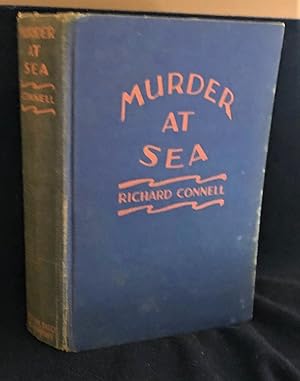
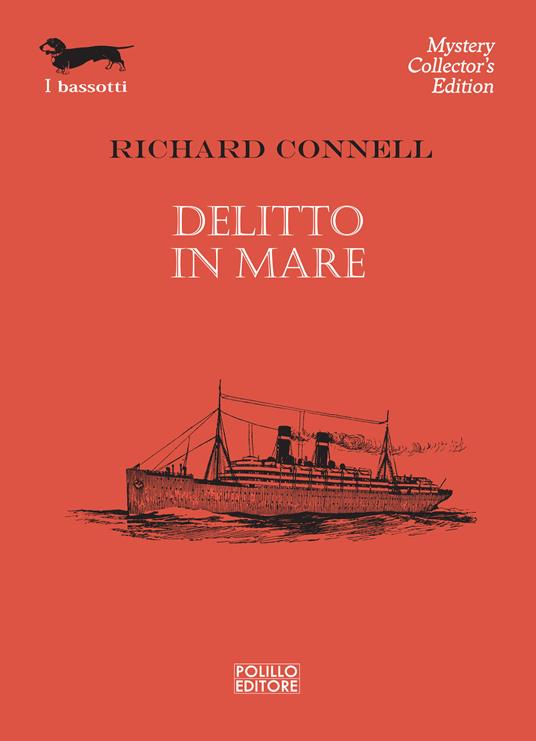
Richard Connell : Murder at Sea, 1929


Richard Connell is a virtually unknown name for anyone who reads detective fiction. The reason is that he was not a prolific author of novels, and is instead known more for his activity as a film and television screenwriter: it is no coincidence that he wrote the screenplay of Frank Capra's Meet John Doe, for which he was nominated for an Oscar. . In the narrative field, he wrote four novels, but only one of these is of the detective genre, and it is the one in question.


WARNING: SPOILERS !!!


Murder at Sea, sees amateur detective Matthew Kelton in action who occasionally collaborates with the police. Due to his health conditions, he decides to embark on the Pendragon steamship to take a sea voyage to Bermuda where he can rest and heal. The beauty is that, as soon as he embarked, and as soon as the ship began its journey, he was disturbed by Captain Gavin who revealed to him how a stewart on board, assigned to one of the cabins, found the body of the man who had taken possession inside. of it, a certain Samuel Cleghorn, an important businessman partner of a famous company that sells wholesale coffee, with a pulverized skull. The presumable time of death should be 5pm or so, because at that time the stewart had talked to Cleghorn and was therefore still alive. Kelton instructed by the captain to unravel the skein before the ship arrives in Bermuda, he must understand who after that hour (presumably at 5, 15-5,20 p.m. because at 6 p.m. when the body was discovered, it already presented rigor mortis) may have committed the murder. And then he begins his inquiries among the other travelers, three of whom are teachers, there is such a Westervelt who is elusive, and so is Varga, then there is Miss Imlay and Mr. Sangerson, Miss Royd (lady of company) and Lady Esther Yate invalid, and finally Mr Mond, such a talkative, who will be discovered after being treated in a psychiatric hospital.

Kelton comes to find himself in a real mess, because several travelers report that sparkling eyes have stared at them in the dark, crazy eyes, only there is no one who has them; yet the subject in question, he even dropped along the side of the ship to look into a porthole at night. Someone then destroyed the ship's radios to isolate it, and if not the same person, another stole expensive perfume bottles owned by passengers from the cabins.

In the course of the story Kelton will learn that the victim, of whom no one knew the past, actually before becoming rich, had been a farm tool trader in Yorkshire, by the name of Jack Murdo and here he had met a girl whom he he was in love, only to abandon her by stealing their son from her, and returning to America as Cleghorn, a partner in a coffee sales company. This sad story of child kidnapping involves three people on the ship, and in turn three of them and a fourth, linked by a profound bond to one of the three, confess themselves to be the perpetrators of the crime. Nevertheless Kelton, due to the incomplete accounts and which place the action in times that do not coincide with those presupposed for the crime, sets aside these four confessions, and after eliminating the owner of the sparkling eyes, who has nothing to do with the crime, and having given a name to the perfume thief, which has nothing to do with the crime, will succeed in a surprising ending to indicate the murderer, despite the fact that all or almost all the travelers only later have actually revealed useful details for the investigations.


The End of Spoilers


The 1929 novel, Murder at Sea, is not what a novel in the wake of Van Dine might seem at first glance, because the detective has none of the typical characters of Philo Vance. I would rather say he may have somehow followed the false lines of the novels of Rufus King, another very famous author in those years, who set his stories almost exclusively at sea. The plot is particularly rich in twists and turns, and given the main activity of the writer, it would have lent itself well to being the basis of a cinematographic film, because in addition to a crime, in the novel there is a mixture of adventure, for an animal escaped from the menagerie time before, hiding in the ship, and a whole series of intertwined but absolutely misleading events, such as the perfume thief, the radio destroyer, the presence of a policeman and a thief in disguise, and two couples of lovers moreover connected to each other, and the hour of death which is then understood not to be the actual one. The result is that the murderer is none of those who had been the subject of the investigation, but another person, who unlike what Van Dine says, does not appear in the action of the novel, except for a tuft of hair that comes found in the victim's bathroom, and although quoted extemporaneously in the novel, he literally falls from the sky in the novel's finale.


 Another oddity of the novel is that if the murderer must have boarded before the ship took off and then got off, how can Kelton trace him back, who has neither seen nor known him? In fact, Kelton employs a certain Mr. Hong from Chinatown, who is his privileged informant, at the head of an organization that sells secrets and information; and it is to him that Kelton turns during the voyage to ask him, via an auxiliary radio, about who knew Cleghorn and the various travelers of the Pendragon. Therefore, the action of the novel cannot be said to be very correct towards the reader, if the detective novel par excellence is the one in which the reader can if he is good at competing with the protagonist of the story in understanding who the culprit is: here this is absolutely impossible, as only the detective has in his possession the crucial information that is made available to the reader only in the solution.

The result is an action-packed novel, written with a brilliant and stylistically very fluent style, which can be read in one day, but which then, despite having solved the various quids in an exhaustive manner, leaves no impression of being a novel that leaves its mark , but more one that serves to distract.


Pietro De Palma

Saturday, October 1, 2022

Helen McCloy : A Question of Time, 1971


                                   Warning : Spoilers !!!

Lisa is an orphan. Her parents were an Italian woman (daughter of a noble), and Rupert Holland, son of Sophronia Holland, heir to a wealthy American (Jewish?) Family. Raised in a convent of nuns in Italy, the child arrives in New York. She does not know anyone in America, yet she is joyfully awaited, especially by Amelia, Rupert's sister, who is married to Hugh Hadueletti, son of the same age, Susan and Roly.

Although Susan does everything to bond with her, Lisa is grumpy: she only manages to bond with Roly, Susan's brother, whom she falls in love with, reciprocated. Youthful loves, adolescents: thirteen, fourteen year old boys. Susan in turn is in love with Jim, a handsome, blond, tall friend of Roly, and Jim with her. From this group are excluded the two twins Heron (a Jewish family too?), Pelléas and Mélisande, children of the neighborhood, envious of the Holland, richer and more fortunate, with whom the girl is in love not reciprocated, of Roly.

One fine day Amelia decides in winter to take everyone ice skating on the lake, and Jim Bandloin, a photography enthusiast, shoots an eight-minute film with the camera. The ending is sad, and seems to anticipate what will later be learned with dismay: the father of Lisa's mother, an Italian Prince, of the Urbani-Pavia family, has tracked down his nephew, and wants her back to Italy. It is not as they are thought to get their hands on the Holland estate, but only for family purposes. So Lisa, especially to Amelia's displeasure, returns to Italy. But before she returns, a very strange thing happens that will have repercussions years later: the Holland house is more similar to a castle than to a villa. And a great ballroom has a singular importance, in which on the two doors that enter it, there are two paintings, one of which is by Goya, which depicts Saturn devouring his children. By chance Lisa enters it, and immediately faints: terrified, she claims to have already entered it and if she enters it again, she will die. Sophronia's doctor, Dr. Neroni, an Italian American, psychiatrist, claims that it is Déjà-Vu, that is a form of alteration of memory (paramnesia), and cites the theories behind it. The fact is, that Lisa is part of her and no one could ever know that after ten years, when she has become a very beautiful girl, she returns to America, after the death of her Italian grandfather.

The returning Lisa, she explains, remembers nothing, absolutely nothing, of the event that had traumatized her ten years earlier: it is how her psyche had, if not removed the memory, at least hidden, so much so that one wonders if it is the Lisa who had arrived ten years earlier, or an impostor (perhaps her cousin Ginevra, who seems to be quite similar). But she remembers Roly, and the two are still in love, and she shows it. Amelia is happy, especially since her children will have a cousin to deal with, now that she is widowed, since her husband who had fled with another, died with his lover in flight. And the ballroom? It remained that it was, only that no longer two entrance doors but only one, the one on which the Goya hangs.

Mélisande is jealous of Lisa because she too is in love with Roly. After so many years, Jim's film is again shown, and then the two brothers, agree, one evening, they manage to lock Lisa from the outside in the ballroom, throwing the key through a window in the garden. . Lisa, who up to that moment remembered nothing of the scene ten years ago, has a furious reaction and furiously bangs her fists on the door for it to be reopened, but these vibrations only have the consequence of having the Goya painting come off on her head, that falls, smashing her skull.

Accident? No.


Captain Elliott, having arrived on the spot, discovers, analyzing the scene of the accident, that the iron wire that held the picture hanging, has been partly dissolved and partly severed. And so it is murder, premeditated: someone had climbed into an antique armchair, at night, twice, two weeks before and a few days before death, and had clumsily operated on the wire.

It won't be Captain Elliott but Dr. Neroni (alter ego of the psychiatrist Basil Willing?) To nail the diabolical killer, who had moved the twins as pawns, tried to kill the old Sophronia in fear during the night, and killed Pelléas who had tried to blackmail him.

Let's say right away that this is a brilliant novel, whose equally brilliant solution adapts wonderfully to the fame that McCloy enjoyed (and still enjoys today): a locked room, absolutely outside the genres, which is linked to a plot in which still once a psychic phenomenon, this time the Deja-Vu (do you remember How was the Doppelganger in a Mirror?), has its basic importance, as well as a certain form of hypnosis.

There are so many things I don't say, and if I did, you'd lose the pleasure of reading this beautifully constructed jewel: the motive is hidden to the end - the ancient Cui Prodest? - and the reader (the undersigned), following the events, wonders several times about who it may be, taking into account that the twins were indictment until the premeditated nature of the crime was discovered. But to no avail. Could it be Mélisande? But how would she have done if she doesn't live in the house? Yet only she has a clear motive: to kill Lisa for Roly's sake. The problem is that there is also the real murderer whose motive is hidden until the end: in this case, it is not precisely the motive that finds out, but three fundamental clues: a modified copy of Goya's painting, in which Saturn has the features of Lisa; a copy of the Memoirs of the Marquise de Créqui, in which a story is quoted in which a painting provoked the insane fear of a girl who later died in the same way as Lisa; and the little film shot ten years earlier, which is, as absurd as it may seem, the murder weapon.

Helen McCloy elaborates a plot of extraordinary impact, in which the Déja-Vu has the value of creating tension and distracting the reader from the true trace, which, at the same time, develops, creating on it a much more subtle plot, hidden however until the last, which has its origin in another psychic phenomenon, the strength of which was evaluated in the seventies, rightly included in hypnosis. In other words, one of the reasons to signify the genius of this novel, is the locked room, which in the time in which it is, does not arise from the presence of a murderer "Vanished into Thin Air" as Carr said, but from a carefully planned plan. studied, so that the victim himself causes his death.

But in addition to this, the genius of the novel lies in having trumpeted a certain truth, instead operating exactly the opposite: it is always about time, A Question of Time, but how it is used becomes fundamental to Neroni, for nail the killer.

Neroni will earn his fame, for having taken the scene from Captain Elliott. But even more ... love.

Masterpiece not yet worthily recognized, by a brilliant writer.


Pietro De Palma

Saturday, September 24, 2022

Vernon Loder : The Shop Window Muders, 1930


 WARNING : SPOILERS !!!


Vernon Loder was a pseudonym of John George Haslette Vahey (1881-1938), an Anglo-Irish writer who also wrote as Henrietta Clandon, John Haslette, Anthony Lang, John Mowbray and Walter Proudfoot. He worked as an architect before venturing into creative writing. Vahey died on June 15, 1938. He was an extraordinarily prolific author: he published 59 books in the period 1925-1938. His work as a Loder was of high quality, as the Collins Crime Club was selective.

With pseudonym of Vernon Loder, John George Haslette Vahey pulished 22 novels:

The Mystery at Stowe (1928)

Whose Hand? (1929) (in USA come Between Twelve and One)

The Vase Mystery (1929)

The Shop Window Murders (1930)

The Essex Murders (1930) (in USA come The Death Pool) - con Ispettore Brews

Death of an Editor (1931) - con Ispettorer Brews

Red Stain (1931)

Death in the Thicket (1932)

Death at the Wheel (1933)

Suspicion (1933)

Murder from Three Angles (1934) - con Capo IspettoreChace

Two Dead (1934)

Death at the Horse Show (1935) - con Capo Ispettore Chace

The Case of the Dead Doctor (1935)

Ship of Secrets (1936)

The Deaf Mute Murders (1936)

The Little Man Murders (1936)

Choose Your Weapon (1937)

The Men with the Double Faces (1937) - con Donald Cairn

A Wolf in the Fold (1938) - con Donald Cairn

The Button in the Plate (1938)

Kill in the Ring (1938)

The novel opens in a very unusual way: the Loder Warehouses are warehouses that have met with enormous success and a crowd of onlookers waits for them to open every day. When the shutters are lifted, after a first moment of bewilderment at the window dressing, you hear the first screams, when you see next to the mannequins, two bodies that do not seem to be such, and that turn out to be Tobias Mander, the owner , and Miss Tumour: the first killed with a gunshot wound, the second with a knife.

Immediately the investigations entrusted to Inspector Davenish proved difficult, due to the enormous problematic nature of the evidence: strips of mud were found on the roof, which seem to have been left by the wheels of a gyroplane; in an elevator, consistent blood traces were found, under the carpet which is clean; at night an engine noise was heard, but engines are in the workshops in the warehouses; at the speaker station where the caretaker Mann is, it turns out that the speakers have been disconnected due to a suitably cut wire; a Mauser gun was found in front of the bodies, which fired but not the bullet that killed Mander, and the bullet that killed him is not found; on the roof, after careful investigations, in one of the sandbags used to brake the wheels of the gyroplanes, a bullet is found, but which does not show any blood traces; bruises were found on the Tumor's arms, as if she herself had been grabbed from behind and pushed; a precious matchbox is found in the alley near the warehouses, which belongs to Jameson Peden-Hythe son of Mrs. Peden-Hythe, Mander's very wealthy financier; Jameson hated Mander; Webley, a mechanic, proves to have been perhaps the inspirer of the Gyroplane, as well as Cane, head of the department, from which Mander made huge profits; Robert Kephim, director of the department stores, was engaged to Miss Tumour, who later turns out to have also been in intimate contact with Mander, who in turn seems to have made Mrs. Peden-Hythe infatuated with him, to the point of obtaining the financing necessary to open the department stores; Miss Tumour's coat, hat, and glove are missing; finally, it turns out that Mann had been Jameson Peden-Hythe's attendant and had been recommended by him to the post of caretaker; the coat and the hat, are found together with others equal in the clothing departments of the warehouses.

Davenish, after very long and full of obstacles investigations, will manage to find the person responsible for the murder of the girl and the one for the murder of Mander.


The novel is a classic whodunnit, which is structured halfway between a procedural and a detection novel, and in this case the protagonist is Davenish, Inspector of Scotland Yard, who conducts the investigations, also helped by Melis, deputy commissioner of Scotland Yard.

Immediately, the presentation of the murders in this novel already brings to mind another novel of the same years, which presents a murder at the opening of the window: The French Powder Mystery (1930) by Ellery Queen. The interesting thing is that both novels, that of Ellery Queen and ours of Vernon Loder, are from 1930. Doug Greene, questioned by me, revealed to me that Vernon Loder's novel had an American edition, always in 1930. It would be necessary to see at this point which of the two appeared first in the USA, to understand which was the archetype and which the next: in my opinion, was published before the Loder e then the novel by Queen, but  it is certain that, if the opening of the novel is similar, almost the same, the two novels evolve differently in two whodunnit, absolutely different.

For how the novel proceeds, and for the pace, which is sometimes very bland, and also for the enormous number of clues, even misleading, and for the high number of true and false clues, the novel is exhausting, like well someone says. We can't wait for the end to come to understand something, because the clues are so many, and many have a double exit, one true and one false: it must be said that Loder's narrative vein very often directs the reader to a track. false, only to adjust the shot. It must therefore be acknowledged that the writer managed to get to the bottom of the novel with an acceptable solution. The only quid that is not explained and resolved is why Miss Tumour was killed: Loder through Davenish proposes that it was carried out on impulse and not premeditated, precisely by virtue of the use of the knife. However, it must also be emphasized that all the clues, whether they turn into evidence or are false, are available to the reader for months; despite this, the identification of the culprit, even if it originates from a confession of guilt of the murderer, is not based on a tangible basis, which can be the weapon used because according to the murderer this has been hidden in a place where no one never would have seen. And therefore, if the culprit, under psychological pressure, revealed everything, if instead he had not revealed that he had a .32 caliber pistol, no one could have blamed him. This is the only weak point of the story: Devenish is convinced that the culprit must necessarily be a determined person, because necessarily he should have had a gun, because others with his duties have it, and therefore assumed that he had to have a gun, that's where the bullet that killed Mander came from.

All the confusion of the clues derives from a precise design of the culprit, which pursues two purposes: to throw dust in the face of those who must investigate, and at the same time not to provide precise false leads to indict other innocent people.

I may be a fool, sir, and acted hasty—me being in
such a funk and getting the wind up proper when I saw the masked man come
up in the lift—but I did not want an innocent person had up for what I had
done accident-like. It seemed to me the only thing was to make everything as
confusing as possible so no one would be proved guilty.’
(Chapter 25)

In short, he is not a bad killer. Which would seem an oxymoron. But then it will be seen that he is not.

Pietro De Palma

P.S.

The gyroplane, on which a lot of the novel rotates, it is good to say, is a vehicle with a large propeller above it, which can only fly forward, like an airplane, but being very light, it must be used in the absence of wind, which otherwise could condition its tightness. It is the forerunner of the helicopter, which however lacks the rear rotor; when it starts it does not climb vertically like a helicopter, but leaps forward, like a locust.