Wednesday, March 18, 2026

Nina Bawden: Who Calls the Tune? , 1953 (U.S. Edition : Eyes of Green)


Today we're talking about a little-known writer, at least in the sense of a crime fiction writer: Nina Bawden.

Who was she? One of the most prolific British writers of all time, who, after writing seven detective novels, found fame publishing numerous children's novels.

Nina Mary Bawden CBE (January 19, 1925 – August 22, 2012) was born Nina Mary Mabey in 1925 in Ilford, Essex, England. Her mother was a teacher and her father a member of the Royal Marines. Immediately after World War II, she earned a degree in Philosophy, Politics, and Economics from Somerville College, Oxford. She was married twice: first to Harry Bawden until 1954, and then to Austen Cark in 1954. She had two sons from her first marriage and a daughter, Perdita, who died in March 2012, from her second. Bawden was seriously injured in a train accident that also killed her husband. She died in London on August 22, 2012. She was awarded the CBE, the highest British honor (Commander British Empire) in 1995. She wrote 55 novels. Of these, the first seven are mysteries, the others are children's books. She was shortlisted for the Booker Prize in 1987 and the Lost Man Booker Prize in 2010. She received the Golden PEN Award.

Her crime novels, in order, are:

Who Calls the Tune? (1953)

The Odd Flamingo (1954)

Change Here for Babylon (1955)

The Solitary Child (1956)

Devil by the Sea (1957)

Just Like a Lady (1960)

In Honour Bound (1961).


WARNING : SPOILERS 

Venetia is a beautiful and passionate woman. She could have had it all, if a bomb hadn't crushed her leg during the war, which was later amputated. And so, at fourteen, life turned against her: while others her age were enjoying their youth, she began to hate it, because she had matured too soon. And her illness had changed her forever, for the worse: it had made her more cynical, tougher, even, in a certain sense, more evil. She had begun to exert a certain fascination on men. Her first lover had been Paul, but one day the two had gone their separate ways: Venetia, infatuated with Harry, had married him, while Paul had married Betty. Two failed marriages. But while Paul had accepted the end of the relationship, Venetia had not; she would never have tolerated a man dumping her, even though in the meantime she had accumulated affair after affair and lover after lover. So one day, she convinced her sister Brigit, whom she discovered was her husband's lover, to come stay at her house, just to torment them. Then at Christmas, someone tried to poison Brigit's son Sebastian with arsenic dissolved in his soup.

Venetia invites Paul to her home. Paul, remembering his great love, accepts the invitation, only to find her flirting with a certain Tom Augsburg, an Englishman who had moved to Austria during the war and then fled to America after 1945 (he had collaborated with the Germans to avenge his treatment in his homeland). There, he met Sophie, a young woman he had brought with him and passed off as his daughter, even though she was his lover.

As soon as everyone is together that evening, it's clear something is about to happen: the atmosphere is unhealthy, corrupt, due to Venetia's behavior. That night, Venetia disappears during a snowstorm. She is found frozen in a quarry. At first, people think it was suicide or an accident, but Tom, confiding in Paul, believes it was murder: her skin color is reddish, a sign of carbon monoxide poisoning.

After this, it's Tom's turn to disappear, only to be found hanging from the beam of a cabin near the house.

It's unclear what could have happened, how, or why Tom died (indeed, this is the darkest part of the novel, which isn't explained): let's just say Tom pays for the betrayal he gave Sophie. But then another inexplicable event occurs, which could have resulted in another death: someone poisoned with chloral a flask of cognac that Paul had on his bedside table, which Sebastian had secretly taken, swallowing a swig. In short, someone had wanted to stun Paul almost to death, but then nearly killed Sebastian.

 
There were two identical flasks, one belonging to Venetia and one to Paul, both full of cognac, which Paul had filled with excellent cognac years earlier. Paul's flask had a scratch on it, and that's what Paul would expect when he takes his flask to give it to the police for analysis. Instead, he doesn't find the scratch, while his flask with the scratch is found where Venetia's flask should have been, in one of her hatboxes. Essentially, a mix-up of flasks: essentially, Venetia had tried to poison Paul, because no one else knew about the hiding place. Why would Venetia want to stun Paul, risking his life? To keep him from realizing she was about to meet and spend a night of love with Tom?

A very intricate plot, with no clear solution—namely, who might have poisoned Venetia, who in turn had poisoned Paul's cognac and ended up poisoning Sebastian—until Harry is arrested on charges of having met Venetia on the night of the murder and murdering her. After all, when a wife dies from murder, the first suspect is always the husband. Sophie could now exonerate Harry by claiming Tom, because Tom and Venetia were supposed to meet that night in a room above the garage, but she doesn't because, jealous of Tom, she had managed to prevent him from meeting his lover, ending up in bed with him. So, in the absence of further developments, Harry is charged with premeditated murder, arrested, and awaiting trial. At this point, the narrative picks up pace, introducing past events shared by the murderer and Venetia, including Caroline's death, which is later revealed to have been killed by Venetia out of jealousy, leading to the tragic conclusion.

END OF SPOILERS 

This is an unforgettable novel by Bawden. The narrative, written in the first person (we won't say by whom) from the very beginning, has the merit of making the reader identify with the narrator, who then experiences the extremely intricate plot firsthand: the novel begins as a mystery, continues as an increasingly dark noir, and at the end, with the identification of the murderer, a Christie novel is cited.

The Noir novel has some distinctive characteristics: a powerfully leaden atmosphere that from the first moment swirls around Venetia, her lovers' tormentor and victim at the same time, who we immediately understand will be the novel's dark side: she is, after all, the Femme Fatale. The detective, Winkler, is a completely unspectacular character, albeit a very insightful one. He's not the hero, however: the heroes are Harry, in his utterly hopeless life; Sophie, a kept woman full of love and compassion but also jealous; Paul, another star-crossed lover, stumbled into a relentless vortex that affects everything and everyone, even bringing to light old, bitter memories; Brigit, who until Sebastian's second poisoning was a completely dull character, then acquires a soul and remorse that finally establish her not only as a lover but also as a mother concerned for her son. The curious thing is that the four heroes, that is, the four figures around which the plot inexorably revolves, can also embody the role of the murderer.


The writing and style are exquisite, and indeed, nothing else could we have expected from an Oxford graduate: the psychological descriptions and intense atmospheres, brimming with pain and hatred, gradually create a jungle of conflicting sensations and feelings, disorienting the reader, who, until twenty pages from the end, is left unclear as to who the murderer might be. And after all, Bawden's novel is less a classic whodunnit than a family drama, constantly presenting different perspectives and ever-changing insights into the characters in the drama: essentially, the only one who isn't interested is the young boy Sebastian, who is instead a potential victim twice, while everyone else has excellent reasons and therefore a motive to be investigated for the murder: Tom, Harry, Brigit, Sophie, and even Paul: jealousy, hatred, various humiliations.

The ending, while a fitting conclusion to a spectacular novel, has almost psychoanalytic overtones: the murderer begins to behave paranoidly, with completely irrational behavior, which in theory should arouse Winkler's suspicion, but which in reality is due to nothing more than the weight of guilt, combined with an unconscious desire to be discovered: it is not just remorse for the murder, but also the excessive things he had swallowed over time for love of Venetia, to the point of even covering up a murder.

In essence, the novel is a noir of rare power, and if not noir, then at least a "noir" novel, brimming with atmosphere and constantly misleading developments. The only flaw, not fully developed, concerns Tom's death, which isn't even framed as the act of suicide, as a possible murderer overcome by remorse—unless, in a first draft, this wasn't the case and was later replaced by an even more complicated development.

An unforgettable novel, whose persistent presence of drama and melancholy reminded me of Lovesey's first novel with Diamond, The Lost Detective, and Pierre Magnan's Le Sang des Artrides.


Pietro De Palma 


Friday, March 13, 2026

Anthony Gilbert : Don't Open the Door, 1945 (U.S. : Death Lifts the Latch, 1945)


Her name was Lucy Beatrice Malleson, cousin of the great British actor and playwright Miles Malleson, and she was a crime novelist by profession. However, no one knew her under this name because she was more famous under the pseudonym Anthony Gilbert. Under this pseudonym (others included J. Kilmeny Kaith and Anne Meredith), she published 69 novels, 51 of which featured detective lawyer Arthur Crook. It should be noted, however, that the writer had attempted to write just over a dozen other novels under the same pseudonym, starting in 1927: in fact, her very first novel was The Tragedy At Freyne. From his first novel, Murder by Experts, in 1936, this new detective was immediately popular. Also because, unlike his other colleagues, he introduced a unique way of appearing on the scene: instead of playing the usual role of a 1930s detective—that is, bringing the culprit to justice after a sharp analysis—he enters the scene when his client has been accused of a crime or is otherwise involved in some kind of trouble. Even in this novel, Don't Open the Door, from 1945 (in U.S. published like Death Lifts the Latch), Arthur Crook enters the scene after at least half a book, and he does so because his client has been singled out as the kidnapper of the beauty of the moment. But...let's take it in order.

Nora Deane is a beautiful orphan who lived with her aunt in Scotland until she died. Alone and with little money, she goes to England to work as a nurse, putting her experience at the service of those in need of domestic assistance. This is what happens when she is sent to the home of Alfred and Adele Newstead. The evening itself, with a fog so thick it could make anyone unfamiliar with the place apprehensive, bodes ill. Moreover, after a delay of over three hours due to a blocked train line, Nora happens to be greeted by an extremely suspicious and unpleasant Alfred Newstead, who barely conceals his distaste for anyone in the house. Thankfully, at least she had been accompanied to the house by a handsome young man she had met on the street, Sammy Parker, who had suggested they have lunch the next day.

She immediately realizes something is wrong: his wife, who according to her husband is suffering only from a nervous disorder, is actually very ill. And although he, after assigning her the terrifyingly ugly and shabby room, warns her not to listen to his wife, she approaches her, just to understand from the woman's tone of voice that Adele is afraid of her husband; so much so that she implores the girl to take a small book from the desk and give it to the woman's brother, Herbert. She barely has time to pocket the notebook when her husband appears, bringing her a cup of tea. After drinking the drink, she suddenly realizes she's been drugged, and when she wakes up, at after 6 a.m., Adele is dead.

The doctor, called by her husband, despite suspecting him of uxoricide by means of an enormous dose of sleeping pills (three more pills than prescribed were missing from a tube of pills provided by the doctor), decides not to intervene and nevertheless signs the death certificate. This is also because the girl's testimony, while raising doubts and uncertainties about the actual behavior of her husband, who claims innocence, proves nothing more than a simple clue. And he, who in the past has caused the arrest of a person for uxoricide, who was later declared innocent and who nevertheless committed suicide, does not want to have anyone else on his conscience.

So Nora returns home, to be sent to another house. Meanwhile, the funeral has taken place, and Alfred has disappeared, disappearing without a trace.

Nora contacts Herbert to deliver the booklet and discovers that the dead woman's brother also suspects his brother-in-law of uxoricide, especially since his wife had long suspected her husband of cheating on her with prostitutes: one of them is Hattie Forbes, the couple's neighbor. Then the lawyer also disappears.

One day, while Nora is working at the home of an elderly spinster, she reads in the newspaper that a decomposing body has been found in a quarry. A watch on his wrist identifies it as Alfred Newstead. The investigation then points to Herbert. Could he have avenged his sister? But when the old woman reveals everything to her nephew, Roger Trentham, a journalist, Nora becomes a danger to the killer, creating front-page scoops about the nurse and her alleged revelations. And so it happens that on the basis of two fake telegrams, she falls into the arms of the murderer, who has planned a fake car accident for her death.

At this point, Arthur Croock enters the picture, summoned by Sammy Parker, who instantly fell in love with the beautiful girl, whose fictitious name appears on the two telegrams sent to her. Everyone thinks it's Sammy who kidnapped her, but instead...

Don't Open the Door (published in the US in 1946 under the other title Death Lifts the Latch) is a good thriller, which thrives solely on suspense and not on the identity of the murderer, who is very easy to identify. And the author's attempt to invent a mistaken identity (there's another murder) isn't enough to distract the reader from the confirmed or quasi-confessional killer: after all, the novel doesn't have a vast pool of suspects, something found, for example, in the novels of Ngaio Marsh or Georgette Heyer or Agatha Christie, but an extremely limited one: whether it's the husband, an unrepentant, untrustworthy womanizer; or the brother, avid for money; or the beautiful and easy-going Hattie, it's a short step. This is because Anthony Gilbert doesn't use psychology as his winning weapon, but rather tension, of which he is master: he uses the old trick of atmosphere (thick fog, dark evening, deserted places, a gloomy house lit by candles, dust everywhere) and combines it with a story with dark undertones: a depressed wife, who has already attempted suicide once, in the hands of a husband who would be very happy if she were dead, and who has entrusted her defense to a brother who cares not about his sister's happiness but about her money, and who would be very happy if he could prove his brother-in-law's guilt; sleeping pills used too easily; secret letters; the presence of another woman, who would return to take her place, declared by the sick woman to Nora; the woman's death under extremely suspicious circumstances. And then everything that follows, with the nurse, who, according to the killer's intentions, should have been minding her own business but who, instead, finds herself the target of an ideal newspaper article. And the race against time to save her. The novel has a fairly high level of tension, not because the killer's identity is unknown, which is obvious, but because the heroine, who is about to be killed as an eyewitness, must be found as quickly as possible. However, the moment the heroine is saved, the novel loses its edge, because everyone has figured out who the killer is.


The novel, which dates back to 1945, sets the story after the war ended, even though it hadn't yet: in this case, the way the story is structured (the darkness, the fog, the death contrasted with the girl's liberation and with love) would also make me think of a reference to the war that was being fought and was coming to an end, a representation of contrasting states of mind (fear, terror, courage, serenity).

It also, in my opinion, pays tribute to the entire cinema that was alive in those years: how can we not think of films like Suspicion, 1941, based on Berkeley's novel, Before The Fact, 1932, in which Cary Grant is suspected by his wife, Joan Fontaine, of wanting to poison her to steal her money, a resounding box office success? The film's famous shot of Cary Grant walking up the stairs carrying a glass of milk that is suspected to be poisoned, in which Hitchcock placed a light to focus the audience's attention. Moreover, in the novel, it is as if the reader's frame were focused on the glass and the sleeping pills placed near the patient's bedside.

It is also interesting to note how the writer had invented her own main character who is not, as was customary at the time, a dandy (Philo Vance), an aristocrat (Lord Wimsey), a cultured policeman (Inspector Sir John Appleby of Scotland Yard), the son of a New York police inspector (Ellery Queen), a New York High Commissioner of Police (Thatcher Colt), but a small-time lawyer, always balancing honesty and dishonesty, who uses unorthodox methods, a bit like Perry Mason to nail the guilty, who to us resembles, but a lot, John J. Malone, a lawyer very fond of alcohol and cigars and very unrefined in his dress!

After all, Craig Rice's first novel with Malone dates back to 1939, and so it could also be that it was the ideal reference for Malleson.

Pietro De Palma

Wednesday, January 7, 2026

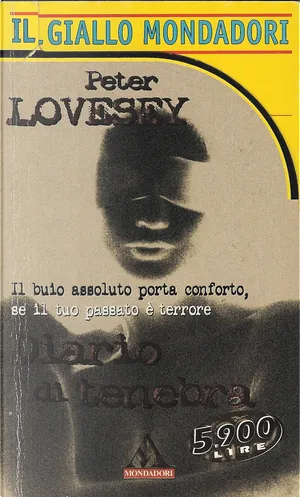
Peter Lovesey : Upon A Dark Night, 1997


Today's novel is still from his most popular series, Peter Diamond, but this is his fifth.

Peter Diamond, who resigned at the end of his debut novel to begin a career as a private detective, has returned to the police force after some time (and a few novels): he is now Superintendent and Head of the Bath Homicide Squad. In this capacity, he is tasked with two crimes, one after the other, seemingly unrelated: the suicide of an elderly farmer, who committed suicide with a gunshot to the chin; and the fall of a young German woman from the parapet of a house.

The first was discovered a week later: a rotting corpse, its head destroyed by the gunshot that exposed the skull and scattered brain and bones (a rather unusual way to commit suicide). The second death was almost contemporaneous with the discovery, and occurred during a large party following the occupation of a house by the villagers, celebrating the lottery wins of four of the house's residents. This death, too, while at first glance appearing to be an accident or suicide, nevertheless has a peculiarity: a sneaker is missing. A search for it is carried out on the roof, first at the site of the fall, and also elsewhere, but it turns up nowhere. Where did it end up? Unless someone took it: the victim appears to have been drunk, but the autopsy later reveals that she was perfectly conscious and had perhaps only drank a can of beer, if anything. Did someone push her? And why?

The investigation is still in the dark.

Along with these two criminal events, a third incident captures Diamond's attention: a woman named Rose Black was found in a hospital parking lot, injured, with cracked ribs, and, most importantly, with no memory. After a quick hospital stay, and not knowing who she was (no documents were found), she was entrusted to a social worker, until a woman named Doreen, posing as her half-sister, came to take her in. What's striking, however, is that everything the woman said turns out to be false: she doesn't live where she was supposed to, because the house and street don't exist, and there's no contact information for her family of origin. The result: Rose has disappeared. Now, what does Rose have to do with the other two deaths? Nothing. And yet...

The first death seems to be related to some Saxon relics found nearby, and in fact, Diamond discovers that someone had previously dug up the victim's property several times, searching for something.

Nothing is clear about the second case, until something happens that turns on Diamond's fateful lightbulb: Hildegarde Henkel, the German girl who fell from the roof of a house onto the street, was staying in the same hostel where Rose Black had also been taken in, and the former curiously resembled the latter. Is it possible that someone, intending to kill Rose, killed Hildegarde? And what's more, the hospital parking lot overlooks the highway leading to the farm where the first suicide occurred, Farmer Gladstone. Is it possible that Rose, walking on that highway, was hit by a car, and was coming from the direction of the farm?

So Diamond, along with Inspector Wigfull, from whom he stole the job, and Inspector Julie Hargreaves, begins investigating Gladstone's past, antiquities hunters, and Saxon relics, to finally identify the killer—already a strong suspect in the German woman's suicide, and now wanted for Rose's kidnapping and Gladstone's death—and to stop him before he kills again.

What's fascinating about this novel is how Lovesey manages to weave a story based on a few, even seemingly unrelated, elements:

There's the adventurous tale of the treasure that everyone seeks but no one finds, which even the beautiful Rose, whose real name is Christine Gladstone, hints at to those who want to kill her so they won't (and then actually finds it behind a bricked-up fireplace); There's one of the most typical elements of the English detective story: the return of the heir, Christine, who, after her mother's death, learns of her father's identity and returns to him, only to find him dead.

A story set in the quintessential English countryside, so dear to Agatha Christie but also, more recently, to Inspector Barnaby.


And an investigation that seems like a procedural because it unfolds through police investigations, but which actually draws on the insights of Peter Diamond, an anti-hero, an anti-cop, who is too gruff and testy to befriend his subordinates, too unconventional to be rewarded by his superiors, and above all, unconventional: a policeman who avoids autopsies like the plague, inventing a thousand different excuses.

Peter actually drops hints here and there, and I think he expected a reader of a certain age to be able to figure out where he was going: when he mentions on several occasions that the road to the farm was Route 46, and that Rose was found in a parking lot accessible by Route 46—well, if you're a reader accustomed to clues, you have to figure out 2+2=4, right? I quickly realized that Rose was immersed in the story of the "suicided" farmer, precisely from these cryptic references. And if someone reads a novel completely detached from what they're reading, well, that's another matter. 

 The only clue that seems a bit far-fetched to me is having revealed too early the identity of the sole suspect in the death of the young German "suicide," unless that was also intentional. From that point on, the reader is led to wonder how the sole suspect, if it really is him, could fit into the story of Rose and old Gladstone. Or perhaps it was just a wild guess on Diamond's part.

Even if it turns out it wasn't.

A very beautiful novel, as usual, by the great Lovesey.

Pietro De Palma