Sunday, June 2, 2024

John Dickson Carr : All in A Maze ( in "The Men Who Explained Miracles", 1963)


Before going further, I believe, for reasons of accuracy, to explain why this story has two titles (it would also have a third: Ministry of Miracles). The story itself, known by its most common meaning (which was later used by Douglas D. Greene to title one of his essays of fundamental importance on Carr) was published under the pseudonym Carter Dickson in E.Q.M.M. of March 1956. Subsequently, when in 1963 (curiously the year of my birth) Carr decided to publish an  anthology of stories referring to Gideon Fell, H. Merrivale and Colonel March, he changed the title of the story to All in A Maze, for a simple and at the same time captivating reason: he used the original title of the story as the title of the collection, varying it however, because if in the original meaning The Man Who Explained Miracles is obviously Merrivale, in the anthology there is no only him, but there are also the other two subjects; and then the title was changed to The Men Who Explained Miracles.

Warning: Spoilers !!!

It all begins when Tom Lockwood sees a terrified girl going down the stairs in St. Paul's, running the risk of breaking her neck. The innate instinct of a knight takes over and so he introduces himself to the girl, who is otherwise quite pretty. Her name is Jenny Linden, and she is also English. But from what she says, she seems to have a French background. And she is terrified: someone had tried to kill her the previous night, and moments before, in the sound tunnel of St. Paul, she heard someone utter a death threat addressed to her, in her ear, even though there was no one who could do it, except the sacristan and a farmer who was eating a sandwich, but too far away for them to have been able to whisper anything in her ear.

Tom, who qualifies as a journalist, offers her tea in a nearby room and so she tells him her story: she is English, the daughter of rich English parents who had moved to France years earlier, where her mother died during the war and his father shortly after. She was entrusted to an old friend of her father, General De Senneville, who acted as her guardian and administered her considerable assets. Now, the girl, who is twenty-five years old, must marry the general's son, Armand de Senneville, an entrepreneur, even if she does not love him, for a sort of arranged marriage, with which Armand will acquire the girl's rich dowry. She has come to England to visit her monuments and visit her relatives and is hosted in their house: the old and sour Aunt Hester, her cousin Margot, and Uncle Fred. Armand didn't want the girl to go to England because he is afraid of losing her, that is, he is afraid that she will seriously fall in love with someone else, but he had to put on a brave face and agree that she should go where expected. But something went wrong. First she found a note on the napkin announcing her imminent death, and then, the following night, someone actually tried to kill her, entering her room, despite the door being blocked by a heavy bolt and the windows being closed by the inside, and opening the stove's gas tap, to make it suffocate to death. Only by a miracle was she saved the next morning.

Aunt Hester, who is watching over the girl, having seen her in the company of someone she knows, rushes into the tea room and there apostrophizes the young man, making a scene. Meanwhile, Jenny has run away through a back door, and when Tom catches up with her, he meets a guy who calls himself an Oeil journalist, who tells him that he sent the girl to Sir Henry Merrivale, and then tells him the story of the attempted assassination. of Jenny, because he, yes he, Steve Lamoreux, a French-Canadian, saved the girl by turning off the gas tap: he is indeed a journalist, but he is also a sleuth, a kind of private investigator who works for Armand de Senneville, who hired him to prevent the girl from meeting English guys. In that capacity he resides at the home of the young woman's old uncles. However, he is unable to fully impersonate the part of the bastard, and for this reason he is trying to prevent the girl from suffering. He offers to help Tom. Since the girl might recognize Steve, only Tom goes to Sir Henry Merrivale who after the war was accused of having made undue expenses, and of having too many current accounts spread across half of Europe, and so was put in the position of having to agree to take care of of the Central Office Eight of the Metropolitan Police, established only by him, the so-called Ministry of Miracles. All the most bizarre cases that only he can solve end up there. And it is no coincidence that Jenny Linden's is. From Merrivale he finds the girl who, when questioned, tells her story of her night of horror and the accident in the acoustic tunnel of St. Paul.

Merrivale listens to yet another reconstruction of the facts and then lights up. Then he makes a phone call, asking to speak to a certain Sam who he saved from trouble once he was found with sixteen girls all naked and asks him if there are twenty around...

The boys believe they are ventilators. But what about fans? NO. Merrivale asked his acquaintance if there were any ventriloquists in the London square, and he among others gave him the name of a certain Charley Johnson, and gave him the address. Just enough time to get to him, to ring the bell, and then the girl finds herself in front of the farmer she had seen in the acoustic tunnel, throwing open the door, holding a sandwich and a glass of whiskey, wearing a bright dressing gown, and down the steps, lying there in the street, with a knife stuck in his back. All over again?

Merrivale, despite having offered to host the girl, turns around and sends her back to her aunt and uncle's house, where she says she will be safe: her aim is instead to keep an eye on Tom, who in reality is not a penniless journalist, but a scion with an annual income of twelve thousand pounds, son of the London Police Commissioner, as he fears that the mysterious murderer may make an attempt on his life: but... why?

The fact is that he, Tom, and Steve decide to keep an eye on the girl by entering her uncle's estate, in time to see Jenny, escorted by her relatives, walking along the avenues. They should have remained silent but as usual the Great Old Man with his histrionic manner makes those under surveillance become aware of their presence. Jenny declares her reciprocated love for Tom, and in the meantime Armand de Senneville himself, in Merrivale's opinion, is lurking somewhere ready to strike: he is not in Paris at all, but there in London, and he absolutely does not want the rich dowry escapes him. But why on earth would he then try to kill the girl?

Jenny wants to enter the labyrinth of her uncles' park against their uncles' advice. Tom follows her, and in the tangle of branches and bushes, someone tries to stab him, until after a furious melee Tom gets the upper hand. In time for him to rush to Merrivale and unmask the murderer.

The End of the Spoilers

The Man Who Explained Miracles, also known by its other title All in A Maze, is the only story Carr wrote about the figure of Merrivale, other than The House in Goblin Wood.

The story presents a series of interesting characteristics: first of all the Locked Room, resolved very brilliantly (I had some inkling of it anyway). The gas gimmick is brilliant. Even more so that of the whispering spirit in the acoustic tunnel: Carr once again resorts to ventriloquism, which he had resorted to several times previously. Mentions of ventriloquism can be found in various novels, from Four False Weapons to Death-Watch, from The Red Widow Murders to The Mad Hatter Mystery, to The Ends of Justice. The tunnel trick reminded me of another time Carr talks about an event that happens in a tunnel, which is when in Fire, Burn! he writes about a tunnel in which a man dies from a bullet that was not fired by any person (at least it would seem so).

 But there are also other references: it's as if Carr has inserted the best of his work as a writer in terms of tricks here. For example, there is a split person, that is, a person who has two identities, one real and one fictitious. This is also a reminder of the young Carr who had written It Walks By Night: in fact there Laurent and Saligny are two identities of the same person. The attack in the labyrinth at night reminded me a lot of the atmosphere of J.J. Connington (who Carr knew well and who he had included in his novels, first of all It Walks By Night), and also a novel by him in which a crime is perpetrated in a labyrinth: Murder in the Maze, 1927.

Furthermore, when Carr talks about the Office headed by Merrivale, the Central Office Eight of the Metropolitan Police, i.e. the so-called Ministry of Miracles, he could also have mentioned another character of his, that Colonel March who is put in charge, in stories about him, of a so-called “Department of Queer Complaints”. On the other hand, in the same collection that contains All in A Maze, there are also two stories with Colonel March: William Wilson's Racket and The Empty Flat.

The story, however, is not notable only for the quotes and the solution (even if of Merrivale's two stories, I always liked the other, an absolute masterpiece, The House in Goblin Wood, for the series of pitfalls and for the solution Grand Guignol, which in that case once again recalls It Walks By Night), but also for a characteristic which is not dwelt upon enough, that is, the humor in Carr: very often Carr in order not to excessively weigh down the atmosphere, which already in itself it is very heavy, full of horrifying details (ghosts, disappearances, rotting or walled-up corpses), dramas and crimes, it often inserts jokes that poison the various scenes. This insertion of jokes, often hilarious, is not so present in the novels and stories with Fell (where everything gives way to salacious comments and pompous self-celebrations, or to the usual exclamations (Archons of Athens, etc..), but in those with Merrivale where the figure of the detective, sketched on that of Churchill, is instead the bad copy, an awkward, ridiculous copy, completely missing instead in those with March and Bencolin where the atmospheres are the darkest that Carr has absolutely invented.

There are numerous jokes and sketches: I report some (almost all) :

“Ah, yes!” said Tom. “It was in New York, wasn’t it, that you wrecked the subway at Grand Central Station and nabbed the right murderer on the wrong evidence?” “Oh, son! I dunno what you’re talkin’ about,” said H.M., giving him an austere look. “And in Tangier, I think, you blew up a ship and let the real criminal escape just because you happened to like him?” “Y’see how they treat me?” H.M. demanded, his powerful voice rising as he addressed Jenny. “They’ve got no respect for me, not a bit.” (page 128)

“It seems I spent more money than I should have, or burn me, than I can account for. It also seems—would you believe it?—I shouldn’t have had banking accounts in New York, Paris, Tangier, and Milan.” “You didn’t know, of course, you weren’t allowed to have those banking accounts?” “Me?” (page 128-129)

They hoicked me up on the carpet before an old friend of mine. I won’t say who this louse is, except to tell you he’s the Attorney-General.” “No,” said Tom. “By all means don’t breathe a word.” “‘Henry,’ he says to me, ‘I’ve got you over a barrel.’” “Did the Attorney-General actually use those words?” “Well…now!” said the great man, making a broad gesture and giving Tom a withering look. “I’m tellin’ you the gist of it, that’s all. ‘Henry,’ he says, ‘on the evidence I have here, I could have you fined a hundred thousand pounds or stuck in jail for practically a century.’” Here H.M. broke off and appealed to Jenny. “Was this just?” he demanded. “Of course it wasn’t!” cried Jenny. “‘However,’ he says, ‘you pay up in full, with a fine, and we’ll forget it. Provided,’ he says—” “Provided what?” “I’m to go back to my own office here, d’ye see? It used to be part of the War Office, before they messed everything about in the war. And I’m to be in charge of Central Office Eight of the Metropolitan Police.” “Please,” said Jenny in her soft voice, “but what is Central Office Eight?” “It’s me,” (page 129)

 Can you explain miracles?” “No. But I know a man who can. Did you ever hear of Sir Henry

Merrivale?” “Sir Henry Merrivale?” “Yes!” “But he is awful!” cried Jenny. “He is fat and bald, and he swear and carry on and throw people out of windows.” “He is not, perhaps,” Tom admitted, “quite the ladies’ man he thinks he is. But he can explain miracles, Jenny (page 115)“And I was so, so wrong about your H.M.!” “Oh?” enquired Tom. “Yes, yes! He does not swear or carry on or throw people out of windows. He is what you call a poppet.” “Hem!” said the great man modestly. “Frankly,” said Tom, eyeing the stuffed owl across the desk, “I shouldn’t call it a well-chosen word to apply to him. You’ll find out. However! When I’d chucked out Aunt Hester, with the aid of two counter-girls and a friendly cop, I thought I’d never get here. I was afraid some infernal thing or other had happened to you, and I might never see you again.” “You may see me,” said Jenny, and stretched out her hands, “whenever you wish.” “Oi!” interposed a thunderous voice. The alleged poppet was now glaring at them with a malignancy which raised Jenny’s hair. (page 130-131)

“Well,” glowered H.M., scratching the back of his neck, “I’ve got a house, and a wife, and two daughters, and two good-for-nothing sons- in-law I’ve had to support for eighteen years. So I expect you’d better move in too.” “You mean this?” cried Jenny, and sprang to her feet. “You would really want me?” she asked incredulously. “Bah,” said H.M. “Sir H.M.! How to thank you I do not know…!” “Shut up,” said the great man austerely. (page 131-132). In essence H.M. he attributes the crazy expenses mentioned previously to the family situation, to the fact of having to provide for many people dependent on him.

“Then there’s your clothes,” he mused. “That’s a very fetchin’ outfit you’ve got on now, and I expect you brought a whole trunkful?” “Yes, my clothes! I forget!” “Don’t worry,” said H.M. with a suggestion of ghoulish mirth. “I’ll send a police-officer to fetch ‘em. (page 132)

“Looky here, my wench. I want to speak to Sam….Oh, yes, I can! This is the old man. You just tell him I squared it when he was givin’ a beautiful party for sixteen beautiful gals without any clothes on, and the silly-ass coppers broke in. Yes, the old man!…” (page 138)

“That you, Sam? How are you…? Never better, Sam! There’s a question I want to ask you….Thank’ee, Sam. How many vents are working now?…” Tom Lockwood looked up wildly at the air-ventilator humming and whacking above his head. He looked at an equally bewildered Jenny. “Only three? You’re sure of that? Right, Sam. Gimme their names and descriptions. Yes, I said descriptions! Uh-huh….No, the first one’s no good. Try the second….Lord love a duck, that sounds like the one we want! But try the third, just for luck….No, he’s no good either. It’s Charley Johnson. Gimme the address. It’s nearly six o’clock—he’s bound to be at home now….Thanks a million, Sam. And try to keep to one woman next time, hey? All right, all right!” (page 139)

“Sir!” protested Tom. ‘What in the name of sense is all this business of air-vents, and how can it help us?” “You wanted a miracle explained, didn’t you?” demanded the great man. “All right. Are you comin’ with me, or not?” (page 139)… “For the last time,” said the desperate Tom, “will you tell what an air-vent—” H.M. pulled down the brim of his hat even harder. “Who said anything about an air-vent?” he howled. “I didn’t. I said ‘vent.’ That’s the theatrical and professional term for a ventriloquist. Didn’t you ever hear a ventriloquist?” (page 140)

Burn me,” and H.M.‘s voice rose up passionately, “people are always sayin’, ‘What an old cloth-head he is; stick him upside down in the dustbin.’ Then they see what I mean. And they yell. Why, Henry; pull him out and dust him off; we should never have guessed it.’ And of course they wouldn’t have guessed it, the star-gazin’ goops! Only—” (page 143)

The role of guide caught Sir Henry Merrivale’s fancy at once. “Hem!” he said, tapping himself on the chest. “Me.” Lamoreux looked doubtful. “Okay, Pop, you’re the boss. But are you sure you know enough about the history of this joint?” “Me?” said the outraged H.M. “The palace of Hampton Court,” he bellowed, “begun by Cardinal Wolsey in the year 1515, was in 1526 pinched from this worthy prelate by that howlin’ old ram King Henry the Eighth, whose wives I shall now proceed to—” “Pop! Quiet!” “Am I a guide,” H.M. asked loftily, “or ain’t I?” (page 146)

Sir Henry Merrivale, in his most maddening mood, sat on an upended wheelbarrow, in one of the few remaining Tudor quadrangles: of dark red brick, with its white stone lions uprearing from the walls beside sly little windows. H.M. was again smoking his black pipe, and looked up at Tom without favour. (page 142)… From under the archway to a second quadrangle the sound of “S-s- t!” hissed at them in a way which made H.M. leap up from the overturned wheelbarrow (page 145). Here we even have a rhetorical figure: an oxymoron = paradoxical union of two antithetical terms. Note how for one of the few times in the passage Hernry Merrivale is referred to by the noble title Sir. The thing was invented by Carr precisely to achieve a result that opposes nobility to sitting on a wheelbarrow, which is something ridiculous.

Furthermore, Carr never loses his tendency to show off knowledge, dates, names and historical references. We see it in the brief but amusing altercation centered on William the Third, in which Sir Henry Merrivale cannot stand having his historical culture held against him : “On our right,” it thundered, “we got the famous Hampton Court gardens, forty-four acres of elegant spinach, first laid out by King William the Third and completed in 1734.” “For God’s sake, be careful,” whispered Tom. “William the Third died in 1702.” H.M. swung round, fists on hips. “And d’ye think I don’t know that?” he bellowed. “I didn’t say the old sour-puss finished ‘em, did I? I just said he laid ‘em out—which is what I’m goin’ to do to you, young man, if you don’t shut up and stop interruptin my lecture.” “Pop! The soft pedal! Give it the old soft pedal! Holy cats, they’ll hear you as far as Thames Ditton!” (page 147).

Overall, a gorgeous novelette.

Pietro De Palma

Thursday, May 30, 2024

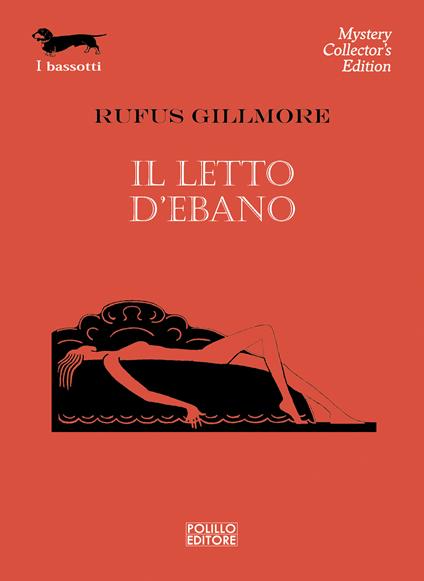
Rufus Gillmore: The Ebony Bed Mystery, 1932


Rufus Gillmore is an author shrouded in a cloud of mystery. It is known that he was a journalist, but very little is known about his life. So little, that some historians of crime literature such as Anthony Boucher or Howard Haycraft, had never read his works and were unaware of who he was. All this, however, has a certain reason: in fact Gillmore, despite having started writing novels at 33 years old - wrote three in two years: The Mystery of the Second Shot (1912), The Opal Pin (1914) and above all The Alster Case (1914 ) which seems to be a parody of The Leavenworth Case (1878) by Anna Katherine Green – she soon stopped writing and for twenty years did something else, to start again, and deliver her fourth and final work, The Ebony Bed Mystery, to the history of the genre, in 1932. Three years later he died.

 WARNING: SPOILERS !!!

The Ebony Bed Mystery tells of a famous crime, from which others derive. The location of the crime is the home of a much talked about New York woman, first dancer, then social climber, Helen Brill Kent: in her bedroom, locked from the inside, she was found killed by a gunshot in the mouth. It would seem like a blatant suicide, if it weren't actually murder, she was killed on the carpet and then placed on the bed from there. An Ebony Bed with black silk sheets.

Prosecutor Hutchinson is in charge of the murder, assisted by Sergeant Mullens. Both initially lean towards suicide, but after the amateur detective Griffin Scott, already an established publicist, proves it was murder, they change the object of their insistence, accusing Dotothy Vroom, the victim's half-sister, of murder. Griffin is assisted in turn by the journalist Rufus Gillmore, who has earned his trust, having managed to trace his true identity and having discovered his New York refuge.

Living in the victim's house until Helen's death were her mother Mrs. Vroom and her half-sister Dorothy Vroom, as well as Helen's only daughter, Ethel Cushing. 4 women. And the servants were made up of women. But on the evening in which the tragedy occurred, a furious argument had occurred with members of the family: Jesse Brill, father of the deceased; Cleveland Brill older brother and Napoleon Brill younger brother. Especially with Jesse and Napoleon, two parasites of the worst kind. Cleveland seems to be different: more fanatical than his family, so attached to Christian values ​​that he became captain of the Salvation Army, he despises his corrupt deceased sister's money and would, if anything, like to use it for charity. And as it turns out, both Jesse and Napoleon had copies of the keys to the room, and both, having created false wills of the deceased, will try to accredit themselves as the sole heirs of the fortune.

But in the meantime, Dorothy has recklessly grabbed the gun in the dead woman's room, which fell on the floor leaving her fingerprints on it, and for this reason she becomes the main suspect by Hutchinson and Mullens, and subsequently someone takes possession of the victim's very rich jewels and then kills Detective Haff , in charge of the surveillance of the Brill Kent house.

Central is the mystery of the 6 double keys, six keys that open two different doors: the door of the house, and the door of Helen's room. One key belongs to the landlady, the mother has another and is also used by the stepsister, the three maids have three, and the last one... we don't know who has it. In the end we understand that a character who is not part of the family and who should have married Helen has it: it is his that Dorothy heard the evening of the murder, coming from Helen's room and which she does not recognize as the one of any of the half-siblings?


Then there is the mystery of a skein of cotton, found in the victim's room, whose length Scott tests, which is subsequently stolen from the room. Scott then understands, unrolling it from one of the windows of the victim's room, that a garment falls two floors below at the window of an unsuspecting condominium owner, a big fish in politics. It is he who Helen Brill Kent should have married for the umpteenth time. But he is not the murderer.

In an attempt to save Dorothy Vroom from the electric chair, Scott Griffin, having understood how the murderer killed, using a gun, an electric wire and a radio antenna, thanks to a stratagem, will be able to frame the diabolical murderer, who will then attempt an unlikely escape, ending up on the pavement of the sidewalk, a few floors below.

The End of Spoilers 

Gillmore is certainly a clone of van Dine, indeed, let me tell you, his novel is the triumph and excess of the genre derived from Van Dine.

In fact, there are many references to Van Dine's novels (and also to the first Ellery Queen):

Gillmore (Scott's author and Watson), the prosecutor Hutchinson and the police sergeant Mullens, model the better known Van Dine, Markham and Heath;

Scott Griffin, who is a well-known advertising man, embodies the amateur detective possessing uncommon analytical skills, and pairs with Philo Vance;

the crime takes place in the home of a person belonging to the (albeit improperly) New York jet set;

as in Van Dine, here too the Handbuch fur Unlersuchungerichter, by Hans Gross, the sacred text of Forensic Criminal Science, is consulted: the volume is consulted by Philo Vance in The Greene Murder Case.

The victim is a former dancer, as in The Canary Murder Case;

As in Greene, the crime matures within a family.

As in Greene, the crime is committed by means of a device connected to a gun.

The figure and nature itself of both the victim and the murderer are connected to Greene.

The assassin who dies during an unlikely escape, and his very nature, can be traced back to The Tragedy of Y by Ellery Queen. In this regard, unless Gillmore had the same idea as E.Queen, which is rather singular given that they are two followers of van Dine, one would think that one of the two was derived from the other, which is also rather difficult to verify as both novels from 1932.

In short, a novel closely derived from those of Van Dine. Unlike van Dine, however, reading is not always enthralling, and there are various moments of tiredness, which the author makes up for by transforming the Mystery into a Thriller (such as when he must at all costs enter Sullivan's house and unmask him and everything that follows) to increase the pace of the narrative. As a character, Griffin Scott seemed to me at times even more unbearable than Philo Vance, and what's more the novel itself, brazenly following many different references to Van Dine, instead of following its own path (although referring to Van Dine, as in Ellery Queen for example or in Abbot), chooses to create a novel that derives step by step (except for some small differences) from The Greene Murder Case, perhaps proving attractive for the public of the time, but for us instead very obvious, and sometimes tiring to read.

Pietro De Palma

Tuesday, May 14, 2024

Give me that OLD-TIME DETECTION (Spring 2024)


The spring publication of Old-Time Detection is out. It contains a story of mine with Locked Room, A Double Locked Room

My English translation was later improved by the writer Tom Mead, with whom I am a friend. 

It is my second story with Impossibile Murder which is published in the magazine published by Arthur Vidro. The previous one was in 2022. On that occasion Mike Grost included it among the best stories with an impossible crime, written in 2022. 

I hope Mike likes this one too, and includes it in the 2024 list.

Tuesday, April 23, 2024

Anthony Abbot : The Creeps, 1939 (La soglia della paura. Italian Translator : Igor Longo. Mondadori, 2008) aka (Being a Full Statement About the ) Crimes at Buzzards Bay


After a long time, we return to review a novel by Anthony Abbot. In this case of the eight novels he published, this is the penultimate.

The Creeps, original title, written in 1938, was published in 1939. It is a novel with a great atmosphere, which seems to be different from the other six first novels.

WARNING: SPOILERS !!!

Thatcher Colt is no longer Chief of the NYPD. He retired to private life and got married. His wife Florence thinks that he is bored without being able to dedicate himself to solving some good case, and so she does everything to get them to agree to go to his relatives in Denmouth. Fortescue Baxter's son, Terry, is to get married the following Sunday to his father's secretary, Evelyn Drew, and so the two Colts plan to have fun and have fun: Thatcher is above all attracted by the idea of meeting the famous Swiss parapsychologist, Doctor Adolf W. De Selles, who will be present to whom Fortescue Baxter, former friend of Thatcher, intends to leave a million dollars for his studies. Thatcher and his wife will be accompanied by their friends, Abbot and his wife Betty.

And it is precisely in the train carriage that is taking them to Denmouth that Thatcher and Anthony and their wives meet De Selles. When they arrive, the landscape is covered in snow. Randall, the Baxter's driver, should be waiting for them to take them to their destination, but there is no trace of him. So, a guy with an old grinder agrees to take them to their destination and they go up towards the property which is on the cliff, under which the sea boils. Everything is covered in snow. In the garden, De Selles looks at someone who seems to be staring at him from a tree, and mutters about something he says is wrong with that house.

Guests are introduced to the host, son and relatives. We immediately notice how most of them are hostile to the old man giving up a substantial part of the inheritance to someone who according to them is an old charlatan: there is Fortecue's sister, Eunice; the future bride; Margaret Dixon, black journalist, acquaintance of Thatcher; Charlie Adams, another cousin, a famous explorer, has just returned after many years spent in Siam and his wife Ursula, who by chance (but nothing is by chance) is also joined by Terry's ex-girlfriend, Mary Stevens.

It is the eve of Thanksgiving Day, November 23rd. The evening passes peacefully or almost as Adams and Eunice and then Margaret who seemed to have gotten lost in the snowstorm and who instead appears, ask that De Selles show his peculiarities, that is, prove that he is a parapsychologist: How? With a séance. De Selles reluctantly accepts: the medium will be Drew who, with De Selles, reveals to have a certain predisposition for these practices. During the session, Drew is possessed by the spirit of Baxter's ex-wife, Gertrude, who accuses someone of having killed her and of having hidden her bones in that house without giving her a Christian burial.

Forterscue Baxter leaves destroyed by the revelation, which would seem to accuse him. Terry looks at his father in horror, and the germ of fear and suspicion creeps into the house. during the night, the girl Evelyn who fell into a trance is found dead in Charlie Adams' bed. What appears to have been an affair that ended badly ends up being seen with a different eye: the girl was chloroformed to death by someone and then the dying girl, looking for help, looked for it in Adams who was snoring on his own for the drunk in the evening, dying in his bed.


After Gertrude's bones and Randall's body are found, the driver who was supposed to take Thatcher Colt and Anthony Abbot and their wives to his estate, Colt assisted by Abbot, called to investigate by the local sheriff in the Baxter estate isolated by the snow, she will pin the diabolical murderer to his responsibilities.

THE END OF THE SPOILERS

A beautiful novel by Abbot, it stands out for its somewhat convoluted style, compared to the previous six, and for a great atmosphere. Some critics overseas (John M. Nevins, the major critic of Ellery Queen, and my acquaintance Mike Grost, author of a history of online detection that would have deserved some recognition) are inclined towards attributing the novel to a ghost writer, instead that to Abbot, due to the slightly different style from the other previous ones, and also due to the abandonment of the identical construction of the title (About + the Murder + Subject) which is characteristic of Van Dine's period since, despite some differences, they use it both Van Dine what a Queen. However, several factors are not taken into account:

first of all, that the previous ones were all anchored, plus the first ones and gradually the rest, to a detection very close to van Dine's style from which they derive; Bear in mind that Abbot's last Vandinian novel, About the Murder of a Man Afraid of Women, dates back to 1937, and Van Dine was still making novels then (The Kidnap Murder Case was written in 1936) but shortly thereafter he would write his last two that show clear signs of weakness and involution (The Gracie Allen Murder Case of 1938 and The Winter Murder Case of 1939). Again in the 1937 novel, Abbot dwells on a series of scientific police and ballistics findings, which are also found in Van Dine's novels, for example The Benson Murder Case. But from The Creeps, everything changes: it is true that Thatcher Colt is no longer a member of the police and therefore in the investigation, an illustration of police procedural techniques would be out of place, and therefore the characteristic of the six previous novels no longer exists which all have a combination of Van Dine detection and Procedural, but it is also true that Abbot, precisely due to the involution of van Dine's stories and his loss of popularity and the affirmation of other novelists, tends to try new paths, rather than refer to Van Dine. Now Thatcher Colt is a well-rounded detective, and with The Creeps, the references in Abbot are to other novelists of his time, first and foremost Ellery Queen. In fact, I detect marked similarities between this novel by Abbot and one by Queen, The Twin Syamese Mystery: there is a house perched on a hill, like here; Ellery replaces the police in carrying out the investigations, and Thatcher Colt does the same thing here, despite no longer having any position in the police; there the house is isolated from the rest of the world by fire, while here it is isolated by snow; there crimes occur within a family, as here: and here as in that case, a scientist is present.

Saying that the novel can be ascribed to a ghost writer, just because you can't find the same way of writing and illustrating the facts as in other works, is a bit risky for me, if you don't take into account a series of other factors. Furthermore, Abbot's tendency to lead a crusade against the boasters and charlatans of the paranormal recurs in this novel: here he is aimed at revealing the false nature of De Selles, revealing the falsity of the construction of the séance; in About the Murder of a Startled Lady (1935), the medium's trance implant is exposed, with a hidden radio implant connected to the medium's apartment being found in the next room. And moreover Fulton Oursler in 1930, under the pseudonym of Samri Frikell, had written the book Spirit Mediums Exposed, in which he declared “I am the foe of fakery, of charlatanism, of hoodwinkers, of wonder-mongers, of miracle pretenders — of BUNK. And of all the low-down creatures in the world, the religious faker, the scoundrel that pretends to trusting and ignorant people that he can bring them face to face and voice to voice with their beloved dead, is the most contemptible.”

His Autobiography, begun in 1949 and published posthumously in the sixties by his son Ousler Jr., also reiterates Fulton Oursler's paternity of his works, which clearly says (page 361 of Behold this Dreamer!): At the same time Fulton kept up his parallel careers. Between 1938 and 1941 he completed two more Anthony Abbot novels (The Creeps and The Shudders) and one short story, “About the Perfect Crime of Mr. Digberry,” which was published in the first issue of Ellery Queen's Mystery Magazine and later made into to movie.

There are many other references to previous novels in the novel: for example. the note on the elegance of Thatcher Colt. In this regard, in Fulton Ousler's biography, we read (page 256): The hero of these detective tales, incidentally, was one Thatcher Colt, the police commissioner of the City of New York. In my mind he was a combination of two men: Grover Whalen and Theodore Roosevelt — the one an impeccable dresser, the other blessed with real brains.

However, although there are very original ideas in the solution of the three crimes, the murderer, despite being present in the story from the beginning, is identified on the basis of clues that appear clear only to Colt, but of which the reader is not precisely informed . Furthermore, as Curtis Evans insinuates, how does the son know where his mother was buried? There are some passages that are not very polished, weak. In the fake message from the mother's spirit, it says more or less "you must bury me Christianly.. it is not right that she is buried like this.. here, my bones are in this house..". Now, if the message had been true, the continuation of the actions, especially the discovery of the bones by his son Terry, would have made sense. But if the message is false, that is, it does not come from Gertrude's spirit, but is the result of a plot carried out by two people, and the words are invented, how does Terry find his mother's bones right in the house? It is a pure coincidence, because the body could have been buried elsewhere, taking into account that when the crime occurred, there was no one in the house except the victim and the murderer, and the estate was one hundred and twenty hectares in size.

This means that the story, despite being original, even if influenced by Ellery Queen and perhaps also by Anthony Berkeley (Murder in the Basement, 1932) or rather by another Vandinian like Stuart Palmer (Murder on the Blackboard, 1932), is more weak in the plot of the other previous novels by Anthony Abbot, even if it has a great atmosphere, and even if the reading is very pleasant and the solution manages to convince. Perhaps this is why Abbot, in retrospect, having ended his period as a writer of detective novels in 1941 with The Shudders, recognized only the six previous novels as public successes, despite having published the other two, again with Macfadden Publications (with whom he published continuously from 1921 to 1941). Moreover, we also have other examples of authors who, very original and appreciated by the public in their first novels - I am thinking for example of Rufus King - over the years, and the loss of their own examples (Van Dine), looking for references in other writers (e.g. Rex Stout) lost their originality and their impact on the public.

Pietro De Palma


Monday, April 15, 2024

William Willoughby Sharp : Murder of the Honest Broker, 1934 (Italian Edition: Morte di un broker onesto - translator: Marilena Caselli - Publishing House Polillo, 2024)


Willoughby Sharp... who could he be? one could say paraphrasing Alessandro Manzoni.
The great tomes of detective literature, dictionaries like the Maspléde do not report it, in GAD there is not a page that concerns it, in Mike Grost's analytical work on the internet, ditto. Yet he is an author of the golden age of the Golden Age of Detection, of the full Thirties.
What we know about the author we learn from the notes on the cover flap: William Willoughby Sharp born in 1900 and died in 1956, he was a New Yorker. Son of high society, he found work on the Wall Street Stock Exchange. After the crisis of 1929, and a much talked about marriage, he left W all Street and, together with his wife, moved to Bermuda, where he wrote his first novel, Murder in Bermuda, in 1933, followed by the second a year later, Murder of the Honest Broker. A third, The Mystery of the Multiplaying, 1935, should have followed after the founding of the company between Sharp and the New York publisher Kendall, but the project did not materialize, and the company soon dissolved. It is not known what the writer did from 1935 to his death. 

Warning: Spoilers !

The novel published by Polillo presents a double crime, which took place in the Stock Exchange Building on Wall Street. In essence, two brokers, Philip Torrent and Sandy Harrison, are killed by curere, absorbed in the case of the first through a cut on the right ear, while in the case of the second by scratches given to him on the left cheek by a woman, Torrent's former lover . It is not clear how the two could have been killed, and above all what motive they had in common, because it seems they have no connection. It would also seem that Philip Torrent was loved by everyone. Of course someone didn't love him if he killed him, but then, under the respectable hypocritical veil, we learn that Torrent had plenty of people who wanted him dead! Not only Jack McDonald, also a broker, lover of Torrent's wife, Mary; but also obviously his wife, Mary; Torrent's abandoned lover, Lucy Laverne; Chipo Martinelli and wife, owners of a clandestine bar set up with 70,000 Torrent dollars, not intending to return it to him; broker associate Temple Hastings, who defrauded him of approximately $300,000; his nephew Howard Torrent, debauched and without ever a dollar who leads an expensive life.


With a meticulous investigation, and with some ideas of genius, Bullock will be able to understand how the two victims were killed and why, and by whom, taking into account that at least Torrent was injured by someone using an improvised weapon, consisting of a pencil in which it was not inserted a graphite lead, but a tip of a phonograph blackened by the fire of a lighter, near its location at the New York Stock Exchange, and then killed in an ingenious way using Curare.
 

The End of Spoilers

The novel is stylistically a procedural, a precursor procedural if we want, seen under the guise of the activity of an inspector who is essentially an amateur detective: there is no usual basic police activity, such as for example. in Hillary Waugh's procedurals, which are real procedurals, but the investigative activity only of Inspector Bullock who, if anything, imitates his boss. In the novel, Inspector Bullock, who moves in the same New York in which Philo Vance, Drury Lane, and Thatcher Colt, deeply detested by him, move, if at first glance he differs from them, in reality he shares them. If anything, it is an attempt to increase visibility and general curiosity about one's hero.
Other details that indicate Bullock to us as a Vandinian hero could be: first of all, the Inspector Bullock (detective) / Mackay (Chief of Police) relationship seems to reiterate that of Philo Vance (detective) / Markham (District Attorney); and then, when Bullock goes to visit Torrent's wife, he appreciates two small Corots hanging near the fireplace, just as the embroidery of the Queen Anne style chairs (late Baroque: 1702-1714) arouses admiration in him: so it is certainly of an inspector with a medium-high cultural level, different from the masses. Furthermore, the weapon with which the murderer kills Philip Torrent reminds us of others from the Vandinian period: the mouthpiece of De Puyster - Rufus King's first detective, who seems to have even influenced Van Dine's Philo Vance - which in The Weapon That Didn't Exist he uses a Curare dart. In turn, the pencil on which, instead of a lead, was inserted the needle of a phonograph - metal - blackened with carbon black, reminds me of the cork on which the pins dipped in nicotine are inserted, from The Tragedy of  X  by Ellery Queen, all those fancy weapons, which are typical of the period. You should read Sharp's first to get a precise idea of the stylistic derivation, that is, whether he is a writer in his own right or whether he can be attributed to a stylistic current of fiction of the period. Mike doesn't mention it at all in his encyclopedic history of online detection, and after all the two novels were released in 2013, ignored or almost ignored.
I also notice in the novel the tendency, already noted in other witers, to humanize the characters of Abbot, Ellery Queen and Van Dine, that is, to decontextualize them and instead talk about them as if they were truly historical characters, not invented in the pages of a book. In this way the author in turn decontextualizes his character and gives him his own characterization. 

Pietro De Palma

Tuesday, February 20, 2024

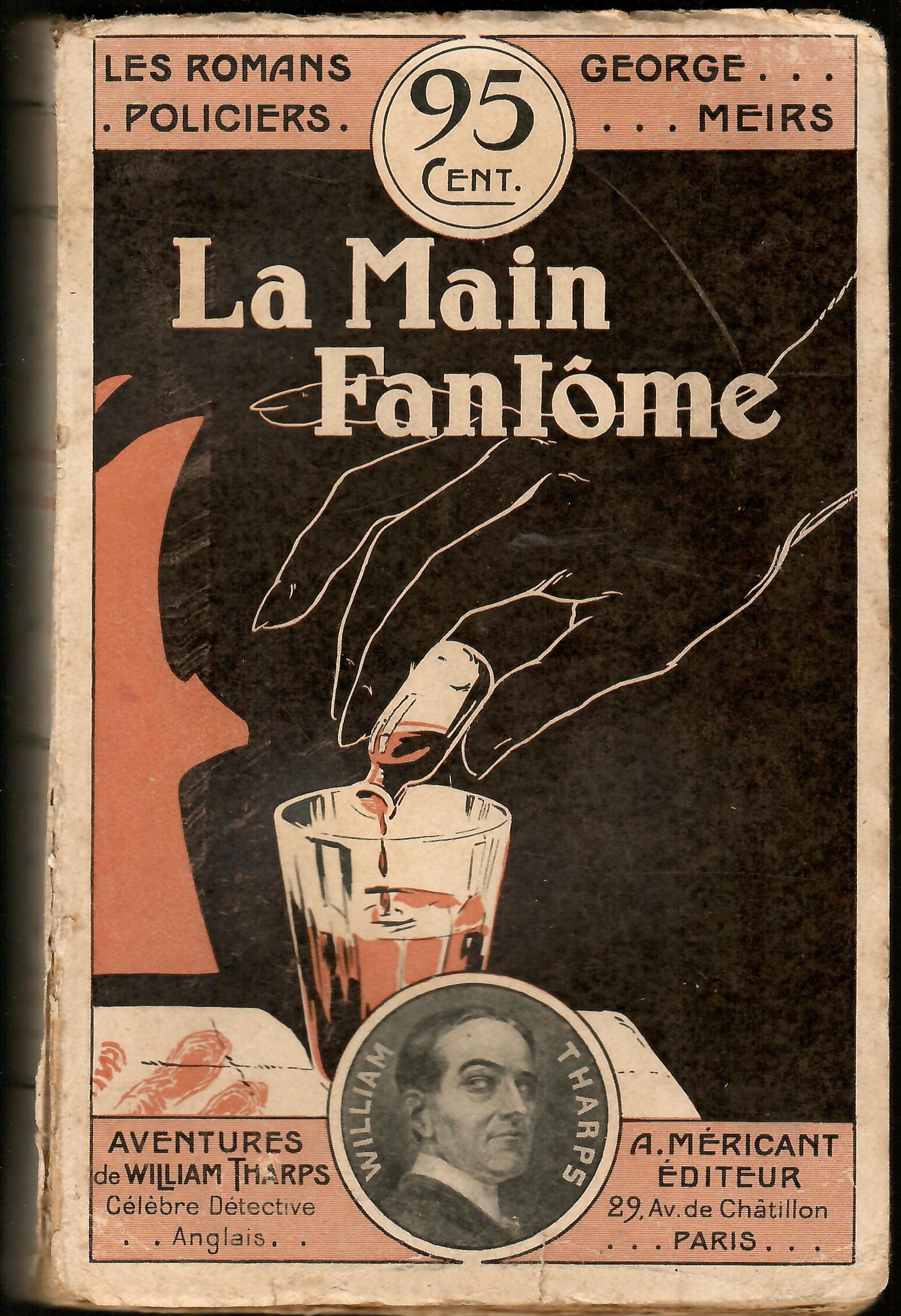
Georges Meirs : La main fantôme, 1913


After several years we return to Georges Meirs, to talk about an excellent novel from 1913: La main fantôme.

Although it is a more than dated text, it is an excellent example of a mystery with an almost impossible crime and three locked rooms. In short, an almost unknown novel, but capable of keeping the reader captivated with a plot full of twists and turns and inventiveness.

 WARNING : SPOILERS !!!

 William Tharps, the famous private policeman, is urgently requested by Inspector Asselin: a crime has occurred in absolutely extraordinary circumstances, and the police are at a loss. In Miromesnil street, on the fifth floor of a building, an elderly sculptor was found dead in an apartment. The doctor has drawn up a death certificate due to embolism, but the inspector has a premonition, which turns out to be right: from how the body was found and from its appearance, Tharps formulates the hypothesis that he was killed instead. The autopsy will attest to Veronal poisoning.

Already in these first signs of a novel, Tharps shows all his deductions and observations, indicating both a series of fingerprints, even on the frame of a painting, and some signs, and finally the imprint of a hand, and poses an antithesis to Doctor Mortet: it would even seem that he hastened to diagnose a natural cause to mask the poisoning. Why?

However, this is not the only oddity, as the police in the figure of the Chief of Police Assarde and the Investigating Judge Ballencourt have already amazed several others: all around the body there are footprints, as if someone had done something during or after the death. Yet it is strange: he was not shot or stabbed or beaten, but poisoned. And the murderer seems to have remained there next to him until his death, which in itself has unparalleled audacity and temerity, and was looking for something: it seems something connected to a check book that Tharps finds while searching the house . It's not the only strangeness: there is an even more astonishing one. The assassin who murdered Mr. Corbat by giving him an elephantine dose of Veronal, entered a house completely barred by bolts and bars, while the servant was busy with his duties, in the other rooms of the house, entering the study, from which he it is also accessed via an external door secured by bolts, passing through a door concealed by a tapestry, which was known only to the staff of the house. But it wasn't the servant: everyone swears by his innocence and even Tharps is convinced of it. Yet someone must have entered the study illuminated by a large window in the ceiling: perhaps he passed through there? Hypothesis immediately set aside: the putty surrounding the glass is old and has no cracks and there are also cobwebs all around which make one think that no one could have gotten through there.

An invisible killer, or rather... a phantom killer. And yes because a hand, a ghost, will make an attempt on Tharps' life later, shooting him in the apartment, guarded by the police, where no one has entered from the outside, as the doorman of the building swears. A killer materialized, who escapes and vanishes into the air: Carr would have been delighted.

But before this occurs, the checkbook will also disappear from the investigating judge's office, barred, and without any break-in having occurred; and for that matter neither Ballencourt nor his highly trusted Chancellor can be held guilty of it.

And after the attack on Tharps, thank God, grazed by two bullets and slightly wounded, another closed chamber with another crime will occur in the apartment, an apartment already defined as cursed before Corbat's death, because in the previous years a series of tenants had died in mysterious circumstances: not least the last tenant, Barolais, who fell from the window into the living room. An unknown body will be found in the apartment watched closely by two policemen, and absolutely barred: how could it have materialized?

Tharps, during a session, in front of Doctor Mortet, the Chief of Police, Judge Ballancourt, the servant and his assistant Pastor Linhyam, will discover his papers and identify the culprit, or rather... the culprits.

 THE END OF SPOILERS

Written in 1913, this novel by Meirs, despite having certain quite dated characters, e.g. the deductions based on Lynham's appearance and several others, which also concern the places of the crime (for example that the murderer must have been of average height) which clearly refer to Sherlock Holmes of whom Tharps is clearly a clone, undoubtedly possesses of his qualities:

for being from 1913, therefore in an age of the detective novel still influenced by adventure, this story is captivating, proposing a series of false culprits: first Mortet, then the servant who leaves the apartment and disappears in search of a phantom person, then again Mortet who materializes, when Tharps is shot, and another servant of the neighbor, then again Corbat's servant, until the unexpected conclusion; a series of cursed and suspicious deaths; a strange bankruptcy story, curiously linked to that apartment; a missing banker with a treasure trove of securities; a poor sculptor living well beyond his means; and a series of near-murders and murders and disappearances of objects and people, in impossible situations.

The solution is logical, and today we would say almost obvious, but not that much: one by Halter is directly connected to it (which makes me suspect that he had read this novel: I'll ask him sooner or later) and also one by Rogers, for one thing clearly indicated, when it is mentioned at the beginning. And that of the disappearance of the checkbook, based on the absolute innocence of the Chancellor and the Investigating Judge who had it in their possession, once resolved, we would say: overused trick, but, if we refer to the time in which it was written... And frankly I hadn't thought about it, because in a book like this where the impossible lingers everywhere, you don't expect something like that, but it's perfectly logical.
 

Tharps reveals everything and triumphs: and explains why there are two murders, attributable to two different people, but committed without real premeditation. However, the first was put into practice by someone who steals and almost kills Tharps, the second by someone who would like to steal a treasure. While the first uses the impossible escape route, the second accesses the apartment naturally, but is not investigated. And the murder happens while the two agents, in charge of surveillance of the house, are down at the bar sipping a coffee and eating a sandwich, having a perfect view of the door, which can only be accessed from the outside, not seeing anything strange. , but then finding the body of someone who is unknown who he is, but who will remind Tharps of someone.

Tharps, who was originally called Thorpe, and who one day had his surname changed because a certain Thorpe showed up at Meirs' publishing house threatening to take legal action if the character's surname was not changed, today shows his great popularity which the now forgotten Meirs, who seems to have also been the illustrator of the covers of the first editions of his novels, already enjoyed at that time.

To add is that the novel is ignored both by Robert Adey in "Locked Room Murders And Other Impossible Crimes, A Comprehensive Bibliography, Revised and Expanded" of 1991, and by Brian Skupin "Locked Room Murders Second Edition", Revised By Robert Adey, Edited by Brian Skupin from 2018, and in Brian Skupin's 2019 compendium "Locked Room Murders Supplement (to "Locked Room Murders And Other Impossible Crimes" by Bob Adey). Also in volume 99 Chambres Closes by Roland Lacourbe, it is not mentioned.

 
Pietro De Palma