

In 20s and 30s, the C series of the novels , confronted
with that of today, would win if not blatantly, surely with a difference of
points.
However it is also true that sometimes (thank God!) some of the contemporary writers is notable for complexity and freshness of invention.
I recently read a novel by the British writer Minette Walters, I own for many years and that I was never able to read first: The Scold's Bridle, 1994 (Gold Dagger Award 1994).
In it there is the story of a crime and shameful secrets, tortuous and devastating that a woman has noted in her diaries.
However it is also true that sometimes (thank God!) some of the contemporary writers is notable for complexity and freshness of invention.
I recently read a novel by the British writer Minette Walters, I own for many years and that I was never able to read first: The Scold's Bridle, 1994 (Gold Dagger Award 1994).
In it there is the story of a crime and shameful secrets, tortuous and devastating that a woman has noted in her diaries.
Mathilde has a daughter, Joanna, and a
granddaughter, Ruth: together they form a trio of "witches", wicked
women, devoted to destruction of the other, but which are beings destroyed in
the depths of their souls: Mathilde, beautiful woman and from a family
extremely wealthy, the Cavendish (the father, was indeed a member of
parliament, but also alcoholic), so exuberant at parties and so desired, in the
center of the events of British country in which she lives, in reality she was
raped by her uncle ogre, George Cavendish , when she was still a minor, and the
shock of this youth violence, perpetrated in the birth of the fruit of
violence, it is transmitted to the small Jeanne, daughter unintended, born in
the hate and doughter from the hate.
At the time of the birth of Joanna, illegitimate daughter of her uncle, among others, in turn, a victim of his subnormality (he is the product of the crossings as part of a family in which tares have developed exponentially), Mathilde found a person who was agreed to marry her, James, in turn impotent. James figures as the legitimate father of Joanna, but following a family dispute (due to his betrayal), abandons his wife and daughter and moved to Hong Kong. One day reappears and decides (after having had an interview with his ex-wife, due to a certain collection of watches of value inherited from his father, declared stolen by his wife and compensated by insurance, but in fact only set aside) to make tit for tat to Mathilde, who has cheated him: he reveals to the daughter the actual paternity, and as George Cavendish, her actual father and great-uncle, had broadcast his inheritance, exclusively, instead became property of the mother. In fact, precisely because of genetic defects of George's father, he had ordered that, his son's death, the property would go to his brother still alive, the second son, the father of Mathilde: this to preserve the property and avoid that excessive generosity of George, due to his subnormality, finally liquidated it in no time at all.
At the time of the birth of Joanna, illegitimate daughter of her uncle, among others, in turn, a victim of his subnormality (he is the product of the crossings as part of a family in which tares have developed exponentially), Mathilde found a person who was agreed to marry her, James, in turn impotent. James figures as the legitimate father of Joanna, but following a family dispute (due to his betrayal), abandons his wife and daughter and moved to Hong Kong. One day reappears and decides (after having had an interview with his ex-wife, due to a certain collection of watches of value inherited from his father, declared stolen by his wife and compensated by insurance, but in fact only set aside) to make tit for tat to Mathilde, who has cheated him: he reveals to the daughter the actual paternity, and as George Cavendish, her actual father and great-uncle, had broadcast his inheritance, exclusively, instead became property of the mother. In fact, precisely because of genetic defects of George's father, he had ordered that, his son's death, the property would go to his brother still alive, the second son, the father of Mathilde: this to preserve the property and avoid that excessive generosity of George, due to his subnormality, finally liquidated it in no time at all.
The conflict between the two
personalities from Mathilde and Joanna, never got along, then deepens due to
the property that each of the two claims as her own. At two adds Ruth, daughter
from Joanna, born in the desperation of a marriage gone bad even before
accomplished, daughter of a failed musician, drugged and died from an overdose,
he spent all the money earned is not in support of his daughter (to which he
wanted very well) but in drugs.
Mathilde is as if he needed
to Joanna, but over time he can not stand because without her money Joanna can
not carry on in modest: she has become a call girl by high board, prostituting
herself in London. On the other hand the same niece Ruth, is remained prey, in
her insecurity, of a certain Hughes, a young illiterate but by great charm, who
has bent her to his purposes: he is at the head of a gang of youths, younger
than him, that he has weaned the rape of young girls even more rich,
blackmailed and forced on the basis of threat of rapes, to steal money and
valuables from their family homes. It’s also the case of Ruth, raped by Hughes
and granted him the pack who raped her in turn for five hours. Ruth has bent to
the will of her executioner-rapist-lover, stealing money and valuables from the
house by Mathilda. The matriarch, not wanting to leave her estate to her
daughter and grandson, because she fears that it could be liquidated in less
than no time, resorts to a ruse, imaginative but that will have devastating
repercussions on raising of family and on the environment citizen: as she has
established a solid friendship with her family doctor, Sarah Blakeney, and also
(but you will come to know later) with the husband by Sarah, Jack Blakeney
(painter not yet recognized but very talented, so much to be portrayed fully
nude, while being older), kicked out of the house for an extramarital
relationship, to the doctor she leaves her entire fortune, wanting in
this way to give a jolt to the environment (and to do this, she shall instruct
a camera crew to shoot a video with the music of background). Although the
video has yet to be completed, someone, seizing the right moment, kills
Mathilda: the old woman is found in the bathtub with her wrists cut, and
wearing a terrible medieval instrument of coercion, "the bite the shrew
", an iron mask holding a muzzle, a pillory that imprisons the tongue.

However, thorny
twigs too symmetrically
arranged inside the mask, so as to torture even
more the victim, leads investigators to classify
the death, a murder.
Many among those who could benefit from them: the
daughter and niece first, but would alibis bombproof (truly removable alibis);
Sarah and her husband; James, the first husband by Mathilda; Jane and Paul, friends
of Mathilda, who fear she spreads their secrets: Jane was the lover of James,
while Paul has fucked Mathilda, and from the relationship was born a creature,
which was previously thought to be male, then turns out to be a female. To
complicate the plot, there is also the pair of Violet and Duncan, tenants of
Mathilda, who live in a wing of Cedar House: Violet has sent letters about the
event, while Duncan was definitely another lover of Mathilda.
Obviously, the murderer shall be really the less likely, in a memorable final.
Obviously, the murderer shall be really the less likely, in a memorable final.
Extraordinary novel by Walters, The Scold's Bridle is a
wonderful blend of Mystery and Thriller, which assumes sometimes even the
movements of social novel, according to a contemporary narrative that would
define Crime Fiction.
The two kinds indicated are
plumbed with a deep psychological cut, even merciless, which dissects the story
in its innermost recesses, moment by moment. The connotation strong and
intensely dramatic, is enriched by ashes hard-boiled, which give verve and
rhythm, to a narrative that for a way to analyze the story very closely, could
also be slow.
The typical design by Minette Walters, author born in Bishop's Stortford, Hertfordshire in 1949, and English author by successful (also winner: John Creasey Awarddel Crime Writers' Association for the best first novel, The Ice House, 1992; the Gold Dagger Award in 1994 for The Scold's Bridle own; the MWA Edgar Award and the Macavity Award in 1993 for The Sculptress, and again in 2003 the Gold Dagger for Fox Evil) that is, to describe dramas within broken families , here, better than in any other case, are exploited to perfection, giving us a glimpse of the social community citizen, intimately linked to embezzlement, theft, rapes, incest, betrayal, murder, shameful secrets, blackmail, fraud, including its representatives, all related in one way or another to each other, except at Mathilda, according to a typically British scheme, in which the victim is almost always belonging to the high bourgeoisie unless aristocracy.
The typical design by Minette Walters, author born in Bishop's Stortford, Hertfordshire in 1949, and English author by successful (also winner: John Creasey Awarddel Crime Writers' Association for the best first novel, The Ice House, 1992; the Gold Dagger Award in 1994 for The Scold's Bridle own; the MWA Edgar Award and the Macavity Award in 1993 for The Sculptress, and again in 2003 the Gold Dagger for Fox Evil) that is, to describe dramas within broken families , here, better than in any other case, are exploited to perfection, giving us a glimpse of the social community citizen, intimately linked to embezzlement, theft, rapes, incest, betrayal, murder, shameful secrets, blackmail, fraud, including its representatives, all related in one way or another to each other, except at Mathilda, according to a typically British scheme, in which the victim is almost always belonging to the high bourgeoisie unless aristocracy.
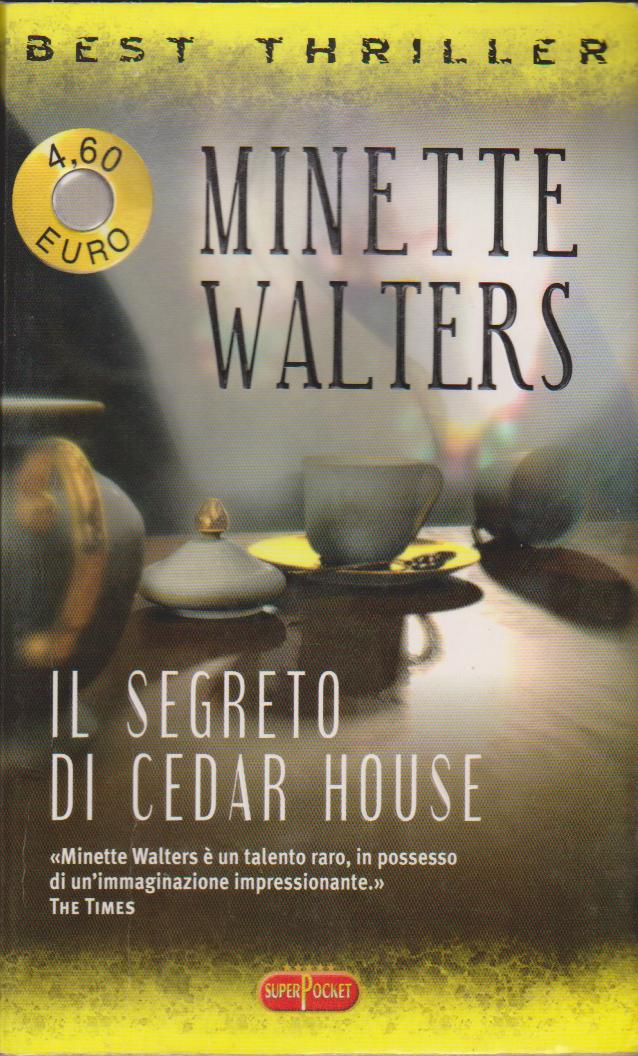
The ability of Minette Walters to deeply understand the
mentality perverse by murderer is not free even to make the potential weakness:
the murders are not games of chesses with investigators, as in the classic
mystery, but are duels painful from which no out injured only the killers but also the detectives, all affected in
the soul. So the murderer here, is not an evil, but a person who kills because
he can only do so, the victim of fate, and also of Mathilda, who is both a
victim, because raped in her lost childhood for a childbirth not wanted, and
executioner, in her bully all those around her, when not in blackmail others
with her memoirs written in the famous Diaries, sought in vain by the police
and instead destroyed by the murderer.
Mathilda is the key element of the story and the same narrative structure gives us more figures of detectives who in turn, support the weight of the narrative: Sarah, Sergeant Cooper, Inspector Jones, the faithless husband of Sarah: Jake. Will be he, avenger of Ruth, redeemed husband able to recapture with a tenderness never revealed so thoroughly, his wife, and at the same time able to thoroughly analyze the action coming to reconstruct the figure of the murderer, freeing the action Investigation from the plate. To four investigators who take turns in the story, is adding a fifth figure detective we would like to say, constantly present: is the character of Mathilda, who, with a different page come from her Diaries, introduces each chapter, and at the same time directs and explains the narrative action and the choices of the other subjects. It’s this a scheme already adopted by other novelists (eg. as in Rim of the Pit, by Hake Talbot).
Mathilda is the key element of the story and the same narrative structure gives us more figures of detectives who in turn, support the weight of the narrative: Sarah, Sergeant Cooper, Inspector Jones, the faithless husband of Sarah: Jake. Will be he, avenger of Ruth, redeemed husband able to recapture with a tenderness never revealed so thoroughly, his wife, and at the same time able to thoroughly analyze the action coming to reconstruct the figure of the murderer, freeing the action Investigation from the plate. To four investigators who take turns in the story, is adding a fifth figure detective we would like to say, constantly present: is the character of Mathilda, who, with a different page come from her Diaries, introduces each chapter, and at the same time directs and explains the narrative action and the choices of the other subjects. It’s this a scheme already adopted by other novelists (eg. as in Rim of the Pit, by Hake Talbot).
But there is not only
the presence of impersonal
and intrusive Mathilda to direct the speech, but
also that of a sixth detective, the great playwright
William Shakespeare, who illustrates hand by hand the personalities
and situations, with specific references and quotations from his works.
The presence of Shakespeare is not random, but even
necessary, because just with the figure of a his character, will explain the death of Mathilda, her
torture and her relationship with
the menage of her
surroundings.
The result is a highly evocative writing, full of ideas
and cultural destinations, and very
flexible in the explanations of disturbed personalities of the characters (all
in various ways, victims of circumstance or of themselves), but at the same
time, never heavy, and instead extremely multifaceted and rich in rhythm.
Pages that are read with extraordinary pleasure, and that
lead to a final no obvious and to a murderer, not fallen from heaven, but
instead very true, in his humanity and in his despair.Wanting to better fathom the narrative material, what emerges is a duplicity of motives, which run within the story on two parallel tracks, and that are crossed by various people. The two tracks, are two temptations always present in the human soul, but that have characterized the last two decades of the twentieth century: money and sex. All the characters more or less, are pervaded by them, but at only one character, the two temptations, bind and fuse each other (although the motive deeper will be the sex): at the soul of the murderer.
Pietro De Palma


