The history of the Criticism of Crime Fiction ascribes to
Patricia McGerr a flash of genius that she would first applied in her novel: before
she thought , the genre most commonly used was the "Whodunnit", that
is, the discovery of the culprit: given a certain riot of suspicion and given a
murder, you must find the murderer. In other words, the Cluedo in printed paper.
The first variation of this procedure, was the so-called "inverted story": already known the murderer, the novel concerned about how it had come to suspect him, in short, a reconstruction of the events that had led to the capture of the guilty. And then of course there was a second variation: known the victim and known someone who wanted to kill, the plot was focused on the fact that the plan to kill was going to succeed or not, and of course the culprit was caught or escaped capture. No one had thought about a third variation. Usually they say Pat McGerr was the first to have innovated the genre : the survey, which is normally focused on the identification of the culprit, would have been by her moved on its opposite, ie on the victim.
Patricia ("Pat") McGerr (1917-1985) was one of the US crime writer. He won an Ellery Queen Magazine / MWA for a her short-story and the Grand Prix de Litérature policière in 1952 for Follow, As The Night. She was born in Nebraska where he graduated, and then took a master's degree in journalism from Columbia University.
The first variation of this procedure, was the so-called "inverted story": already known the murderer, the novel concerned about how it had come to suspect him, in short, a reconstruction of the events that had led to the capture of the guilty. And then of course there was a second variation: known the victim and known someone who wanted to kill, the plot was focused on the fact that the plan to kill was going to succeed or not, and of course the culprit was caught or escaped capture. No one had thought about a third variation. Usually they say Pat McGerr was the first to have innovated the genre : the survey, which is normally focused on the identification of the culprit, would have been by her moved on its opposite, ie on the victim.
Patricia ("Pat") McGerr (1917-1985) was one of the US crime writer. He won an Ellery Queen Magazine / MWA for a her short-story and the Grand Prix de Litérature policière in 1952 for Follow, As The Night. She was born in Nebraska where he graduated, and then took a master's degree in journalism from Columbia University.

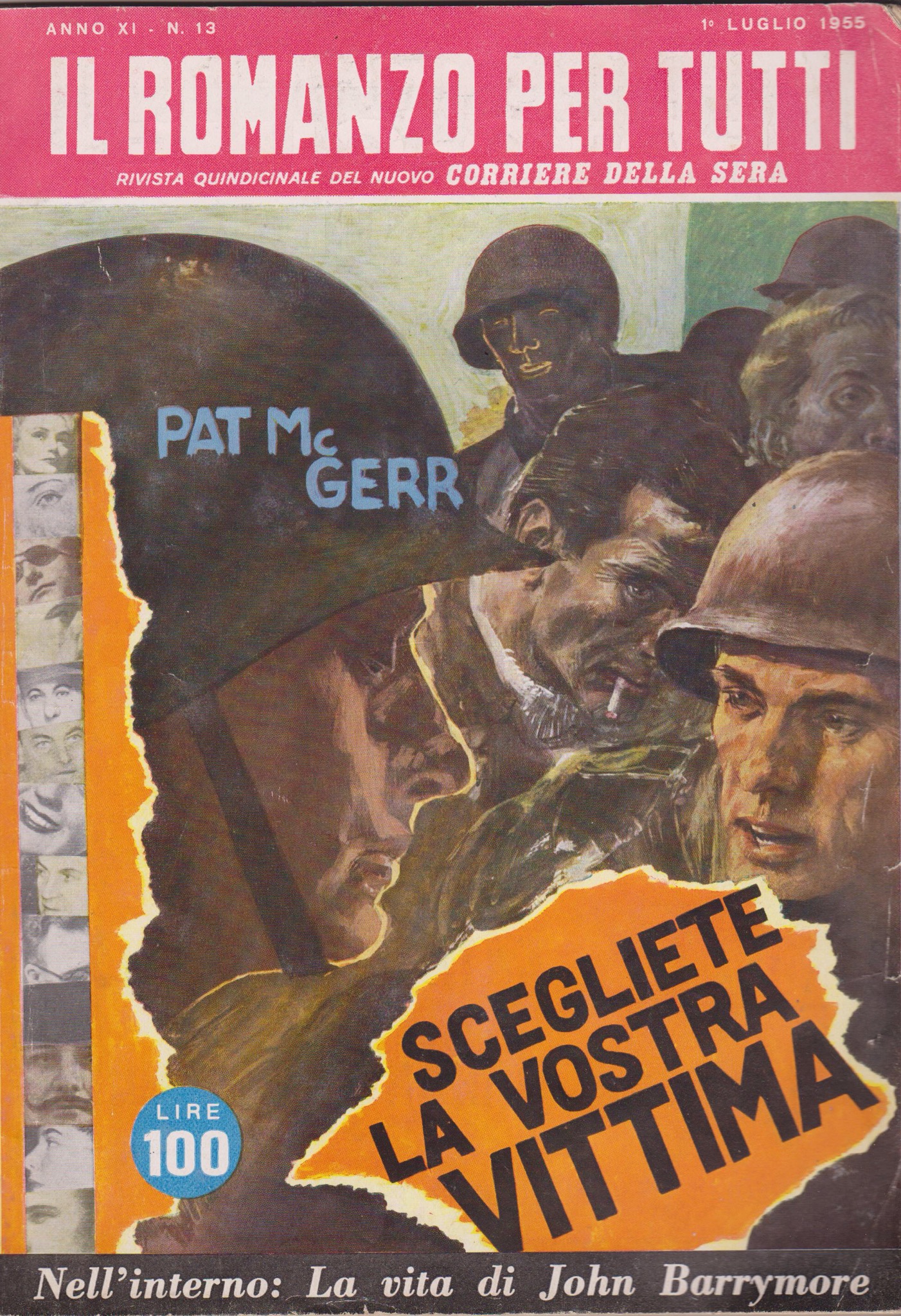
The situation changes for the better, when one of them, Pete, receives, from his family, a package of food: the mother, so that the jars are not broke, has wrapped them in newspaper, and on these cuttings are pinning the 'soldiers' attention, especially on one of them which tells about the murder by an acquaintance of the owner of the parcel of food, the other person: Paul Stetson, the murderer, is the undisputed master of STUDS, an association founded by aims to put an alleviation with advice and guidance to the duties of those women who live particularly unfavorable working conditions, a kind of protectorate, as a union, to take care of them and protect them, protect even their working environment, the activity home, in which all women, according to the purpose of the foundator, deputies are: cooks, waiters, valet, women less defenses of all, because their menial tasks in the home. Now, the article tells their condemnation of Paul, guilty of having killed one of the leaders of his society; only that the victim's name is unknown, because where there was supposed to be his name, there is a tear, missing a piece of paper. Despite the soldiers put together the pieces, to want to make the page, in fact the hole is still there. The soldiers then bet among themselves, each pointing a certain amount, and the narrator telling the story of his work in STUDS, omitting nothing and then giving a certain amount of evidence that must be conveniently by his comrades, will win the soldier who, basing on the story, he will be able to make the name of the murderer, since the narrator can not participate in the bet and likewise will be the only one to have first response, given that he asked a colleague, Sheila, by letter.
The trick of the novel McGerr is clear: the soldiers to pass the time, bet, as they would bet about anything, the mail is to be able to put the name of the missing as a result of that hole.
The narrator, Pete, knows all the ten executives (Chairman Hunter
Willoughby, Vice-Presidents: Frank Johnson (Head of the Legal Office), Chester
Whipple (Head of Publicity), Anna Coleman (in charge of 'education), Carl
Doherty (in charge of the Register of Members), Ray Saunders (President’s
Office), Loretta Knox (in charge of the West Coast), Harold L. Sullivan
(responsible for research), Secretary: Bertha Harding, Treasurer: George
Biggers. it will provide a profile of each of them, based on their work
experience and his direct knowledge of the possible victims. So essentially,
there will be "a bet in the dark" as he wanted to do another comrade,
leaving the decision to chance name of the winner, but it will be a sort of
"Let's play the killer," a Clue reversed, whereas normally it starts
from the victim and through a series of clues, trying to put a face to blame.
Here, however, is the opposite: the culprit is unknown, but we do not know who
among the ten leaders, was the victim. And that it should be inferred only on
the basis of the story told by the narrator, working at Press department by
that company.
The story that Pete does to his fellow soldiers, he begins with his inclusion in the organization of the Company Scuds, by Chet Whipple, the first of the ten leaders who he has known, because it is through him that he was hired. As he outlines the data indicative of the personality, his presumption, the adulation of the head and contempt for his colleagues, together with a good deal of gossip on the work of them that he, "upright man", turns to his wife and then pull back when accused.
So Pete already indicates a possible victim because there is someone who may have had grievances, to slander uttered by Chet and his wife not only against Mary Dalton, the companion of Biggers, but also to other people.
And so each chapter. So, a few pages later we learn that in society there were two women among the ten leaders.
The story that Pete does to his fellow soldiers, he begins with his inclusion in the organization of the Company Scuds, by Chet Whipple, the first of the ten leaders who he has known, because it is through him that he was hired. As he outlines the data indicative of the personality, his presumption, the adulation of the head and contempt for his colleagues, together with a good deal of gossip on the work of them that he, "upright man", turns to his wife and then pull back when accused.
So Pete already indicates a possible victim because there is someone who may have had grievances, to slander uttered by Chet and his wife not only against Mary Dalton, the companion of Biggers, but also to other people.
And so each chapter. So, a few pages later we learn that in society there were two women among the ten leaders.
George Biggers, talks to Pete and portrays the women of the company Anne Coleman and Bertha Harding, one against the other (you will see that it is the second against the first). Actually Bertha "is tough as nails, direct action, incisive in speech. "She wears suits, shoes, hair arranged in poses very strict and so manifest to others. In short Anne Coleman becomes the lover of Paul Stetson, the head of the company, which is at odds with his wife. One day the narrator and her friend Sheila become suspicious because Coleman that would have to be present at an event for her own statement and instead she didn’t go, they went to his house, and they find her dying, because she tried to suicide with barbiturates, and everything after a venomous letter she received, in which with signature by Stetson's wife, Claire, has returned the key of apartment used by the lover (Paul Stetson), because the two, Claire and Paul, have decided to make peace. Truely, as turns out Sheila, the two didn’t make peace.
Someone who hates Coleman must have written the letter. Miss Harding is the one that would have benefited from the disappearance of Coleman But Harding is not alone. She’s linked to Ray Saunders, another of the vice-presidents. He could have given her the key that was in the President’s car, used by Saunders at the end of the week." So, all against all, a nest of vipers.
And so we have other potential victims.
Paul Stetson could kill:
his wife to live with his lover; the lover, to return to live with his
wife; Harding, for attempting to commit suicide Coleman; Saunders for
conspiring against him and his mistress. He could kill Chet Whipple for the
smear campaign mounted by him in relation to other (perhaps even the Coleman).
The resentment against the Harding becomes tangible few pages later, when during a game of poker, the Harding talks too much and accused her head a mistake in playing colossal, humiliating him in front of everyone, more or less with these words: "..or you have not seen your cards right or the warmth of the room gave you in the head "
And yet other things.
In conclusion..each chapter offers fresh perspectives to identify new potential victims by Stetson. Among the comrades by Pete, is Joe that understands everything and indicates the victim at the end of a certain reasoning, whose correctness is confirmed when, a few days later, comes to Pete the letter from Sheila, containing a newspaper clipping, a twin of the deteriorated newspaper came to the military, where it is mentioned the name of the victim of strangulation.
This novel, however, was not the only attempt by Patricia McGerr to change the features of the classic Whodunnit. In fact, she repeated in another novel, Follow As in the Night (1950), published just a year before with another title, Save the Witness, the same basic idea used in Pick Your Victim: Larry Rock decides to kill one of the four women he loved. But which among his wife, ex-wife, his current companion or his lover? In 1947, however, he published his other novel that gave fame him, The Seven Deadly Sisters (1947) in which the reader is up to identify not only the victim but also the killer: the US Sally Bowen, has moved to England and there a letter informs her that her aunt was killed from her husband. Who is ? The letter did not mention the name by assassin or the victim. It 's a problem, because Sally has seven aunts all married.
We know that President Truman liked Patricia McGerr. At least liked some of her books, of strong religious inspiration: Martha, Martha (Martha, the sister of Lazarus, the friend of Jesus) or The Missing Years. The McGerr was a fervent Catholic, traditionalist, and in her novels are gathered some hints on the traditional role of women in society, for example in the American family. In fact, at least these two books were found in the study of Harry S. Trouman, at his home.
At this point, it is clear that Patricia McGerr, although not very popular and considered almost exclusively by industry insiders, has been an innovator in the Whodunnit, ascribing to her the invention of the displacement of the investigation not about the guilty, knowing the victim, but about the victim, the offender known, based on a summary of relevant facts. At least so speak a lot of sources.
The resentment against the Harding becomes tangible few pages later, when during a game of poker, the Harding talks too much and accused her head a mistake in playing colossal, humiliating him in front of everyone, more or less with these words: "..or you have not seen your cards right or the warmth of the room gave you in the head "
And yet other things.
In conclusion..each chapter offers fresh perspectives to identify new potential victims by Stetson. Among the comrades by Pete, is Joe that understands everything and indicates the victim at the end of a certain reasoning, whose correctness is confirmed when, a few days later, comes to Pete the letter from Sheila, containing a newspaper clipping, a twin of the deteriorated newspaper came to the military, where it is mentioned the name of the victim of strangulation.
This novel, however, was not the only attempt by Patricia McGerr to change the features of the classic Whodunnit. In fact, she repeated in another novel, Follow As in the Night (1950), published just a year before with another title, Save the Witness, the same basic idea used in Pick Your Victim: Larry Rock decides to kill one of the four women he loved. But which among his wife, ex-wife, his current companion or his lover? In 1947, however, he published his other novel that gave fame him, The Seven Deadly Sisters (1947) in which the reader is up to identify not only the victim but also the killer: the US Sally Bowen, has moved to England and there a letter informs her that her aunt was killed from her husband. Who is ? The letter did not mention the name by assassin or the victim. It 's a problem, because Sally has seven aunts all married.
We know that President Truman liked Patricia McGerr. At least liked some of her books, of strong religious inspiration: Martha, Martha (Martha, the sister of Lazarus, the friend of Jesus) or The Missing Years. The McGerr was a fervent Catholic, traditionalist, and in her novels are gathered some hints on the traditional role of women in society, for example in the American family. In fact, at least these two books were found in the study of Harry S. Trouman, at his home.
At this point, it is clear that Patricia McGerr, although not very popular and considered almost exclusively by industry insiders, has been an innovator in the Whodunnit, ascribing to her the invention of the displacement of the investigation not about the guilty, knowing the victim, but about the victim, the offender known, based on a summary of relevant facts. At least so speak a lot of sources.
Gadetection, the web site more specialized about the Crime
Fiction speaks about Pick Your Victim by McGerr, in this manner: “A stunning tour de force, from a then-debutant
author. Reversing whodunit’s priorities in a revolutionary fashion, Mc Gerr
reveals the guilty party from the start and turns on an unusual, compelling
problem. Who has died? The answer is as surprising as expected, and wholly
fair-play. As usual with McGerr, however, the book doesn’t limit to a
well-exploited gimmick. We have in bonus some delightful characterization and a
lively office-life evocation. Barzun and Taylor raved about this book. They
were right.”
And Xaver
Lechard says: “Pat McGerr’s “Pick Your
Victim” is a comparatively little-known entry into the annals of crime fiction,
but which is nevertheless held in high esteem among a small group of
knowledgeable and well read Connoisseurs of Crime – praising the story for it’s
unique take on the classic detective format, that’s both original and
successful.”
In short, the experts recognize
her an undoubted merit. But ... is it really so?
I mean: really, for the first
time, did she overthrow
the terms of comparison of Whodunnit?
End first part
Pietro De Palma