martedì 30 ottobre 2012

Fredric Brown : Death Has Many Doors


Fredric Brown, was born in Cincinnati, October 29, 1906. As a young man, he held various jobs, working in an amusement park (in fact one of his most famous novels, The Deep End, it is set in such a place), before finding a job as a proofreader, after he had entered the university without graduating. Published some short stories in pulp magazines and in 1947 he attempted the paper of the novel, writing The Fabulous Clipjoint: the novel, rejected by many publishers, it was eventually published by Dutton, winning the year after, the coveted Edgar Allan Poe Award for outstanding first mystery novel. Since then he began to also publish novels Fiction, as What Mad Universe or Martians, Go Home.
He died in 1972.
Brown was one of the greatest writers of Mystery and Science Fiction: his plots are full of inventions, and the finals are always of great workmanship.
In the field of mystery, Brown wrote several novels, some of which with the pair Ed Hunter and his uncle Ambrose, star of the hit novel, The Fabulous Clipjoint: for many years considered a minor novel in the bibliography of the author, it was only few years ago revalued, becoming one of the great crime novels of the twentieth century, and putting its author alongside other more celebrated as Jim Thompson, Dashiell Hammett, Ross MacDonald.
Fifth novel with Ed and Am Hunter, Death Has Many Doors (1951), is one of those novels that may well frame the multifaceted personality of Brown.
The novel tells of a pair of detectives, uncle and nephew, employed by a client at least strange, Sally Doerr, a shorthand typist, who, convinced of the existence of aliens, states that they, hidden in disguise human, they want to kill her. The two investigators make every effort to dissuade his commitment to making investigators, because, honest to the core, they think that the girl is a little unscrewed, and therefore does not intend to take advantage of her, nor would like to see other people as less scrupulous of them, I took advantage. However, if only to reassure the girl, Ed Hunter promises that he will watch over her, and, accompanying her at home, will stand near. Winning attraction rather than legitimate, since the girl is very beautiful, and she would to fuck with him (because she thinks  would be better protected so), and he wanted to be as professional as possible, Ed sits on the couch while her, completely naked, sits on the bed, the bedroom door ajar, so that at any time he can run. The fact is that Hunter falls asleep, waking up at two o'clock, when the phone ringing the alarm: he answers, but has no answer. However, still seeing the light on in her room, he goes to see, realizing that the girl, naked on the bed, inexplicably died. There are no marks on her body or injuries that may suggest a murder. However, the girl was found with his arm in a strange position as if she was taking a book, including those posed close to the bed.
Ed calls his friend, Homicide Bureau Captain Frank Bassett, with whom he has already worked a few times, and tells him about the events. The police visits, the corpse is taken away and autopsied, reveals that, in case there was still some suspicion that the girl died of a heart attack: she was suffering from heart and then, probably for the stress derived from its fears she wad dead.
Case closed. Or rather, no. Because he has some suspicion about it, or rather he wants to remove all possible stones, before they ended the matter, especially since she died while he was in the next room. And, because of this thing, he asks relatives. He can not find any possible motive that could justify the murder of the girl. She and her sister belong to a family of modest conditions: orphan son was bred by Gerard and Eve Stanton. Her uncle lives in the house, Ray Wernecke, which exceeds with alcohol and the stories of Martians: he communicated to the niece these absurd fears.
The fact that she was sleeping naked, poses no possible reason to investigate Ed, especially as he turns out, interviewing family members, as this was a habit of the girl. And the parents and relatives of the girl, recognize as Ed and his uncle behaved more honestly that against her. When it appears that you could put a lid on it, a mysterious phone call get the two investigators: the girl was murdered. The mysterious caller qualifies as a Martian eager to prove perfect strangeness of extraterrestrials in the affair. He makes sure that the two discover, in their study, their reward: a thousand-dollar banknote.
At this point the two on the basis of the pharaonic remuneration, they decide to take an excellent typist, Monica Wright, who will fill the post left vacant by Sally farm where she worked (and they will pay the difference in more about his paycheck ) to find out there, talking with her colleagues. And both Ed and his uncle, the first will discuss again with the Captain of Homicide Bureau, and then with a series of people, work and family entourage thereof. And in particular, Ed knows Sally's sister, Dorothy, a beautiful girl. Ed and Dorothy will fall in love. The strange thing that happens then is that this girl believes she can die like her sister, and who killed Sally could kill her too.
At this point, the two investigators, discuss with each other: Ed would not deal with the matter, but his uncle convinced him instead to deal with, not least to prevent another murder may be repeated, if absurd that the fears were well founded . Ambrose convinces his nephew to go with Dorothy, and spend the night with her in a secret and do not disclose to anyone where they are. Nevertheless, at night, while Dorothy and Ed, naked, are bathing in the lake, she dies.
There is no one beyond him, and that there was no one else around, attest the Auslander, a family living in a house on the lake. They were at the scene, they saved Ed, and they swore to the police as he was alien to the girl's death. However, do not tell, for decency and not to harm it, that he was naked, and when he found the girl, they bathe her clothes in the lake and wear her so that no one could imagine that Ed and Dorothy were both naked before.
Also this time, it may seem absurd to the matter, it would seem that the girl died of natural causes, an accident. And once again, the Stanton and Wernecke, destroyed by adverse situations, do not impute anything to Ed for girl's death.
However, Ed and Uncle investigate, and do not give up in front of the simpler explanations. And although the types that surround them seem harmless, among them discover the killer, who kills using sneaky scientific knowledge notch. And he will find out after even thought that he may be dropped from some balcony above and he was able to enter through the open window, but Ed then will reject this possibility after a complex series of conjectures, he will identify the weapon and the motive more oldest in the world: money. But, the two sisters were not poor?  And two adoptive parents didn’t pay the university to Dorothy ? The fact is that things are never as they seem. And it shows the final, ending, totally unexpected, in the wake of the many designed by Brown.
The novel is, among other things written in a style that captivates and much fascinating light and fluffy, the novel could be said to be a handled mystery. Nevertheless, it is written with great intelligence and is necessary for two impossible crimes. The beauty is that, unlike what normally happens, the inability of the two crimes is only assumed for the entire novel and confirmed only in the final pages, where it is explained in the light of the identification of the weapon (that would make the happiness of John Rhode) and the motive. Which in turn, as the two weapons used to kill the two girls brings back to the Cold War atmosphere that it was breathed in years when Fredric Brown delivered his audience his best work, and to secret weapons and to not secret weapons used at those years.

Pietro De Palma

domenica 21 ottobre 2012

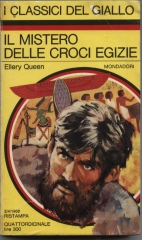
Ellery Queen : The Egyptian Cross Mystery


Among all the novels of Ellery Queen, The Egyptian Cross Mystery is not a reading relaxing and free from strong scenes (as was the habit of english detection), but instead a deafening roar of death, blood and wickedness.
This mystery was the first that I've read: I found out to my aunt's house, on a shelf in the library. I was fifteen. Won me over immediately. I read and reread. A total of 4 times.
And every time that I've read has caused different sensations.  
The novel is one of the bloodiest of the entire production, with three brutal murders: the beheadings of three brothers. It certainly had to have a precise position in the queenian literary production, if it is true that you can associate ideally it with two other novels of the period of Queen (The Tragedy of X and The Siamese Twin Mystery) by virtue of a particular common: all three novels develop in a particular moment of their plot, the property has diabetes to cause rigor mortis earlier than normal.
The novel starts with the "crucifixion of a school teacher" Andrew Van, however, devoid of head, symbolizing a monstrous Egyptian Tau, on a pole indicator to a crossroads in the city of Arroyo: is Christmas morning.
Continues with the "crucifixion of a Millionaire": Brad Thomas, owner of Bradwood, "famous importer of carpets", beheaded, tied to a totem, the figure sadly recalling an Egyptian Tau.
And it ends with the death of Stephen Megara, to the mast of his boat, still without a head.
A story in which the blood flows freely: not only the blood of the three bodies outraged, but what sold away. In fact, it would seem that at some point the brutal murder of three men, three brothers, fled to America to disappear from the face of the earth, not to be reduced to nothing more than a tribal vendetta, a blood feud between two clans, the Krosac’s clan and the Tvar’s clan in Montenegro: in fact, it turns out in the end, is much more than that. And in a sense, the horror of the dramatic situation, is higher than that resulting from the completion of a vendetta distant geographically and temporally. Three men to escape and change his identity had chosen to claim a fictitious original nationality: Andrew Van, the Armenian; Brad Thomas, the Romanian; Stephen Megara, the Greek, changing theirs names at the original three respective cities: Van in Armenia, Brad in Romania, Megara in Greece.  
There were three brothers who wanted desperately to leave behind a sad past and look in America hopes immutable, new ideas of life: they will find a sad fate, pursued by a murderess who comes from afar. But, then, is all this really true?
And that monstrous “T”, formed by the arms outstretched linked or crucified, of a human body of missing head, suggest during the novel multiple interpretations: first, the Egyptian Tau, which will reconnect other suggestive theories. It must be said that the same Egyptian reference is a very precise linking together several writers having in S.S. Van Dine their prophet. In fact, from The Scarab Murder Case by S.S. Van Dine (1930), other novels derive their plot, referring variously to Egyptian civilization: The Egyptian Cross Mystery by Ellery Queen (1932), Arrogant Alibi (1938) by Charles Daly King, even The Man from Tibet (1938) by Clyde B. Clason in Tibet, that reads a story that comes verbatim from the novel by Van Dine. Do not forget that at the very beginning of the last century are ascribed important archaeological discoveries in Egypt (for example, the discovery of the tomb of Tut-Ank-Amon), the immediate media coverage both in Europe and in America, and that their European and American archaeologists were engaged in those years in Egypt and the Middle East.  
And let's not forget either, that before Van Dine thought to set one of the adventures of Philo Vance in a museum of Egyptology, he had already thought Richard Austin Freeman to conceive a novel in which for various reasons was talk of Egypt: The Eye of Osiris (1911). And the rest of the way as Ellery treats matter, causes its culture encyclopedic be underpinned directly to his archetype, i.e. Philo Vance by  S.S. Van Dine.
But then comes the epilogue and then the mystery will be revealed after a terrifying succession of twists and turns that starting feuds and vendettas consumed in the mountains of Montenegro, through a series of clues inconsistent: a Tarzan loincloth, a piece of check, pipes, ansate crux, a package hidden under the key of a piano, will reveal the perfect plan of a sick mind, a murderer implacable, that would never have been caught if he had not committed an insignificant error: why to disinfect a wound, would have to take a bottle of tincture of iodine without the label, when there was another one available and with so much information?
One detail that only Ellery analytical mind can frame in all its light, fitting perfectly in the puzzle so that it gives a sense of the rest.
During the period in which you create this remarkable novel, however, is not the first time that we speak of Montenegro in mystery: even Rex Stout, who was also a follower of Van Dine in the early novels, he created his main character and most successful, Nero Wolfe , attributed, after a birth in Trenton New Jersey, the Montenegrin origin.
The purity of the breed had always attracted more than one writer, and that they were Montenegrins, as in the case in question, or Corsicans, as in Colomba by Prosper Mérimée, what attracted was also the impulse of feeling, not mediated by any element civilized: strong hate and strong love, interesting elements for the writers who lived life experiences in multiracial nations even then, such as France at the end of the century or America at the beginning of the twentieth century, home of all those who wanted to start a new life there.
Besides, having chosen a subject like this, and have dabbled  the novel in the blood, it is only a reference distance of everything shed in the wars of the Balkan Peninsula, that evidently to a civilized consciousness appeared to be a tribute too high and too unreasonable for not amplify well, also and only at a mystery.

Pietro De Palma

domenica 14 ottobre 2012

Helen McCloy : Through a Glass, Darkly (1950)


There are novels that I read in a single blow, putting one or two days, and there are others for whom it takes me a bit 'more time: I read this in a longer time than other equally challenging.
The thing may seem a pseudo-problem, because it related to subjectivity, in reality its importance has it: the length of the reading of this novel, in my opinion is related to the expectation that one can have. If you read it, like any novel, there is already half a disappointment, because the space before the first offense is too long, if you read it as a supernatural thriller that he can be very charming; if, finally, you read it, as in my case, because it has been lauded by the great critics of the "Looked Room", the attitude of reading oscillates between love and hate.
Because, now, after reading it, and re-reading it a second time to be more secure, I have not figured it to be called a Locked Room.
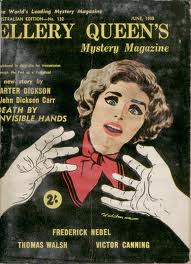
Through a Glass, Darkly (1950) was written by Helen McCloy, from a short story she had written two years before,“Through a Glass Darkly”, published in Ellery Queen’s Mystery Magazine in September 1948. She is called by many critics the greatest woman writer of detective genre in America: in addition to this novel, which is her most famous, Helen McCloy who was also married to hard-boiled writer Brett Halliday, creator of private detective Mike Shayne, wrote other novels always with his main character, the psychiatrist Basil Willing, including his other masterpiece novel Mr. Splitfoot (1968).
In several novels, McCloy addresses the issue of the crime impossible, for example in Mr. Splitfoot: Mr. Splitfoot is another name for Satan define (the charade is explanatory). It seems curious to note that a character in the novel object of our analysis, that the Director of the School Brereton, called Mrs. "Lightfoot", as the later "Splitfoot" used elsewhere: the common denominator may be the supernatural call, which can be attributed to the characters in question. In fact, Mrs. Lightfoot is one of the people who claims as Miss Faustina Crayle, the hapless protagonist of the novel, was persecuted by his double if not the evoked with his feelings.
This Faustina is a teacher very unfortunate, because where is teaching, tends to obscure events occur, i.e. her inexplicable dislocations in different places, in front of witnesses, who swear that while Faustina was engaged to paint, her dual sat elsewhere before their sight aghast. In fact, the origin of the double, the “Doppelganger”, can be attributed to the belief that they experience near death of a person, and that was a manifestation of supernatural origin.
This kind of ghost, which creates an aura of mystery, terror, suspicion, and slander about Faustina, real or perceived, means that she has to change seat of learning frequently. Until something happens that is not properly connected to the supernatural: Alice Aitchinson dies, a student who hated Faustina. She dies, breaking his neck, falling down a stairway.
Someone swears he saw Faustina just before the Aitchinson fall, but this is not possible, because in the meantime Faustina is miles away. It’s this a Locked Room? It is because the murderess some persons say they looked her from a distance, she would seem to be evaporated? I do not know. It is certain that this does not seem a "Locked Room" in the strict sense, as there are the qualities that make it impossible to crime, except that the murderess seems to have split in two different places. But what we will see, invests more the sphere of the supernatural or would-be than anything else.
Accidental death? Suicide or something? It 'obvious that slander now reach the summit, so much so that Basil Willing, the boyfriend of Gisela von Hohenems, a colleague of Faustina, encouraged as a psychiatrist to deal with such events para-psychic, feels the need to defend Faustina. Until that even Faustina died in a way that frees the murderess, if he was stopped, from any possible accusation against him: Faustina injured, nothing that can connect to an assault or act of violence.
She died for a heart attack, and it is Gisela find her, on a dark night in the cottage where Faustina was going to stay. A cottage that belonged to the mother of Faustina, Pink Diamond, a famous maintained high board, and before that it had belonged to one of his lovers.

The testament of Rose, entrusted to his legatee, says if Faustina were to die, the jewelry that her mother has given to daughter would be returned to their rightful owners (heirs of those who had donated to her at the time) even if there were , otherwise would be added to the rest. In short, a good motive to kill her. Why, if she died for a heart attack?
Here, too, I do not really think that there’s a Locked Room: Faustina opens the door and sees that the lighting does not work out so he needs to look for a light switch: she leaves her luggage at the door, which remains open and she enters. The taxi driver who took her home, says that in practice he did not see anyone leave, since the house was in his view until he put back into the path of the forest from which he came, but in the opposite direction. However, the murderess could have been dressed in black, and take advantage of the dark to avoid being seen. Not only. Gisela takes time to get to the cottage, time that could be used in case the killer was there, simply disappearing. But beyond that, Gisela, who is going to Faustina, invests almost a figure in the woods, revealing for a moment, in front of his eyes terrified, Faustina: how could she be there at that time, if the coroner says she was already dead in the house?
Basil Willing demonstrate that the Doppelganger was not really but…of a different nature. If it there wasn’t  a Locked Room, however, it should be a novel about the supernatural. And the method used by the killer to kill, to induce the player to have a heart attack, is the fear: fear of something ancestral, fear of his double, fear of death.

The death, "Der Tod" in German, introduced by male article because he was represented by a knight with scythe, on a black horse, appears in many poems, when the man is about to pass away. The fear of  Faustina to see herself, her Doppelganger, could be related to the fear of being about to die, what then happens. Moreover, the Doppelganger is attested in many literary texts and in the tradition of Central European countries, as a figure appeared, which could be seen only on the bias, with one eye, only near death.
Now the title of the novel, can have a triple meaning: it may allude to the verse of  St. Paul, 1 Corinthians 13:12: ".. βλεπομεν γαρ αρτι δι εσοπτρου εν αινιγματι ", "For now we see through a glass, darkly"; it could allude, in my opinion, the way to commit the second murder: ".. as in a mirror, in the dark." The protagonist was led to see herself, since the murderer has built, based on the absence of light, a mirror, transforming a large glass door, with doors opening at the center of the room, in a craft but tremendously effective mirror.
And it could finally reconnect the eponymous anthology of short stories of the great novelist and Irish writer Joseph Sheridan Le Fanu: In a Glass Darkly, in which Dr. Martin Hesselius investigates cases the limit of the paranormal and can be found in references to the theme of Doppelganger : for example in The Familiar, version of the story appeared in The Watcher in the previous collection Ghost Stories and Tales of Mystery (1851), and in Mr Justice Harbottle. Dr. Hesselius, this singular figure of detective before his time, paid to the paranormal, will also make Dr. Fell by John Dickson Carr, if not Colonel March always by Carr.
Through a Glass, Darkly, rather than being another, is a novel that mixes very cleverly and intelligently elements of thriller and the supernatural. It 's very close to or even tributary of The Burning Court by John Dickson Carr which is today still the best example of the mixture of supernatural and crime stories, so as to be taken as an object as an example of fantastic literature (besides Helen McCloy dedicated to Carr and his wife Clarice, her novel Alias ​​Basil Willing).
In this, the novel McCloy, is really built in a wonderful way, and that is tributary to the Carr's novel, it shows the ending very cleverly alludes to Carr with his double hypothesis: the rational, built by Willing at the expense of  killer; the irrational at which the killer, as long as he is the killer of course, will never be accused by any court for the murder happened while he was away: he is accused by Willing only on the basis of a series of clues, very skillfully stuck. However, they are clues, no courts : on these an English-speaking country could put on trial him.

He knows it and Willing knows it, although Basil Willing would expect at least on that occasion, an admission that at least, if it had not the merit of bringing to life Faustina, may clear the field of any supernatural dispute
Only that the accused, not only continues to profess himself innocent, but also he reinforces the supernatural thesis, so it remains the Hamlet-like doubt.
I emphasize "Hamlet doubt", because I think the end, the last line of this intense dialogue, which concludes the novel, the last page, when the murderer looking at the sky and smiling to himself, says to Willing “only God knows what happens up there”, Helen McCloy  links to Shakespeare:
There are more things in heaven and earth, Horatio,
Than are dreamt of in your philosophy.”

Pietro De Palma


lunedì 8 ottobre 2012

My new short essay or long article about John Dickson Carr, on "Blog del Giallo Mondadori":


A few minutes ago was published in the "Blog of the Giallo Mondadori" my new short essay or long article - if you prefer - about Carr:

 http://blog.librimondadori.it/blogs/ilgiallomondadori/2012/10/08/king-arthur%E2%80%99s-chair-l%E2%80%99etica-in-carr/

The great writer, who is also my favorite, I have devoted more essays, including one about "The Third Bullet", another about "The first four Bencolin's stories", and yet another, very long, in three parts, on "The History of Locked-Room Lecture in The Hollow Man by John Dickson Carr."

The latter writing takes into exam ethical aspects of Carr, examining his wonderful story: "King Arthur's Chair", and presenting an alternative reading of it and, I believe, stimulating
In the future, I could present it in this blog, but for the moment, to read it you need to know the Italian language  or help with web translators.

Pietro De Palma

mercoledì 3 ottobre 2012

Stanislas-André Steeman, a belge master

L'Ennemi sans visage, 1934


The novel by Steeman tells about automata. Why Steeman had thought of this plot for a crime is not given to know. But it is not so odd to remember that at that time abounded literary stimuli and films, concerning the animation of inanimate subjects, complex surgery, people who perhaps had more to do with the horror with yellow. But so much so that Steeman wanted to give his personal contribution: and what contribution!
So to animated automaton by Fritz Lang's Metropolis due to an exchange of vital energy and transfer of the soul;  to the Golem, inanimate mud, which comes to life because of a sign that is placed on his forehead; to intervention on Siamese Twins that Ellery Queen ago groped to Dr. Xavier; to the creature that has life force again by Dr. Frankenstein, who in 1931 returned to be popular by virtue of a successful film adaptation, directed by James Whale, with Boris Karloff, still considered one of the most important films of the genre, it also added the contribution by Steeman.
Stanislas Ansré Steeman, when he wrote in 1934, L’ Ennemi sans visage (alsore-published as M. Wens et L'automate, in 1943), however, was already a name in the panorama of Polar.
Born in Liège in 1908, Belgian as Simenon, before turning to crime fiction, was essentially dedicated to comics, and as a journalist from 1928 to 1933 for La Nation Belge. It was his journalistic activity to promote his inclination definitive writer of detective novels: in fact, along with another journalist under the same head he worked for, Herman Santini (aka Sintair), he wrote his first five novels, then publish novels each their own. However, even he collaborated with his friend, in 1930 he began writing alone, publishing three novels: Peril, Le doigt volé, and reaching fame with Six hommes morts, who had won the “Grand Prix du Roman d'Aventures” , in 1931. In the novel, the character was introduced thicker, Vorobeitchik Wenceslas as Monsieur Wens.
Steeman was known for his loyalty to the styles and rules of the police. In fact most of his first production adheres faithfully to the canons of the orthodox crime literature. But his genius could not be stifled. And so the novels are each marked differently: there is a thriller, parody, the psychological novel, the mystery.
The story, to see it well, is not that interesting, if you see it under the eye of originality. From this point of view, someone I know and called it a work by Steeman modest after all, would not have a point. However, the work by Steeman is more properly an experimentation, a mixture of genres, and as such is not to be original, if anything, would be revolutionary, attempting a fusion of genres: fantasy and detective.
This can be seen as the very first attempt, even if not perfectly successful: instead we succeed with results imaginative Carr with The Bourning Court. But Carr is Carr, and Steeman is Steeman. Without detracting from the Belgian oestrus.
In appreciation of the past, Steeman intersects his action with that by Mary Shelley, with that by Gaston Leroux, and also with Fritz Lang
Jund is a man who expects nothing from life. He was sentenced to death and he waits for the dawn fatal, in a state of sheer terror.
The beginning of the novel gives us a picture of this man, this criminal, who is afraid that someone will look out the door of his cell because this could mean his death.
“La porte de la cellule s'ouvrit en grinéant et un trait de lumiére courut obliquement sur le sol jusqu'au mur du fond.
- Jund! 
Le condamné à mort, émergeant du sommeil, poussa un sourd gémissement. 
- Jund! redit Clark, le gardien-chef de l'aile ouest, se penchant et le secouant par l'épaule. 
A l'instant l'homme, comme touché par une décharge électrique, se réfugia dans l'angle de la muraille, les traits convulsés par la terreur. 
- Qu'est-ce que ... ? Quel jour sommes-nous ? questionna-t-il d'une voix rauque. 
- Jeudi. 
Jeudi ! répéta le condamné”.
In a few lines, Steeman outlines the figure of a man sentenced to death, which is not to die: I emphasize the strength of the phrase with the analogy that contains. It well represents the incisiveness of psychological by Steeman: “A l'instant l'homme, comme touché par une décharge électrique, se réfugia dans l'angle de la muraille, les traits convulsés par la terreur” (translation: "At the moment the man as affected by electric shock, he tooks refuge in the corner of the wall, the features convulsed by terror").

I thought a thing  while I was posting this article and I had not thought of before, is it that Headed for a Hearse (1935) by Jonathan Latimer, begins with a man locked in a cell on death row. And Latimer's novel was published a year later to Steeman. May have used the opening scene of the novel by Steeman reprocessing it for his part, Jonathan Latimer skillful re-user to the things of others?
Tuesday is the day of the execution, but also the day of salvation for Clarence Jund. But at what price? To save his life, Jund must agree to undergo an experiment: his vital energy, his mind, his brain will be replanted in an automaton. An automaton, not a collage of pieces of bodies such as Shelley's Frankenstein, but even here the electricity plays a fundamental role, and Fritz Lang, peeps, in an authoritarian manner. The transfer of life energy, soul, does not take place in Metropolis, his film of 1921? In some ways we Metropolis seems much closer to the novel by Steeman, that's Frankenstein by Whaley of 1931!
The fact is that the player for the first time perhaps in the literature of the genre, feels pity for a criminal like Jund, condemned to a cruel death: to live as a larva can do that, deprived of his vital energy, his passions and fears, of his mind.
Before he dies, however, another reference to the past will dawn: Jund tried to escape, a desperate escape, because his supervisor is that Ramshaw who arrested him and to which was ordered to kill him if he tried to escape. And while they fight, break into a dark room. When the room lit, it reveals full of robots, including the famous Chess-Player, which also talks about Edgar Allan Poe, the automaton Maelzel.
Who are the main characters of this drama? Professor Arthus (a scientist a little crazy), his two sons (Max and Tiburzio), Michele Patiny visitor to the residence of Arthus, Clarence Jund (the prisoner) Ramshaw (the cop), Monsieur Wens (private investigator ). Why .. drama? Because soon, events start to dye red.
The night Arthus must perform the experiment of transfer of the brain, in his laboratory is the imponderable: you can hear noises of struggle, broken furniture and then a gunshot. The door is locked from the inside. When you break down the door, you found dead the professor, murdered with a gun, and only two bodies on the two operating tables: Jund and automaton, ready for the operation. In fact, to tell the truth, the operation must be started already when the murderer killed the scientist, since he has begun to affect the skin of the skull of Jund
(who is asleep) and try a bowl full of blood. So none of the two (the inanimate automaton and Jund) may have taken part in the murder. Still .. can not find anyone in the lab.
In fact, when they return to the lab, the automaton is gone. On the other hand, by the time he shows up several times in various places of the house, in spite of stalking. Does he use inputs secrets?
Here is another presence of the illuminated literature at french novel by Steeman: Gaston Leroux. Not one of his novels with Rouletabille, but the universally known, Le Fantôme de l'Opéra. Who has read it, he knows as the Phantom will be able to appear and disappear within the Paris Opera House. Well, the black man by Steeman, appears and disappears in the same way, and as the Phantom, he is masked.
I will not say more. Who had the good fortune to read this Steeman vintage, so could groped to enjoy them.
However, I want to make a consideration on the Locked Room, considered by Roland Lacourbe as one of the top 99 locked rooms in all: in my opinion, Steeman tried a fusion of two of the three temporal ways of implementing a Locked Room, then expressed by Carr: “before”, “during” and “after”. In practice, he tried the fusion between “before” and “during”. Into which manner? That is the point.
If the death of the professor had been implemented prior to the noise coming from inside the room, you would have to force to find something that had produced those ruins. But do not find anything, or anyone, outside of two bodies: one waiting to be animated and equipped with a human brain, and the other waiting to provide the brain, but completely under narcosis and in such a state ( also determined by Wens) of prostration, as to be close to death, which would have been impossible to kill the professor. And if the death of the professor had been implemented after the noise, one should consider the possibility that the same teacher had committed suicide. But why he would do all that mess inside his lab? Just as he was about to complete his business?
No. The professor was killed. But by whom? The automaton, a being hidden?
The solution is as simple at the same time mesmerizing.
In my opinion, Edward D. Hoch could have read the novel Steeman, before writing his The Frankenstein Factory (1975). I wrote on Mondadori blog:
".. Even Hoch have known Steeman: here the creature has a perfect body, even out here, here is attributed to the atmosphere of blood, even here at the end will be unrelated to crime."
I now add one more thing that I had not thought of, and that is substantial: in both cases, the automaton would have to have the mind of a criminal. But that has nothing to do.
Clarence Jund will not live as larvae for the rest of his days, but will return to prison in Louisville, and here will be led to the electric chair. But he will die?
Steeman stores for us in the last lines, a promise of salvation, by the only person who Jund would never have thought he was her savior.
As if to say that "hope is the last to die."


Pietro De Palma